---
title: "Decision Log Template for Teams and AI Agents"
description: "Use this decision log template with fields, status, and a human accept step for agent proposals."
url: https://projectify.si/blog/decision-log-template
updated: 2026-11-01
---
# Decision Log Template for Teams and AI Agents
Published 2026-11-01 by the Projectify team · Topics: decision log template, architecture decision record, decision status, AI agent decisions, project documentation
**66% of surveyed physicians reported using healthcare AI in 2024**, up from 38% in 2023, according to figures the [American Medical Association published in 2025](https://www.ama-assn.org/practice-management/digital-health/2-3-physicians-are-using-health-ai-78-2023). That doesn't tell a software team how to choose its database. It does sharpen a question every team using AI should answer: when an assistant influences a consequential choice, where does the accepted reasoning live?
A **decision log template** should preserve more than the answer. It needs to show how a proposal became an accepted decision, who took responsibility, and what would justify changing course. Otherwise, you've just moved a disappearing chat message into a tidier form.
## Table of Contents
- [Why Outcome-Only Notes Fail Later](#why-outcome-only-notes-fail-later)
- [Record the reasoning someone will need later](#record-the-reasoning-someone-will-need-later)
- [Decision Log Template Fields and a Worked Example](#decision-log-template-fields-and-a-worked-example)
- [Why these fields stay separate](#why-these-fields-stay-separate)
- [Make consequences testable](#make-consequences-testable)
- [Which Choices Belong in the Log](#which-choices-belong-in-the-log)
- [Make current authority legible](#make-current-authority-legible)
- [Reopen for evidence, not preference](#reopen-for-evidence-not-preference)
- [How to Record a Decision From First Draft to Acceptance](#how-to-record-a-decision-from-first-draft-to-acceptance)
- [Move the record through review](#move-the-record-through-review)
- [Show the transition in ordinary work](#show-the-transition-in-ordinary-work)
- [Recording Decisions When an Agent Is Involved](#recording-decisions-when-an-agent-is-involved)
- [Attribute the work precisely](#attribute-the-work-precisely)
- [Record human changes, not just human presence](#record-human-changes-not-just-human-presence)
- [Backfilling Decisions Already Made in Chat](#backfilling-decisions-already-made-in-chat)
- [Separate history from reconstruction](#separate-history-from-reconstruction)
- [Let uncertainty remain visible](#let-uncertainty-remain-visible)
- [Pitfalls That Make a Good Template Useless](#pitfalls-that-make-a-good-template-useless)
- [Keep retrieval and review connected](#keep-retrieval-and-review-connected)
- [Check what actually happened](#check-what-actually-happened)
- [Put the Next Real Decision on the Record](#put-the-next-real-decision-on-the-record)
## Why Outcome-Only Notes Fail Later
Teams often record the conclusion and leave the process scattered across chat, slides, and ticket comments. A later reader can find what changed but can't tell which constraint mattered, which alternative lost, or whether the person commenting had authority to approve it.
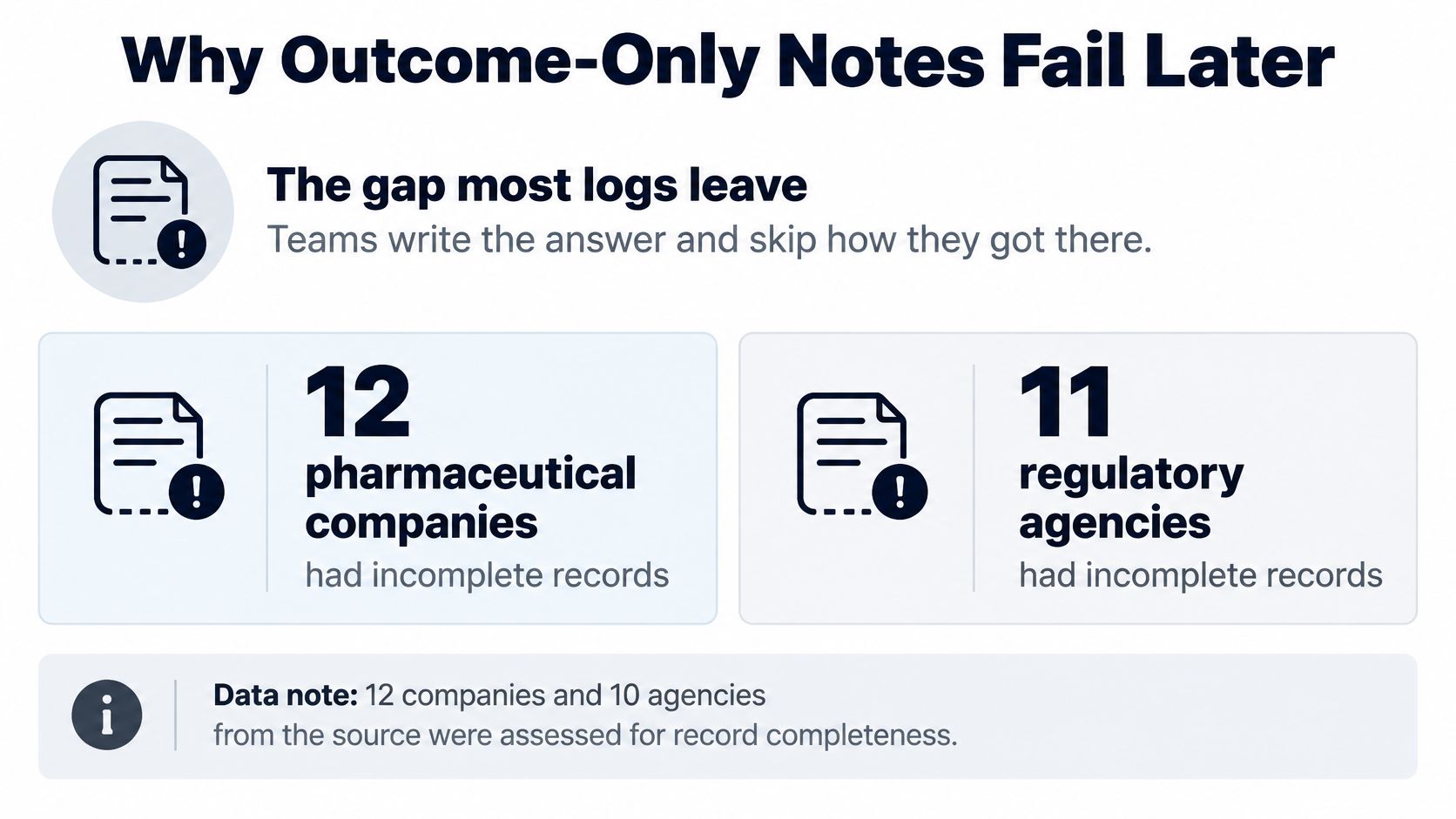
The gap is visible even where organizations already document major decisions. A [peer-reviewed study of pharmaceutical companies and regulatory agencies](https://pmc.ncbi.nlm.nih.gov/articles/PMC7704497/) found that **11 of 12 companies recorded what was decided, but only 4 documented how the decision was reached**. Among the agencies surveyed, 9 of 11 captured the outcome, while 6 captured the process.
The difference isn't cosmetic. An outcome tells the next engineer to keep reporting queries on Postgres. The process explains whether that choice followed a load test, a staffing constraint, or an assumption about future demand.
The documentation gap is easier to see side by side.
### Record the reasoning someone will need later
A useful record lets a colleague reconstruct the choice without interviewing everyone who attended the meeting. It should preserve:
- **Context and constraints:** What problem needed a decision, and what limits shaped the available options?
- **Alternatives and rationale:** What else could the team have done, and why didn't it?
- **Authority and consequences:** Who accepted the choice, what should happen, and what needs checking afterward?
Meeting minutes can remain chronological. A decision record should extract the durable reasoning from that chronology, not reproduce every exchange.
> **Practical rule:** Write enough for someone who wasn't in the conversation to distinguish an accepted commitment from a persuasive suggestion.
This distinction matters in [agentic project management](https://projectify.si/blog/agentic-project-management), where an assistant may retrieve an old recommendation without the surrounding conversation. An unmarked draft can look just as authoritative as an approved direction.
Don't solve that problem by preserving every message. Keep the relevant evidence, summarize the reasoning, and make the acceptance visible. Before choosing a tool, establish what a complete record must contain and who is responsible for confirming it.
## Decision Log Template Fields and a Worked Example
| Field | What to write | Example |
|---|---|---|
| Identifier | Stable ID that never changes | DEC-014 |
| Title | One decision in a short phrase | Use Postgres as the only system of record |
| Status | Proposed, Accepted, Rejected, Deprecated, or Superseded | Accepted |
| Date and effective date | When it was proposed and when it takes effect | Proposed 4 Mar 2026; effective 12 Mar 2026 |
| Context | Problem, pressure, and what is already true | Analytics queries are slowing the app database |
| Constraints | Limits that options must respect | One on-call datastore; no new vendor this quarter |
| Options considered | Viable choices, including rejected ones | Keep Postgres with a read replica; add an analytics warehouse now, rejected because it adds another datastore this quarter |
| Decision | The selected option in one sentence | Stay on Postgres and add a read replica |
| Rationale and trade-offs | Why this option won and what was given up | Familiar operational tooling; warehouse flexibility deferred |
| Consequences | Expected measurable effects | Reporting reads move to the replica; compare app read latency and total database cost against the recorded baseline |
| Owner and approver | Who drives it and who accepted it | Owner: tech lead; approver: engineering manager |
| Affected work | Components, repos, or tasks touched | App database, reporting queries, replica setup task |
| Evidence links | Documents, benchmarks, or threads available at the time | Load-test note and cost sheet dated 3 Mar 2026 |
| Review trigger | Date, metric, or event that reopens it | App p95 read latency above the accepted load-test ceiling, or monthly database cost above the approved cost-sheet cap |
This is a **hypothetical completed record**, not a recommendation that every team should use a replica. Paste the field set into a document, ticket, or knowledge page, then replace the example with your own evidence and constraints. The example's dates and identifier illustrate how to fill the form.
[Microsoft's architecture decision record guidance](https://learn.microsoft.com/en-us/azure/well-architected/architect-role/architecture-decision-record) supports recording context, constraints, rejected alternatives, implications, and current status. Use **one record per decision**, with enough detail to explain the choice without turning the entry into a design document.
### Why these fields stay separate
The identifier gives tasks and handoffs a stable reference even if someone improves the title. Status prevents a draft from being read as policy, while separate proposal and effective dates show when discussion became applicable guidance.
Context describes the pressure. Constraints describe the boundaries. In this example, slow analytics queries create the problem, but operational capacity helps explain why a warehouse loses despite its potential flexibility.
Keep the selected decision separate from its rationale. Someone should be able to scan the commitment immediately, then inspect the trade-offs without confusing explanation with scope.
The owner maintains the record and follows through on implementation. The approver supplies the acceptance, which isn't necessarily the same responsibility.
### Make consequences testable
Faster is too vague to review. Identify the workload, baseline, measurement location, and accepted limit in the linked evidence, then compare the implemented result against them.
The review-trigger cell uses rules rather than invented performance targets. Before acceptance, the owner must ensure that the load-test ceiling and cost cap are written in the referenced documents.
Keep the accepted rationale intact. Append dated observations and status changes rather than rewriting the original argument after implementation. Duplicate the field set for the next decision, not the completed content, and split independently accepted phases into linked records with their own owners.
## Which Choices Belong in the Log
| Choice | Log it | Reason |
|---|---|---|
| Data store, architecture, or API boundary | Yes | Expensive to reverse and widely felt |
| New dependency or vendor | Yes | Locks other work to that choice |
| Quality target for latency, cost, or uptime | Yes | Needs a metric that can reopen it |
| Access, security, or compliance rule | Yes | Later review needs the approver and evidence |
| End of a spike, keep or kill | Yes, that call only | The experiment notes aren't the decision |
| Naming, formatting, or local refactor | No | Routine detail already lives on the task |
| Day-to-day task sequencing | No | Scheduling isn't a durable decision |
A focused log is easier to trust than a detailed diary. Use this filter before opening a record, especially when an agent can generate documentation faster than teammates can review it.
Scope matters more than the label on the task. Renaming a local variable doesn't belong, but changing a public API name may create a migration commitment for other teams. Likewise, routine scheduling can stay on the board, while a durable change to release policy deserves explicit reasoning.
### Make current authority legible
Use statuses consistently rather than letting each author invent their own meaning:
- **Proposed:** Available for review, not guidance for implementation.
- **Accepted:** A named human has authorized the choice.
- **Rejected:** Considered and declined, with the reason retained.
- **Deprecated:** No longer suitable for new work, even if existing implementations remain.
- **Superseded:** Replaced by a linked, newer decision.
Keep implementation progress on the associated tasks. An accepted choice may still be unimplemented; combining approval and delivery in the same status makes both harder to interpret.
### Reopen for evidence, not preference
Lifecycle-oriented [decision log guidance](https://boardmix.com/articles/decision-log-template/) includes statuses and revisit triggers, but a team still needs to assign review authority. Name the review owner or authorized role in the record so a new objection doesn't automatically restart a settled debate.
Distinguish **an invalid decision** from **changed assumptions**. If the original benchmark measured the wrong workload, the rationale was faulty when accepted. If a new customer introduces a different workload, the original choice may have been reasonable under the conditions then.
> A disappointing result doesn't prove the original decision was careless. Compare what was known then with what changed afterward.
Add a confidence note, the expected outcome, and a dated place for the observed outcome. Confidence should identify uncertainty, such as an untested peak workload, rather than offer an unsupported numerical score.
For small teams, this is the useful replacement for informal chat reconsideration. The owner brings evidence, the authorized person decides whether to reopen, and the record preserves whether the team corrected an error or adapted to a new situation.
## How to Record a Decision From First Draft to Acceptance
A sound format doesn't guarantee participation. A [2018 Agile Alliance experience report](https://agilealliance.org/resources/experience-reports/distribute-design-authority-with-architecture-decision-records/) described IBM Watson's WIRE team maintaining **more than 80 ADRs across more than 24 repositories over two years**, yet only about half the team recorded them as regular development practice.
The lesson is operational: make capture part of work, not a documentation exercise people remember after shipping. Start with a visible draft and a clear route to acceptance.
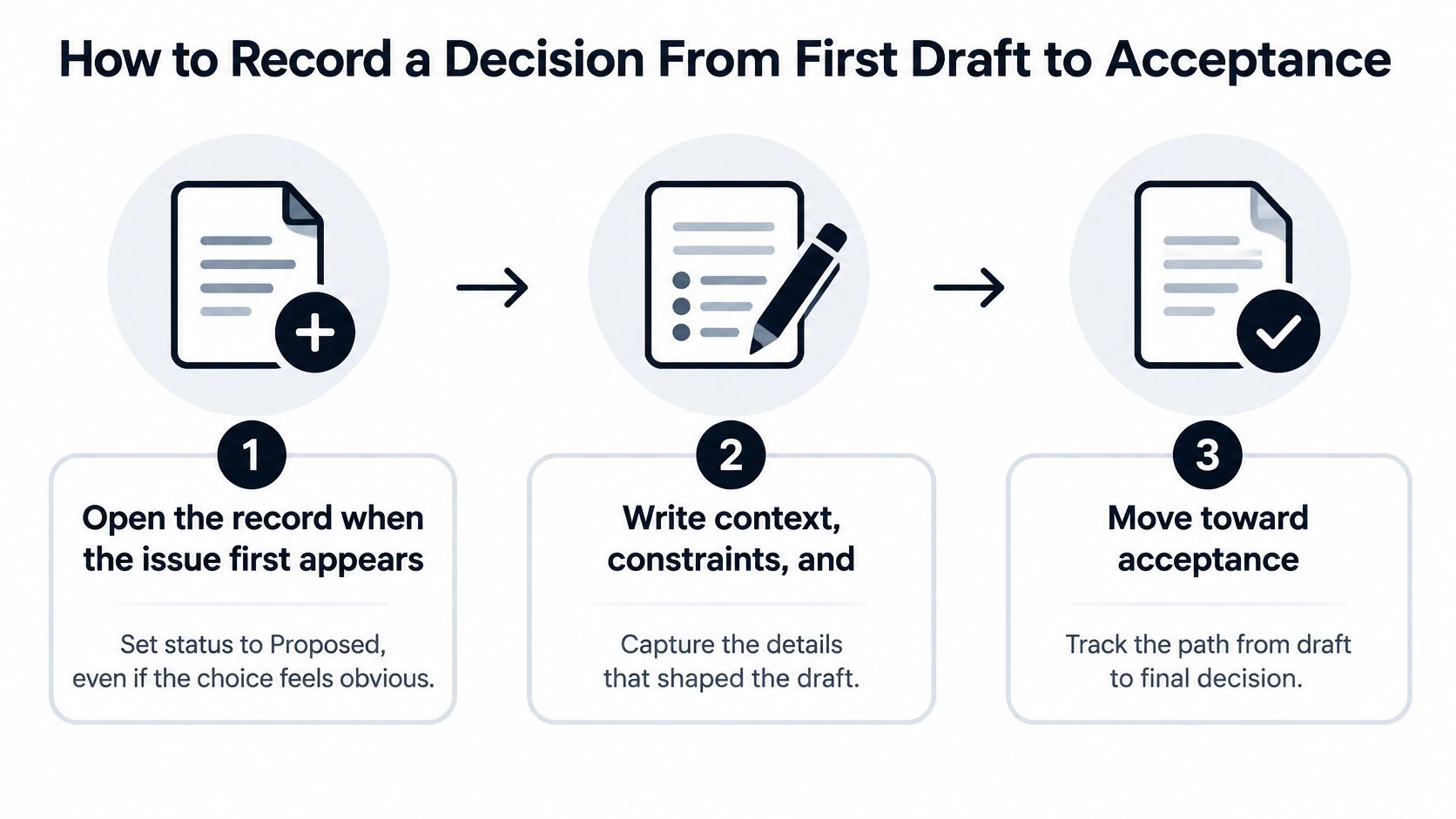
The process begins before anyone announces the final answer.
### Move the record through review
1. **Open it when the issue appears.** Set the status to Proposed, even when the preferred option seems obvious. Capture the question while the constraints are still clear.
2. Write the context, constraints, and credible alternatives. Keep the rejected option and its rejection reason in the text, rather than leaving them in a disappearing thread.
3. **Separate the roles.** Identify who proposed the choice, who should challenge it, and who can accept it. A confident author isn't automatically the approver.
4. Route the draft to affected people. Ask reviewers to address specific trade-offs, such as operational load, reporting freshness, or budget exposure, rather than request undirected comments.
5. **Record the explicit answer.** Mark Accepted only after the approver says yes to the stated choice. If the answer is no, retain the Rejected record and the reason.
6. Connect the accepted record to implementation tasks, affected components, and evidence available at decision time. Include it in the relevant handoff so the executor doesn't have to rediscover the reasoning.
7. **Replace without rewriting history.** When a later choice changes the commitment, create a replacement record, link both directions, and mark the earlier record Superseded.
### Show the transition in ordinary work
Say engineers disagree in chat about whether reporting needs a replica or a warehouse. The proposer files DEC-014 while the discussion is active, and the engineering manager accepts the replica approach after reviewing the evidence.
Later, a cost increase justifies reconsideration. The replacement becomes DEC-021, with the new cost evidence and a link to DEC-014, rather than an edit that makes the original decision appear to have anticipated everything.
Build this into [project management for software teams](https://projectify.si/blog/project-management-for-software-teams): a task that depends on an unresolved decision should reference its Proposed record. That makes the approval dependency visible before someone starts implementing a recommendation.
Use this video alongside a real draft when discussing the practice with your team.
## Recording Decisions When an Agent Is Involved
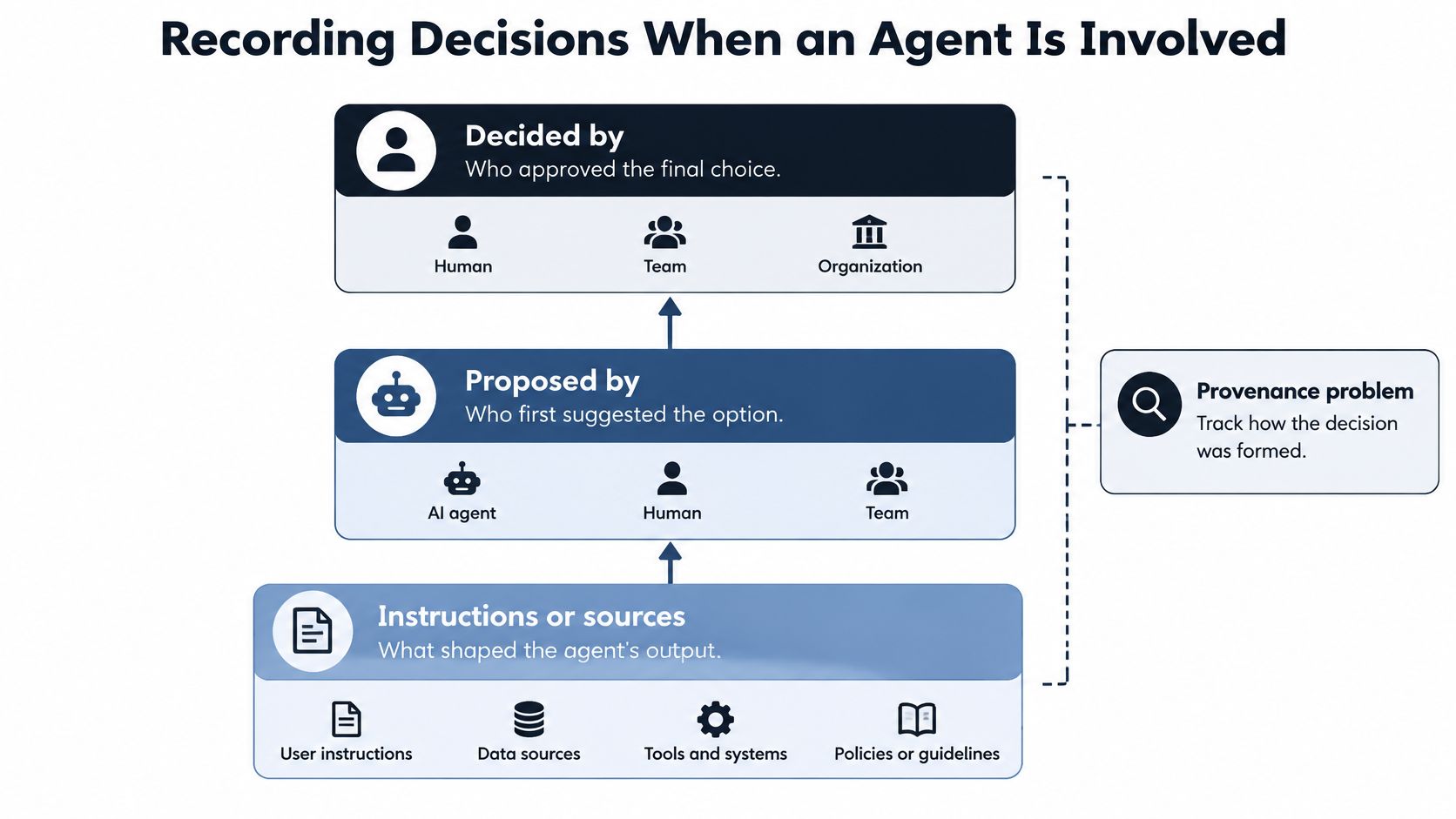
Agent assistance creates a **provenance problem**, not a blame problem. Decided by doesn't explain who generated the options, what instructions shaped them, or whether a person accepted the recommendation unchanged.
A [decision-log guide discussing AI governance](https://intermind.com/blog/decision-log-template) cites a 2025 KPMG survey reporting that **fewer than one in four companies conduct regular AI audits**. A decision record isn't a substitute for an audit, but it can preserve the evidence an internal reviewer would otherwise have to reconstruct.
The useful distinction is between proposing, reviewing, authorizing, and carrying out a choice.
### Attribute the work precisely
For consequential agent-assisted decisions, extend the record with explicit roles:
| Role | What the record should establish |
|---|---|
| Proposer | Agent or person that suggested the option, including the person an agent acted for |
| Reviewer | Person who checked evidence, feasibility, and risks |
| Approver | Human who accepted the final commitment |
| Executor | Person or attributed agent responsible for implementation |
Record the agent's identity and relevant tool or model context when known. A short description such as repository coding agent acting for the tech lead is more useful than AI helped.
Summarize the instructions that materially shaped the recommendation. For example, the agent was asked to preserve the current vendor and compare operational effort, not to conduct an unconstrained architecture redesign.
Link the actual brief, benchmark, ticket, and cost evidence available during that proposal. Don't replace them with newer documents that make the recommendation look better informed than it was.
### Record human changes, not just human presence
In the replica scenario, an agent proposes the option and cites the load test. The draft stays Proposed while the engineering manager checks the cost assumptions.
The manager then changes the proposed spending cap and explicitly accepts the revised choice. Record that modification and identify the executor responsible for the replica task, rather than flattening the exchange into approved by engineering.
Also retain dissent and unresolved risks. If a reviewer warns that replica lag could affect reporting freshness, the accepted record should state whether that risk was accepted, mitigated, or left as a blocker.
> **Acceptance boundary:** An agent can prepare a persuasive recommendation. Only the authorized human can turn that recommendation into a consequential commitment.
Don't copy full prompts, secrets, customer data, or unrestricted transcripts into the log. Use a concise instruction summary and access-controlled evidence references; remove sensitive content before sharing the record more broadly.
In [AI agent workflow automation](https://projectify.si/blog/ai-agent-workflow-automation), downstream actions should check acceptance rather than infer it from a positive comment. Looks reasonable is a review response, not necessarily permission to provision infrastructure.
## Backfilling Decisions Already Made in Chat
Start with decisions that still constrain current work, not the oldest thread you can find. The database, hosting target, access model, and quality targets people quote from memory are useful candidates.
Apply the scope filter before reconstructing anything. The aim is to recover active commitments, not convert your chat archive into a second documentation backlog.
### Separate history from reconstruction
Use the same decision log template, but distinguish the original decision date from the date someone documented it. If the original date is unknown, mark it unknown rather than assigning the transcription date and implying certainty.
- **Preserve the source:** Reference the original thread, ticket, or meeting note.
- **Mark reconstruction:** State that the record was assembled retrospectively and identify who assembled it.
- **Expose missing evidence:** Write **no surviving evidence** when that's true.
- **Request confirmation:** Ask the original approver, or the current authorized owner, to confirm the reconstructed commitment.
Don't manufacture alternatives because the template contains an alternatives field. Write that they weren't recorded, then ask whether the missing reasoning matters enough to reopen the choice.
### Let uncertainty remain visible
An agent can extract candidate decisions from a transcript, but its reconstruction remains Proposed until a person verifies it. Attribute the reconstruction to the agent without pretending the agent made the historical decision.
Add a review trigger that addresses the present uncertainty. If nobody can recover why a hosting target was chosen, an upcoming renewal or migration planning event may be the right point to reassess it.
Bound the exercise to a short working session and a confirmation pass. A small set of verified, current records is more useful than an impressive archive whose rationale nobody can defend.
## Pitfalls That Make a Good Template Useless
Storage and ownership cause trouble before missing columns do. An [action-research study on architecture decision records](https://research.chalmers.se/en/publication/542849) found improved cooperation after introducing ADRs, while documentation culture, prioritization, knowledge transfer, distributed components, and especially storage location affected their usefulness.
Choose **a canonical, searchable index**. Full technical records can remain beside their repositories, but teammates need a dependable place to discover the applicable decision without knowing which repository contains it.
### Keep retrieval and review connected
Link accepted records from project overviews, implementation tasks, and closing handoffs. Use stable identifiers in those references so renamed pages don't create ambiguity.
Review unresolved proposals during an existing project check-in. Ask whether each needs evidence, an approver's answer, or closure, rather than letting Proposed become a permanent parking state.
Watch for these common slips:
- **Outcome without reasoning:** The entry records the choice but can't explain it.
- **Missing alternatives:** Rejected options and assumptions vanish.
- **Rewritten history:** A replacement changes the accepted rationale with no trace of the original.
- **Duplicate authority:** Separate records claim to govern the same choice.
- **Unowned follow-up:** Nobody is responsible for checking consequences.
### Check what actually happened
Close the implementation loop with an observed result: latency, cost, defect rate, migration effort, or customer impact. Record the measurement conditions so reviewers don't compare unlike workloads and declare a reversal justified.
A neat form can create false confidence when nobody tests its assumptions. A shorter entry with a responsible reviewer and a meaningful trigger is more useful than polished reasoning that nobody checks.
Keep access appropriate to the content, too. Searchability should help authorized teammates find the decision, not expose sensitive commercial or security details across the workspace.
## Put the Next Real Decision on the Record
Pick a consequential choice hiding in chat this week. Open a record, set it to **Proposed**, and name the human who must accept it before implementation proceeds.
If an agent drafted the options, keep that attribution intact. Ask the approver to check the rejected alternative, the supporting evidence, and the consequence the team expects to observe.
Before creating more entries, decide where the index belongs. A shared document is enough if teammates can find it, distinguish current guidance from history, and reach the work it governs.
> Start with a record someone can accept and use, not a folder full of empty templates.
For teams already working with agents, Projectify keeps short decision records containing context, the decision, alternatives considered, and consequences. An agent can propose a record, and a person accepts it.
Your next action is specific: file the live choice, request acceptance, connect the implementation tasks, and set a review trigger. Don't wait for the whole team to agree on a perfect documentation system.
---
Projectify gives people and agents a shared place to preserve proposals and human-accepted decisions alongside their work. Visit [Projectify](https://projectify.si) and put your next consequential choice on the record, with the alternatives, the reason, and the person responsible for accepting it.