---
title: "Project Management for Agencies That Hold Margin"
description: "Project management for agencies: a weekly scorecard for utilization, client-board sync, change orders, and AI agents that do not collide."
url: https://projectify.si/blog/project-management-for-agencies
updated: 2026-10-29
---
# Project Management for Agencies That Hold Margin
Published 2026-10-29 by the Projectify team · Topics: project management for agencies, agency operations, billable utilization, client boards, AI agents
In 2025, **97%** of 130 U.S. marketing and advertising agency professionals surveyed by the [Project Management Institute](https://www.pmi.org/about/press-media/2025/97-of-agencies-faced-major-creative-campaign-challenges-according-to-new-pmi-survey) said they had faced at least one major campaign challenge in the previous year. **55%** reported going over budget, and **54%** reported overdue deadlines.
A campaign can still ship after that kind of week. The fee doesn't come back. **Project management for agencies** is the weekly loop that spots the mismatch between the promise, the hours, and the price while you can still restaff, cut, or reprice.
You don't start by shopping for software. You start with a fixed baseline, a capacity check, a priced change, one client board that stays honest, and a named owner when an agent drafts the work.
## Table of Contents
- [What Agency Project Management Must Connect](#what-agency-project-management-must-connect)
- [Weekly Utilization and Variance Targets](#weekly-utilization-and-variance-targets)
- [What a repeating overrun means](#what-a-repeating-overrun-means)
- [Weekly Review Cadence and Roles](#weekly-review-cadence-and-roles)
- [Fixed owners](#fixed-owners)
- [How to Price a Change Before It Is Free](#how-to-price-a-change-before-it-is-free)
- [Six steps before anyone starts](#six-steps-before-anyone-starts)
- [Client Boards With Two-Way Sync](#client-boards-with-two-way-sync)
- [Set the boundary once](#set-the-boundary-once)
- [Coordinating People and Agents on One Board](#coordinating-people-and-agents-on-one-board)
- [The gate before production](#the-gate-before-production)
- [Three Client Weeks Side by Side](#three-client-weeks-side-by-side)
- [A design retainer on Trello](#a-design-retainer-on-trello)
- [A product item in Azure DevOps](#a-product-item-in-azure-devops)
- [A content sprint with two sessions](#a-content-sprint-with-two-sessions)
- [Start One Client Project on This Loop](#start-one-client-project-on-this-loop)
## What Agency Project Management Must Connect
The [Project Management Institute's 2024 project-success research](https://www.pmi.org/about/press-media/2024/pmi-champions-a-new-era-of-project-success) classified **48%** of projects as successful, **40%** as producing mixed results, and **12%** as failures. PMI calculated a **Net Project Success Score of 36** by subtracting the failure rate from the success rate.
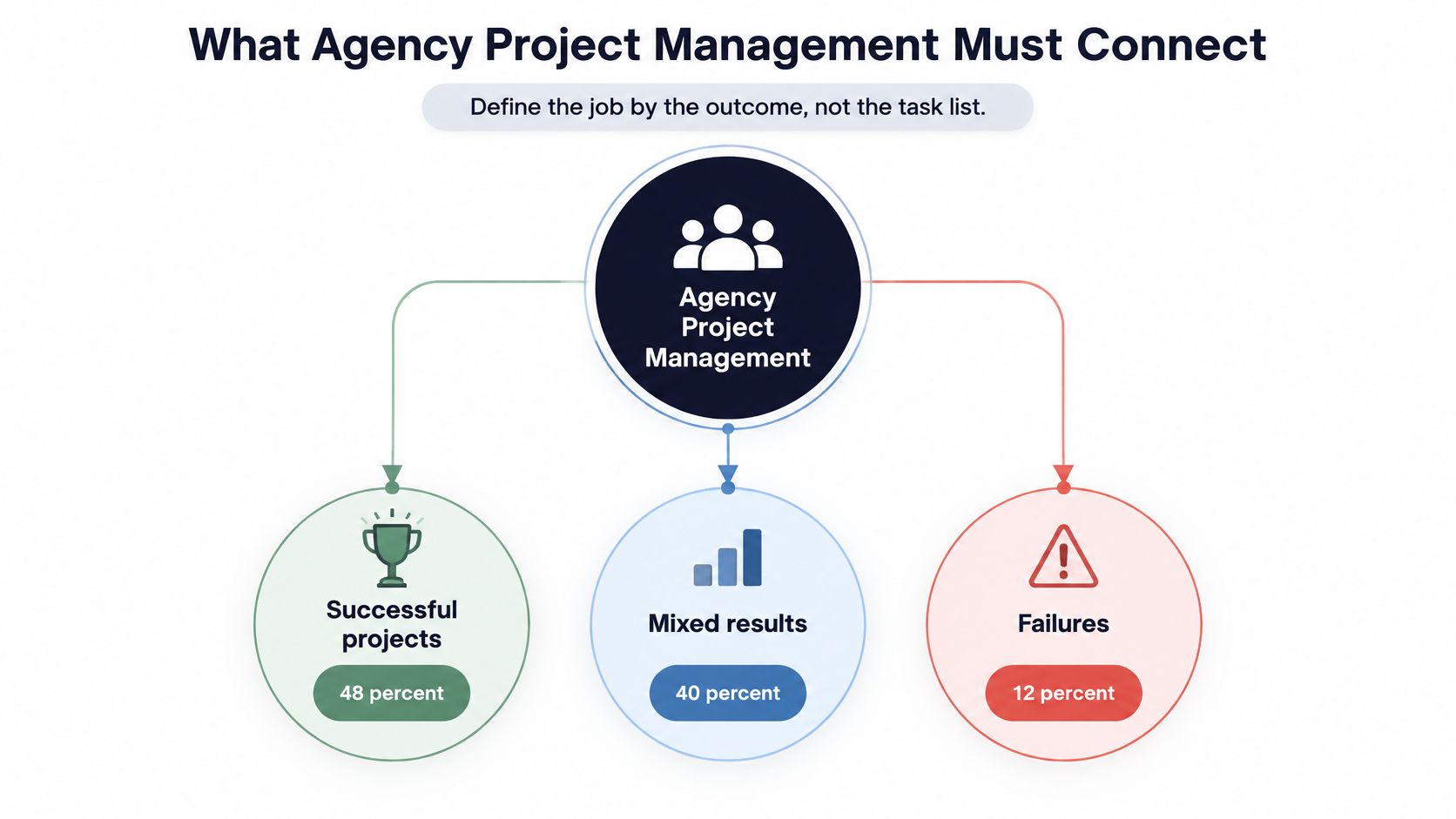
For an agency, mixed results are where margin goes. A site, a campaign, or a sprint can ship and still miss the client date, blow the approved budget, or soak up unpaid rework. Completion isn't the score. **Schedule, budget, quality, business value, and stakeholder satisfaction** are.
Think of the board as the intersection, not the destination. The lanes that have to meet are scope and acceptance criteria, staffing, dependencies, approvals, risk, and a path for change. A task list only shows that something moved. Management shows whether that move still matches the promise and the price.
Before you add a card, write those five outcomes on the project overview with a **baseline**: deliverables, acceptance criteria, assumptions, dependencies, and an effort estimate.
- **Schedule:** the date you promised.
- **Budget:** the approved hours and fee.
- **Quality:** the test a deliverable must pass.
- **Business value:** the client result the work should move.
- **Stakeholder satisfaction:** who must approve, and by when.
A card you can't check against that page is a note. Later invoices and agent handoffs get judged against something fixed, not against memory.
## Weekly Utilization and Variance Targets
**Billable utilization** is billable hours divided by available hours, times 100. Published professional-services benchmarks commonly place a sustainable delivery-role target around **75-80%**, as [Toggl's guide to productivity metrics](https://toggl.com/blog/productivity-metrics) lays out. Below that band, capacity is usually going to coordination, rework, sales support, or unplanned requests, not to a lack of effort.
| Control | How to calculate it | Review when |
| --- | --- | --- |
| Delivery-role utilization | Billable hours ÷ available hours × 100 | Sustained result well below the 75-80% band, or a push to schedule every hour as billable |
| Weekly forecast | Scheduled billable hours versus actual logged hours, by person and by project | Actual hours repeatedly exceed the schedule |
| Time variance | (Actual − estimated) ÷ estimated × 100 | Variance stays positive across tasks, not just one bad day |
| Specialist load | Utilization of the scarce role, not the agency average | One person is full while other client work waits |
| Non-billable reserve | Hours held for project management, review, and contingency | The plan has scheduled every available hour as client delivery |
### What a repeating overrun means
If actual hours keep beating the schedule, the cause is usually a weak estimate, tasks that are still too large, or scope that grew. It isn't a verdict on one person's effort. Forecast utilization by person and by project, then compare scheduled billable hours with hours logged.
An agency-wide average can look fine while one specialist is full and other clients slip. Overloading that person on a single account creates delays everywhere else. Hold a **non-billable reserve** for project management, review, and contingency. Treat 75-80% as a ceiling, not a score to chase. Scheduling every available hour as client delivery leaves no room when a review runs long.
> A strong margin can sit next to a weak delivery week. Read both.
The [2025 SPI benchmark published by Deltek](https://www.deltek.com/resources/articles/professional-services-benchmarks/) reported billable utilization of **66.4%**, the lowest level recorded in its survey. On-time delivery was **73.8%**, below the five-year average of **76%**. Project margins improved to **37.7%**. Margin can look healthy while delivery reliability and unused capacity both weaken.
Set the baseline estimate before work starts. Record actual effort by task. **Time variance** is (actual minus estimated) divided by estimated, times 100. When that variance stays positive across tasks, open a scope, staffing, or pricing review the same week. Don't wait for the invoice to tell you the loop failed.
## Weekly Review Cadence and Roles
Read the controls before anyone drafts an invoice. One short rhythm is enough.
**Monday.** The account lead confirms the five outcomes and the baseline are still on each active overview. The producer forecasts billable hours by person and by project, and leaves review, project management, and contingency off the delivery schedule.
**Midweek.** The producer compares scheduled hours with logged hours at task level. A task whose actual hours have passed the schedule, or whose variance stays positive across more than one day, goes onto the change path that day.
**Friday.** The account lead checks specialist load, the open change log, conflicts flagged by two-way sync, and any agent handoff nobody has accepted.
### Fixed owners
- **Account lead:** owns the client promise and the price.
- **Producer:** owns capacity and the schedule.
- **Specialist:** owns the estimate and the hours they log.
- **Named person on each agent session:** the agent doesn't change price or client scope on its own.
Keep the meeting to thirty minutes. End with one decision per project: restaff, cut scope, reprice, or hold. Studios still forming that split can borrow the ownership pattern in [project management for startups](https://projectify.si/blog/project-management-for-startups), then apply it to client fees instead of an internal roadmap.
## How to Price a Change Before It Is Free
PMI data cited in Loomdeck's agency benchmarks found that **52%** of projects experienced scope creep or uncontrolled changes, compared with **43%** five years earlier. Projects affected by scope creep averaged approximately a **27%** budget overrun.
Each unapproved request adds labor, eats the schedule buffer, and pushes planned work aside. Without a formal path, that labor becomes free even when the client accepts the file.
The baseline has to exist first: deliverables, acceptance criteria, assumptions, dependencies, and an effort estimate. Every request is then classed against that page.
### Six steps before anyone starts
1. **Log the request the day it arrives**, in the client's words.
2. **Classify it** as in scope, a trade-off that drops or delays something already promised, or a separately priced change order.
3. **Estimate the hours and name the schedule hit** before design, build, or writing begins.
4. **Compare planned and actual hours at task level** during the week, not on the final invoice. Early variance still leaves room to recover.
5. **Investigate deviations around 5% from baseline** while you can restaff, cut scope, or reprice. Waiting for a large overrun removes those options.
6. **Record the decision, the alternatives, and the invoice effect** in a change log the account lead can show the client.
Repeated positive time variance is the trigger for this path. A single bad afternoon isn't.
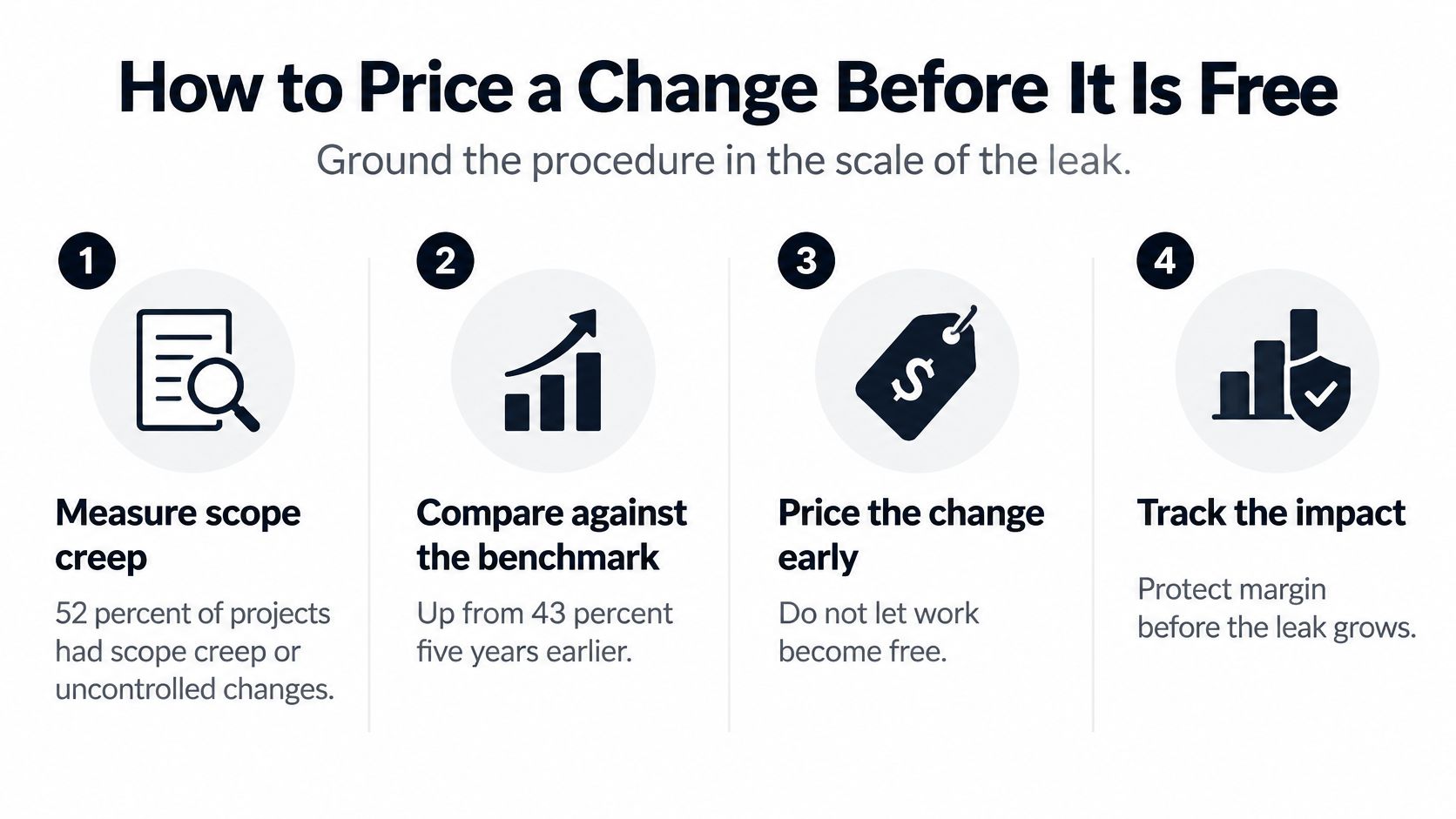
Say a retainer client asks for one more landing-page variant on a Monday call. Log it that morning. If the social set already in progress has to slip, that's a trade-off, and the client picks which promise moves. If both stay in the week, price the hours and the new date before anyone opens the file.
> If it isn't in the baseline and it isn't on a change order, it isn't billable yet.
The log is what you show when you defend margin or ask for an extension. It ties the client's words to the approval, the revised estimate, the date, and the invoice line.
## Client Boards With Two-Way Sync
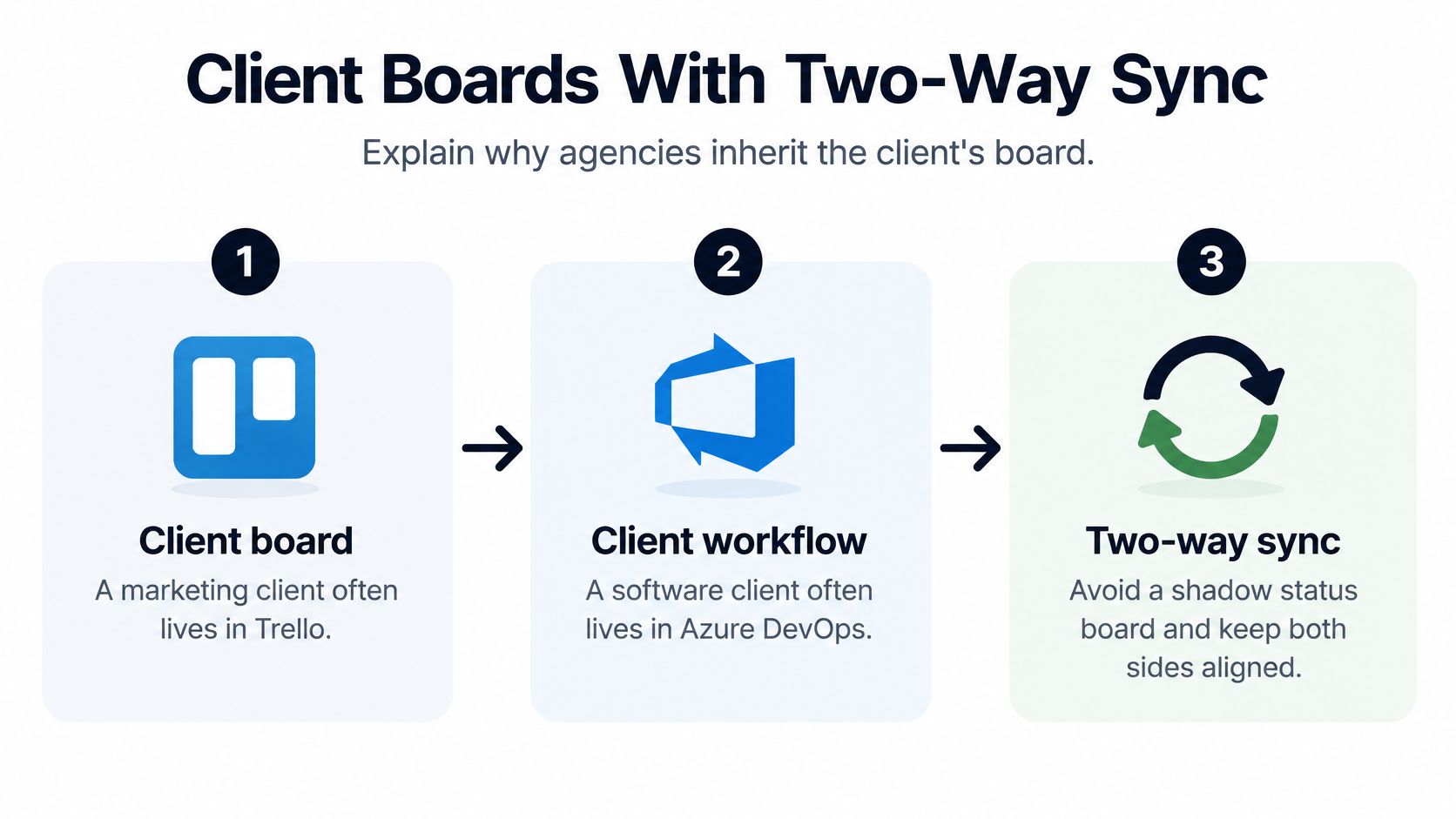
A client's existing board is often part of the delivery process. Marketing clients may use **Trello**, while software clients may use **Azure DevOps**. Asking them to move can create a second place to check, so agree on how the boards relate before work begins.
**Two-way sync** lets work move between the agency board and the client's Trello or Azure DevOps board. Projectify supports this sync, with conflicts surfacing where users already look. Sync does not decide what your agency should share. Set that boundary as an operating rule, then check that the client-facing board shows only information approved for that audience.
### Set the boundary once
1. **Map statuses.** Agree how the client's To Do, Doing, and Done correspond to the agency workflow for that work.
2. **Choose what the agency shares.** Decide which titles, descriptions, statuses, client-side assignees, and due dates belong on the client board. Treat this as an agency policy, not a field-filtering feature of the sync.
3. **Keep internal planning in the agency workspace.** Keep budgets, estimates, and internal comments there unless the agency has agreed to share them.
4. **Resolve conflicting edits visibly.** When both sides change the same work item, review the surfaced conflict instead of assuming one version is right.
5. **Agree on access.** Decide what clients can see and what producers and agents need in the internal workspace.
| Field | Recommended agency decision | Where it belongs |
| --- | --- | --- |
| Title | Share when client-facing | Client board and agency board |
| Description | Share the approved description | Client board and agency board |
| Status | Map before sharing | Both boards |
| Client-side assignee | Share when relevant to the client | Client board |
| Due date | Share agreed dates | Both boards |
| Budget and estimates | Keep internal | Agency workspace |
| Internal comments | Keep internal | Agency workspace |
| Agent draft reasoning | Keep internal | Agency workspace |
If a client moves a card to Done while acceptance criteria remain open, treat the status change as a signal to review, not as proof of acceptance or approval to invoice. The board records movement; your team still applies the agreed delivery and billing rules.
Use one external board per project so everyone knows where client-visible updates belong. For agencies comparing people-focused boards with tools designed for people and AI agents, this [guide to AI project management tools](https://projectify.si/blog/ai-project-management-tools) offers a starting point.
## Coordinating People and Agents on One Board
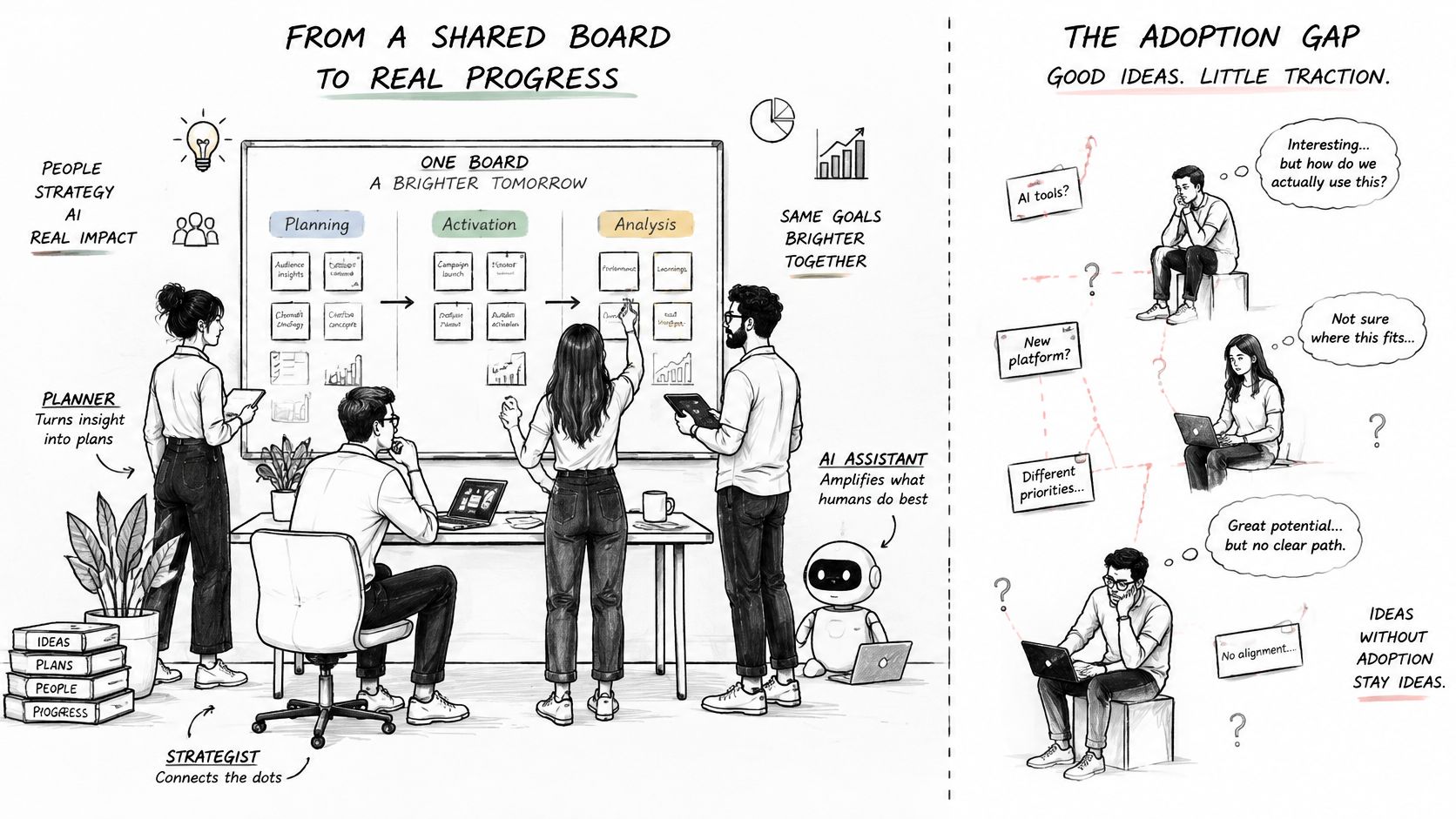
In 2025, **70%** of agencies, brands, and publishers had not fully integrated AI across media planning, activation, and analysis, while nearly two-thirds reported major barriers involving tool setup, data quality and protection, expertise, legal compliance, and fragmented systems, according to the [IAB State of Data 2025 report](https://www.iab.com/wp-content/uploads/2025/03/IAB_State_of_Data_2025_March__V2.pdf).
Faster drafts don't close that gap. They add **coordination debt** when handoffs, review queues, and attribution stay informal. You can produce more pages and still lose the week to rework and risk.
**Ownership.** The person stays accountable. The agent acts for that person, and the activity names both, so a client can see who accepted the work.
**Collisions.** Only one holder may change a deliverable at a time. A second session is told who holds it and when they were last active, then waits or leaves a comment.
**Records.** Keep the brief, the decision with the alternatives considered, and an end-of-session note covering what finished, what didn't, and which tasks were touched.
**Permissions.** The client board shows approved status. The internal workspace holds rules such as always cite sources and never email the client. Those rules are shown to every agent before its own defaults.
### The gate before production
The agent states what it understood, sizes the task, and starts only when a person says go. Shorter creation time isn't profit until review effort and price are in the plan. A concrete map of claims, briefings, and handoffs is in this [note on AI agent workflow automation](https://projectify.si/blog/ai-agent-workflow-automation).
## Three Client Weeks Side by Side
### A design retainer on Trello
Monday the client asks for another landing-page variant. You log it the same day and class it as a trade-off against a social set already in Doing. The Trello card stays in Review until they pick which deliverable slips. Internal hours never appear on that board.
### A product item in Azure DevOps
A bug and a feature share one developer and one agent. The agent claims the bug. The developer keeps the feature. The client closes the DevOps item before acceptance tests pass, and the conflict shows on the task. The producer reopens it and doesn't count it done.
### A content sprint with two sessions
Both sessions reach for the same article. The first holds it. The second is pointed at the next unblocked task. The session ends with a handoff that names unfinished sources and the tasks touched. A person approves the draft before it is client-visible.
Each week avoided free work or a double edit by deciding ownership and price before production. None of them needed another status meeting.
Pick one live account and map it onto the week it resembles. If the client already has a board, you're in the first or second week. If two sessions are drafting the same asset, you're in the third.
## Start One Client Project on This Loop
Run the loop on one active client this Monday, not on the whole agency.
1. **Write the five outcomes and the baseline** on the project overview.
2. **Connect the client's Trello or Azure DevOps board**, write the field map, and turn on two-way sync so conflicts appear on the task.
3. **Forecast billable hours by person**, and leave review and project-management time unscheduled as delivery.
4. **Route each new request** through in scope, trade-off, or change order before work starts.
5. **If agents draft or ship**, give each session the brief and the rules first, allow one holder per task, and require a named person to accept decisions and client-facing work.
Projectify is one board built for that loop. Agents are members of the board, connect over MCP, claim work, keep the Brief current, and hand off cleanly. Two-way sync covers Trello and Azure DevOps, with conflicts showing where the team already looks. Claims stop people and agents from colliding, a briefing stops a session from starting cold, and every change is attributed to a person. Early access is on the product site for small teams. Larger rollouts start with a conversation with us.
Next week, status either comes from memory or from a baseline, a synced board, and a named owner.
---
Projectify gives agencies one board where people and agents share claims, a current brief, and a clean handoff, including two-way sync to the client boards you already inherit. If margin is leaking through unpriced changes and unsigned agent drafts, put one live client on that loop. Visit [Projectify](https://projectify.si) and run next Monday from a baseline instead of from memory.