---
title: "Project Management for Startups: A Practical Guide"
description: "Practical project management for startups: lightweight processes, tooling, AI agent coordination, and ready-to-use templates for small teams."
url: https://projectify.si/blog/project-management-for-startups
updated: 2026-10-23
---
# Project Management for Startups: A Practical Guide
Published 2026-10-23 by the Projectify team · Topics: startup project management, lightweight project management, AI agent coordination, project management tools, startup project templates
Your engineer is fixing onboarding, an AI agent is editing the same files, and the founder has just promised a customer something nobody put on the board. Yesterday's decisions are buried in chat. When someone asks what's ready to ship, everyone gives a different answer.
That's the point where project management for startups becomes necessary. Not a dedicated project manager or a calendar full of ceremonies, but a dependable way to decide what matters, see who's doing it, and preserve enough context for the next person or agent.
## Table of Contents
- [Why Startups Cannot Afford Unmanaged Work](#why-startups-cannot-afford-unmanaged-work)
- [The work you can't see still costs you](#the-work-you-cant-see-still-costs-you)
- [Small teams have fewer ways to absorb mistakes](#small-teams-have-fewer-ways-to-absorb-mistakes)
- [What Lightweight Project Management Looks Like in Practice](#what-lightweight-project-management-looks-like-in-practice)
- [Give every task enough structure to move](#give-every-task-enough-structure-to-move)
- [Track progress rather than motion](#track-progress-rather-than-motion)
- [Building a Lightweight Process Your Team Will Follow](#building-a-lightweight-process-your-team-will-follow)
- [Choose work against a business question](#choose-work-against-a-business-question)
- [Bound the commitment before starting](#bound-the-commitment-before-starting)
- [Coordinating Human and AI Agent Work](#coordinating-human-and-ai-agent-work)
- [Separate accountability from execution](#separate-accountability-from-execution)
- [Reserve attention for consequential actions](#reserve-attention-for-consequential-actions)
- [Choosing Tools and Where Projectify Fits](#choosing-tools-and-where-projectify-fits)
- [Common setups for startup project management](#common-setups-for-startup-project-management)
- [Evaluate behavior rather than labels](#evaluate-behavior-rather-than-labels)
- [Templates and a Worked Example for a Five-Person Startup](#templates-and-a-worked-example-for-a-five-person-startup)
- [Preserve the reasoning and the unfinished work](#preserve-the-reasoning-and-the-unfinished-work)
- [Review delivery without rewarding instability](#review-delivery-without-rewarding-instability)
- [Your Next Step to Start Managing Work This Week](#your-next-step-to-start-managing-work-this-week)
- [Start with rules people can apply](#start-with-rules-people-can-apply)
- [Add software when the manual work becomes the problem](#add-software-when-the-manual-work-becomes-the-problem)
## Why Startups Cannot Afford Unmanaged Work
Consider a hypothetical five-person startup. The founder handles sales and product, engineers switch between features and support, and the designer answers implementation questions between customer interviews. Several agent sessions run alongside them.
Everyone is busy. Nobody can confidently say what shipped last week, what remains unreviewed, or whether the customer request displaced something more important.
### The work you can't see still costs you
The immediate cost isn't a missed status update. It's an engineer rebuilding something another session already completed, a founder promising an uncertain release, or a reviewer discovering that an implementation solves the wrong problem.
Historical software outcomes give that risk some perspective. The Standish Group's initial CHAOS research classified **16.2% of projects as successful and 31.1% as cancelled**, while the 2020 distribution was approximately **31% successful, 50% challenged, and 19% failed**, according to this [summary of software project outcomes](https://anthonywest.co.uk/research/software-project-outcomes-over-time).
Those figures aren't a forecast for your startup. They're a reason not to assume that capable people, working hard, will automatically produce a coherent result.
> **Practical rule:** If the team can't distinguish finished work from started work, don't add more work.
### Small teams have fewer ways to absorb mistakes
A larger organization might move people onto a delayed project. A startup may have to postpone a customer commitment or stop another initiative entirely. The same engineer who could repair a release may also be the person needed for the next product experiment.
Unmanaged work creates several distinct risks:
- **Cash risk:** The team keeps implementing without checking whether the work deserves further investment.
- **Delivery risk:** Dependencies and unfinished changes remain invisible until someone tries to release.
- **Customer risk:** Internal activity gets mistaken for progress on an actual customer problem.
- **Continuity risk:** Important reasoning disappears when a person leaves or an agent session ends.
The answer isn't to make uncertainty disappear through more detailed planning. It's to make uncertainty visible early enough to act on it.
Good project management protects the team's ability to change direction. That matters more than making every original estimate come true.
## What Lightweight Project Management Looks Like in Practice
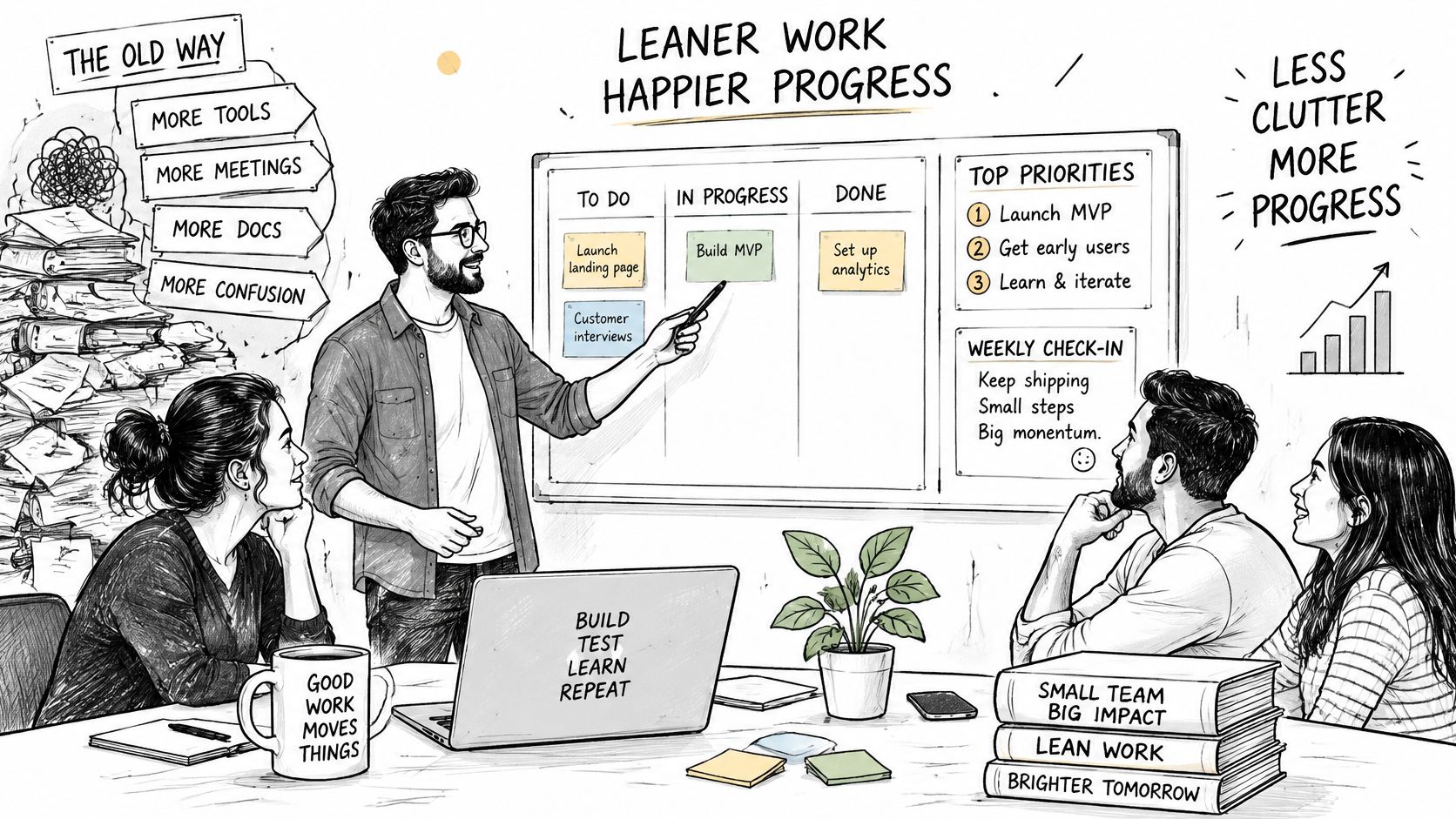
A kitchen during dinner service is a useful model. The cooks don't need a presentation explaining the organizational structure. They need visible orders, clear stations, and someone who notices when a dish is waiting on another station.
Your product team needs the same operational clarity.
A shared workspace should make coordination visible without becoming another job.
### Give every task enough structure to move
**Lightweight project management** means keeping the information needed to make the next decision, then leaving out administration that doesn't help anyone act.
| Element | What it answers |
|---|---|
| Owner | Who is accountable for moving this forward? |
| Next step | What concrete action happens next? |
| Status | Is it ready, active, blocked, awaiting review, or finished? |
| Checkpoint | When will we inspect the result? |
| Decision record | Why did we choose this approach? |
These elements work together. A status without an owner describes a problem nobody must resolve. An owner without a next step becomes the person everyone asks for updates. A finished implementation without an agreed outcome may be technically complete and commercially useless.
Keep the task description readable enough that a teammate can challenge it. If understanding the assignment requires reconstructing a chat conversation, the task isn't ready.
### Track progress rather than motion
In the kitchen, chopping ingredients isn't the same as serving dinner. In product development, writing code isn't the same as helping a customer complete their job.
An activity-oriented task might say **build onboarding dashboard**. An outcome-oriented version asks the team to help a new customer understand what to do after signup, then specifies the smallest deliverable that could test that idea.
That distinction changes scope discussions. A proposed feature must justify how it helps the intended outcome, rather than earning a place because someone can build it.
Leave out elaborate approval chains, compulsory presentations, and duplicate status documents. Keep constraints that help people coordinate: what matters, who owns it, and what evidence would make the team reconsider.
The process is lightweight when people can use it while doing their work, not when it contains the fewest fields.
## Building a Lightweight Process Your Team Will Follow
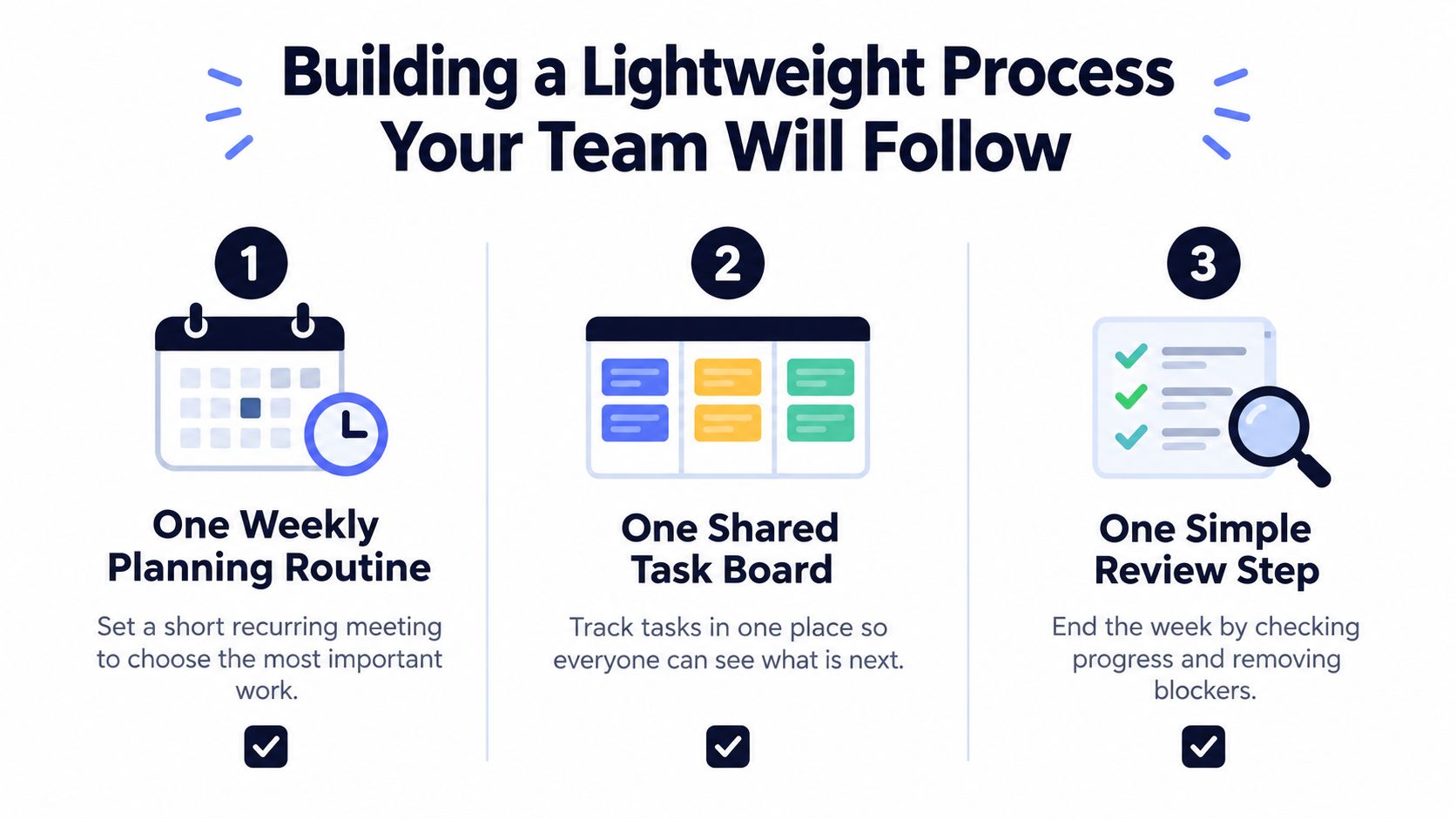
Start with a recurring planning routine, a shared queue, and a review that produces decisions. Don't begin by importing an entire framework.
The operating rhythm should be easy to recognize at a glance.
### Choose work against a business question
Research discussed in this [startup project and risk-management analysis](https://acta.uni-obuda.hu/Venczel_Berenyi_Hriczko_142.pdf) attributes **34% of cited failures to insufficient market need or product–market fit, and 29% to lack of funds**. Those figures don't establish that project management determines survival, but they support a practical priority: connect spending and implementation to evidence of customer value.
During weekly planning, choose the most important uncertainty the team can reduce. Keep the meeting short enough that preparation must happen beforehand, and end when priorities, owners, and unresolved decisions are clear.
Use a single prioritized queue. If you're choosing how to display it, this guide to [Kanban board software](https://projectify.si/blog/kanban-board-software) provides a useful starting point. The important choice is where commitments live, not how attractive the columns look.
### Bound the commitment before starting
Each initiative needs a hypothesis, a small deliverable, and an **evidence threshold**. For an onboarding change, the threshold might be observing target users complete setup without intervention, with the team agreeing beforehand what would count as convincing evidence.
Define **done** separately. That should cover acceptance criteria, checks, review, and any release or documentation requirements.
Record dependencies and risks alongside the task. “Waiting for billing access” needs a named resolver; “might affect existing accounts” needs an investigation or safeguard.
At the checkpoint, make an explicit decision: **continue, change, or stop**. Don't let unfinished work roll forward automatically just because someone has already invested effort.
Use a walkthrough to help teammates discuss the routine, then settle the rules in your own workspace.
Copy this checklist into the planning document:
- **Outcome:** What customer or business problem deserves attention now?
- **Hypothesis:** What do we believe, and what evidence would challenge it?
- **Scope:** What will we deliver, and what are we deliberately excluding?
- **Responsibility:** Who owns execution, review, and unresolved dependencies?
- **Acceptance:** What must be true before the work is finished?
- **Checkpoint:** When will we decide whether to continue, change, or stop?
Remove process that nobody uses to make decisions. Add structure only when a recurring failure shows what's missing.
## Coordinating Human and AI Agent Work
Adding human approval to every agent action sounds safe. It can also turn the founder or senior engineer into a full-time permission desk.
The better question is **which actions require judgment, and which can proceed safely within explicit limits?**
A [TechTarget report on AI coding and production problems](https://www.techtarget.com/it-infrastructure/news/366632374/Market-research-AI-coding-tools-push-production-problems) describes a survey in which **51% of 350 respondents were actively deploying agents**, while security and compliance were the leading challenge for **39%**. Adoption doesn't remove the need to establish who can authorize an action and who must answer for its consequences.
### Separate accountability from execution
A human remains accountable for the outcome. An agent can execute a bounded assignment on that person's behalf.
The coordination layer needs more than an assignee field:
- **Agent identity:** Record the person responsible and the agent session doing the work.
- **Claim or lease:** Reserve a task while a session works on it, with renewal and expiry rules.
- **Session briefing:** Supply current scope, project rules, relevant decisions, dependencies, and recent progress.
- **Handoff:** Preserve completed work, unfinished work, next actions, and affected tasks.
- **Accepted decisions:** Let agents propose meaningful changes, but require a person to accept changes that exceed delegated authority.
- **Attributed activity:** Distinguish human edits from agent edits and retain their connection to the task.
A task claim isn't a repository lock. Agents working on different tasks can still edit shared files or make incompatible architectural assumptions. Use branches or separate working directories, integration checks, and explicit boundaries alongside task coordination.
### Reserve attention for consequential actions
Let an agent draft documentation or run approved local checks without asking permission repeatedly. Require escalation for production access, sensitive data, security changes, architectural departures, and ambiguous requirements.
Keep permissions narrow. An agent assigned to improve help text shouldn't inherit deployment authority merely because its human principal has it.
> Human oversight works best when reviewers receive a clear decision, the supporting evidence, and the consequence of saying yes.
A review request should identify the proposed change, tests performed, unresolved uncertainty, and rollback path where relevant. A raw transcript isn't an adequate review package.
For teams implementing these mechanics, [AI agent workflow automation](https://projectify.si/blog/ai-agent-workflow-automation) is best approached as controlled delegation, not unattended execution.
The trade-off is deliberate. Selective autonomy requires more setup than unrestricted access, but it avoids spending scarce human attention on routine actions while consequential decisions wait unanswered.
## Choosing Tools and Where Projectify Fits
Choose software by testing a workflow that currently breaks. A feature checklist won't tell you whether teammates can recover an interrupted assignment or whether an agent can recognize that another session already owns it.
Start with an ordinary task. Then introduce an interruption, a blocked dependency, and a reviewer's request for changes.
### Common setups for startup project management
| Approach | Best fit | Gap to watch for |
|---|---|---|
| Shared spreadsheet, chat, and simple board | A team with limited concurrent work and direct communication | People must manually reconcile commitments, decisions, and session context |
| General work-tracking suite such as Linear, Jira, or Notion | Teams needing structured human workflows, documentation, and established tracking practices | Agent coordination depends on the particular integration and operating rules |
| Shared board designed for people and agents | Teams delegating real work across parallel agent sessions | Task coordination still needs repository controls, testing, and human judgment |
A spreadsheet is a reasonable choice when everyone can reliably keep it current. Its weakness appears when a human must repeatedly copy status from conversations, resolve ownership, and reconstruct why something changed.
A general suite can be the right long-term home for human planning. Don't assume, however, that connecting an agent to its API establishes exclusive ownership, session continuity, or a review policy. **Board access and coordinated execution are different capabilities.**
Use a [task-management software comparison](https://projectify.si/blog/best-task-management-software) to narrow the options, then test your actual failure cases rather than a vendor's ideal demonstration.
### Evaluate behavior rather than labels
Ask the vendor to demonstrate what happens when competing sessions request the same task. Does the system reserve it, identify the holder, and recover abandoned claims? Can a person override a stale reservation without erasing its history?
Next, end a session unexpectedly. The replacement should be able to identify the current objective, accepted decisions, unfinished changes, and outstanding questions without someone rebuilding the context manually.
Check whether the product provides:
- **A shared next-work queue:** People and agents should draw from consistent priorities.
- **Separate review state:** Generated work shouldn't become accepted work merely because the agent reports completion.
- **Visible attribution:** Reviewers should see which person and agent made a change.
- **Recoverable knowledge:** Briefings, handoffs, and decisions should remain accessible outside chat history.
- **Permission boundaries:** The team should understand exactly what an agent can read and change.
Finally, inspect the commercial and operational details. Ask how seats apply to agents, what authentication requires, whether activity can be exported, and how you would leave the tool.
Don't migrate because another board looks cleaner. Migrate when you can name a coordination failure the new setup prevents, and demonstrate that prevention with your own work.
## Templates and a Worked Example for a Five-Person Startup
Consider a hypothetical five-person team: a founder, a product lead, a designer, and two engineers. They also run agent-driven implementation and documentation workstreams. This is an illustrative scenario, not a customer case study.
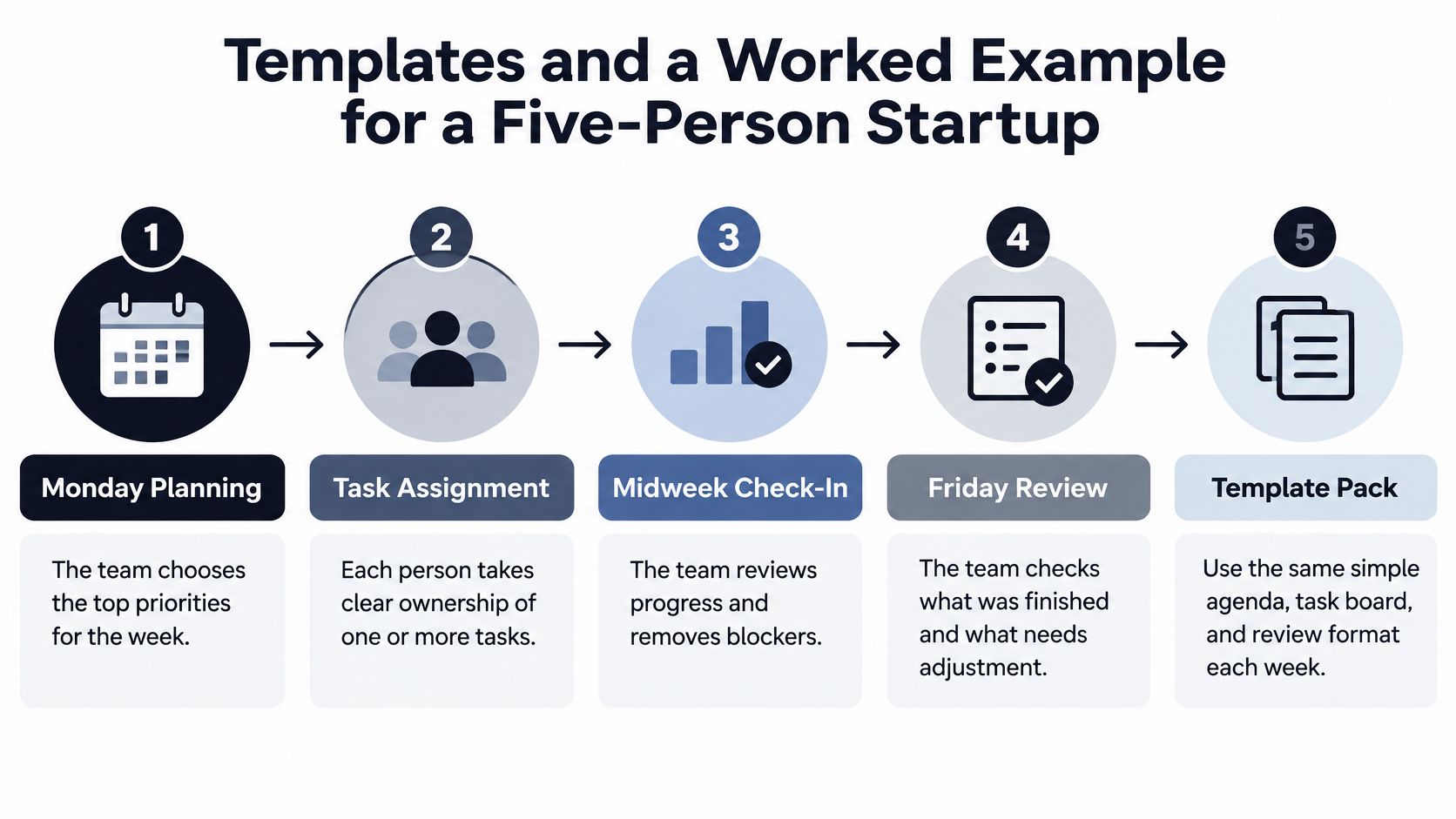
During planning, they choose to investigate a confusing onboarding step. The designer owns the interaction, an engineer owns implementation, and the product lead owns collecting customer evidence.
The weekly flow keeps execution connected to review.
### Preserve the reasoning and the unfinished work
Midweek, the implementation agent proposes replacing the onboarding flow. The engineer decides to test clearer guidance first, avoiding an unrelated account-state change.
They record the decision in a short, reusable format:
- **Context:** New users need clearer guidance after connecting their account.
- **Alternatives considered:** Replace the flow, add guidance, or investigate further before changing anything.
- **Decision:** Add guidance within the existing flow.
- **Consequences:** Keep account behavior unchanged; revisit structural changes if the guidance isn't sufficient.
- **Acceptance:** Record the human reviewer and whether the proposal is accepted.
When the session ends, the agent leaves a separate handoff:
- **Done:** Drafted guidance and added the interface change on the working branch.
- **Unfinished:** Accessibility review and customer validation remain open.
- **Next:** Ask the designer to inspect focus behavior before engineering review.
- **Tasks touched:** Reference the implementation task and documentation task.
- **Cautions:** Don't release while acceptance checks remain unresolved.
Keep both records brief enough to write before closing the session. Use fragments where they remain clear; move detailed test output into the task rather than pasting it into every handoff.
### Review delivery without rewarding instability
At the weekly review, the team examines **change lead time, deployment frequency, and change-failure rate**, drawn from the [DORA delivery-metrics framework](https://dora.dev/insights/dora-metrics-history/), alongside the customer evidence.
Their review template asks:
- **Customer result:** What did we observe, and does it meet the evidence threshold?
- **Flow:** Where did committed changes wait before deployment?
- **Release pattern:** Did we deliver small changes or accumulate a difficult batch?
- **Failures:** Which deployments required corrective action, and why?
- **Adjustment:** What specific practice should change next week?
DORA's findings associate AI adoption with reduced delivery stability, so the team shouldn't treat faster implementation as sufficient evidence of better delivery. That association isn't proof of causation.
> A useful review ends with a decision someone can carry out, not a judgment about whether everyone worked hard enough.
In this example, the team might discover that review availability, rather than coding capacity, limited delivery. The sensible adjustment is to change how work reaches review, not launch another agent session.
## Your Next Step to Start Managing Work This Week
Run a bounded experiment with your current workspace before attempting a full rollout. Choose an active project whose work is visible enough to inspect and important enough that the team will maintain it.
Write project rules in plain **always** and **never** language. These should settle recurring ambiguities, not repeat general aspirations such as being collaborative or writing good code.
### Start with rules people can apply
- **Always name the approver:** Make release and scope authority explicit.
- **Always preserve unfinished work:** Leave a session handoff before moving on.
- **Always escalate uncertainty:** Ask when requirements conflict instead of guessing.
- **Never treat generated output as approval:** Keep creation and acceptance distinct.
- **Never hide a blocker in chat:** Put the dependency where the team tracks the task.
Use the shared queue for the week and inspect the result at the next review. Don't judge the experiment by whether every field is filled in. Ask whether someone could resume interrupted work, whether reviewers knew what needed attention, and whether the team stopped work that no longer deserved investment.
### Add software when the manual work becomes the problem
If people understand the rules but keep spending time enforcing claims, assembling briefings, or tracing changes, test a tool against those specific jobs. If priorities are still unclear, another integration won't settle them.
Avoid expanding the process immediately after an awkward week. Identify what failed, make the smallest useful adjustment, and run the routine again. The process should help the team make better decisions with less reconstruction, regardless of which software holds the board.
---
Projectify offers a shared board for people and AI agents, with task claims, session briefings, handoffs, and attributed changes. Visit [Projectify](https://projectify.si) to try the free early access and test it on an active project with the AI assistants you already use. Keep the process small, and keep the software only if it makes coordination easier.