Multi Agent Systems Explained: Coordination and Protocols
You can feel the problem before anyone names it. Two Claude Code sessions are open, both reach for the same bug, both edit the same file, and both push with confidence. Nothing exploded, which is why the mistake is so easy to miss, the codebase just drifted into a wrong state.
That's the puzzle behind multi agent systems. The hard part isn't whether each agent can think, search, or write. The hard part is how they work together without colliding, losing context, or passing bad decisions forward as if they were facts.
That's why coordination has to be treated like a control-plane engineering problem, not an afterthought. Multi-agent coordination is the difference between parallel help and parallel damage, especially when several sessions, people, and tools are all touching the same project at once. The useful mental model here is simple, start with the primitives that keep work ordered, then add the protocols and guardrails that keep the whole system auditable.
Table of Contents
- When Two Smart Agents Step on Each Other
- What Counts as a Multi Agent System
- Why Coordination Breaks Down in Practice
- The Core Coordination Primitives
- Where MCP Fits in the Stack
- Choosing a Coordination Topology
- Governance, Attribution, and Least Privilege
- Putting It Together and Answering the Hard Questions
When Two Smart Agents Step on Each Other
A team thinks they're being efficient. One agent starts fixing a flaky lint rule, another opens the same file from a separate session, and both assume they own the task. By the time the second push lands, neither agent has done anything “wrong” in isolation, but the combined result is a mess that takes longer to unwind than the original bug.
That's the pattern people miss when they talk about AI help as if more sessions automatically means more output. The issue isn't raw capability, it's whether the work has a shared operating model. A system with two smart workers and no task ownership is just a faster way to create ambiguity.
The question worth asking
The right question isn't “how do agents think?” It's “how do agents know what to touch, what to leave alone, and when they're done?” Once that question is clear, the rest of the stack becomes easier to reason about, from task claims to shared state to handoffs and review.
Practical rule: if two agents can edit the same thing at the same time, you need a lease, a queue, or both.
That's the frame this article uses. It treats coordination as the core engineering problem, then walks through the primitives that make parallel work safe enough for real projects. The same ideas show up in distributed systems, in software teams, and in any workflow where multiple actors can make progress on the same objective without waiting in a single file line.
What Counts as a Multi Agent System
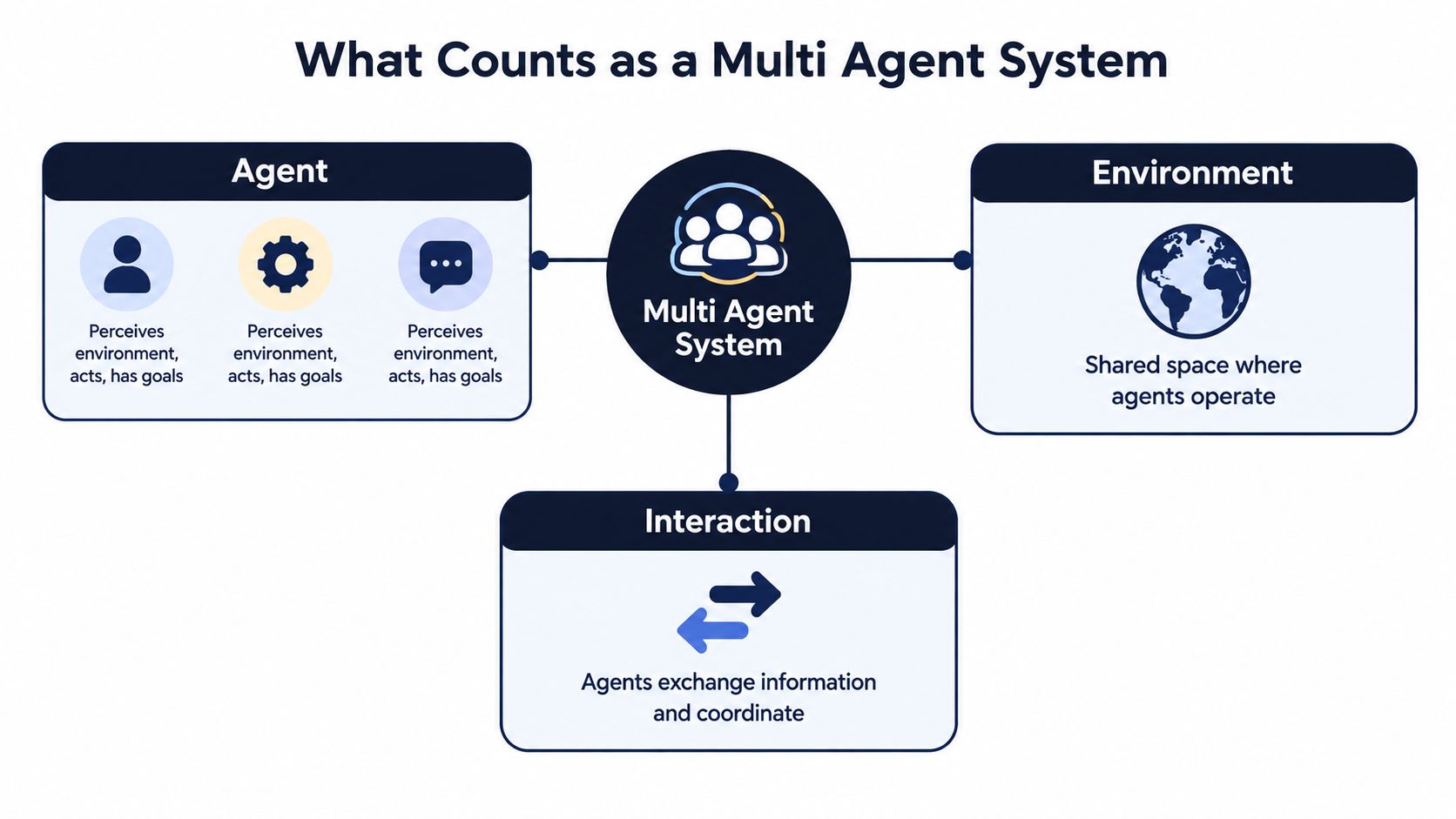
A multi agent system is a set of two or more agents operating in the same environment, where each agent has some autonomy, some goal, and some ability to affect shared work. An agent can be a human, a script, or an LLM session. The key point is that each one perceives something, decides something, and acts on something that may overlap with another agent's work.
A useful analogy is a kitchen brigade. Each cook owns a station, keeps private state in their mise en place, and still has to respect the timing of the pass. One person chops vegetables, another manages the grill, and another plates, but all of them share the same menu, the same order flow, and the same risk of stepping on each other when timing slips.
The four properties that matter
Every real multi-agent setup has to manage autonomy, interaction, decomposition, and attribution. Autonomy means each agent can move without asking for every tiny permission. Interaction means the agents exchange information. Decomposition means a large job gets split into smaller pieces that can be owned. Attribution means someone can later tell who changed what, and why.
That definition fits software agents cleanly. A coding agent reads a repo, edits files, calls tools, and depends on other sessions or humans for approval and context. A board that cannot express ownership, shared state, or traceable handoffs is not coordinating a system, it is just collecting chatter.
For teams already using tools like Projectify or other shared boards, see the overview on Projectify's blog, where the vocabulary matters because it keeps the discussion concrete. You are not asking whether an agent is smart enough. You are asking whether it has a station, a task, a handoff, and a record of responsibility. That is the level where coordination becomes visible.
Why Coordination Breaks Down in Practice
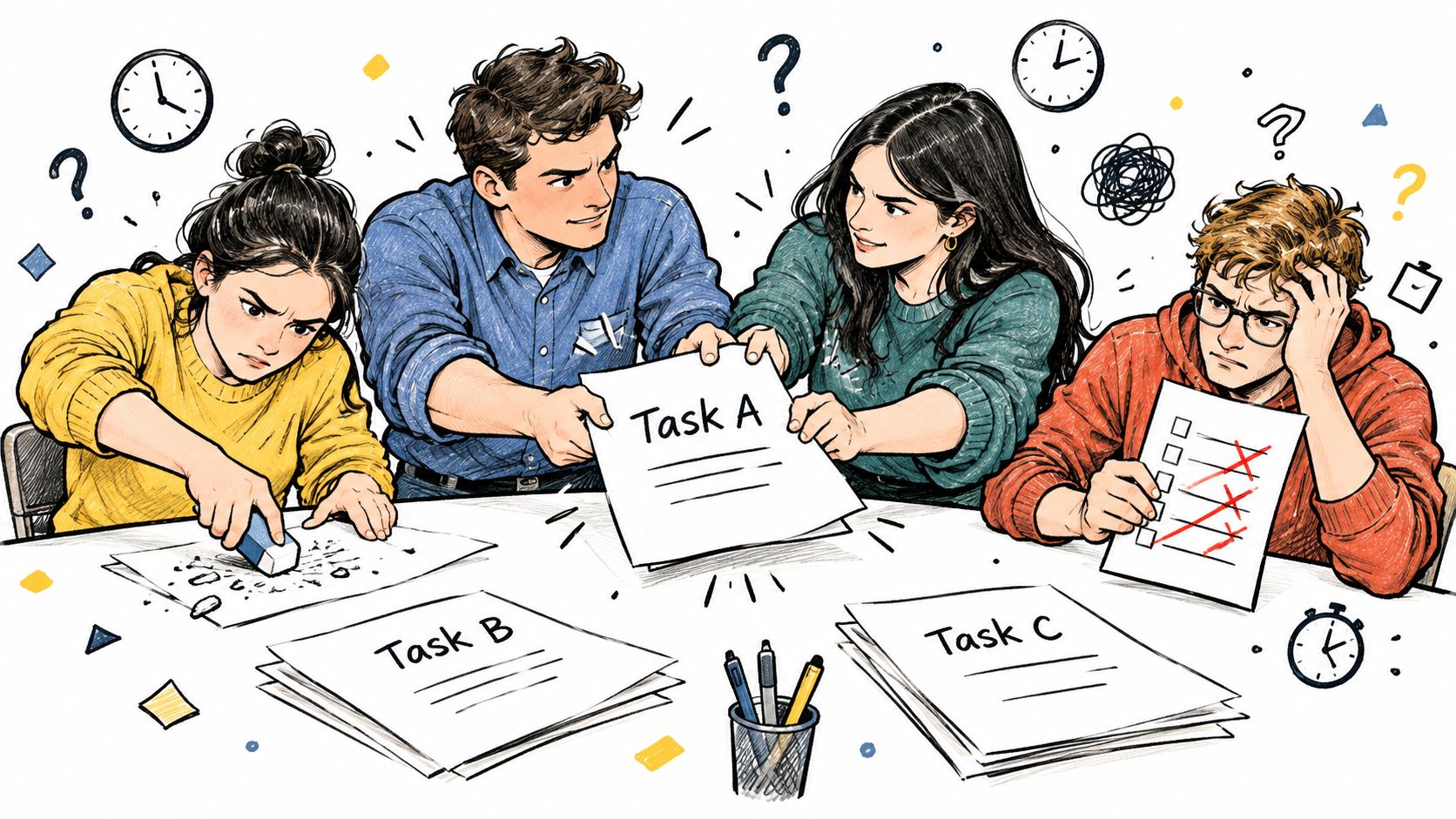
Most failures don't look dramatic. Two agents fix the same issue in parallel, then one overwrites the other's cleanup. A new session starts with a blank slate and re-discovers decisions that were already made last week. The code still builds, but the team spends time untangling duplicated effort and missing context.
The four failure modes teams hit first
Duplicate work happens when multiple agents solve the same problem because nobody assigned ownership clearly. In a codebase, that looks like two sessions both touching the same lint rule, both writing the same migration note, or both preparing the same PR fix. The output may even look fine until merge time.
Conflicting edits are worse because both agents think they're being helpful. One merges a refactor while another is still cleaning up a teammate's abandoned branch. A small rewrite can wipe out a careful change if the system never enforced exclusive mutation rights.
A kitchen can still serve plates when two cooks reach for the same pan. The food just gets slower, messier, and harder to trust.
Cold starts happen when every session has to re-learn the project from scratch. If the project brief, rules, and current state live only in chat history, then each new agent spends its first minutes rebuilding context instead of doing useful work.
Lost context is the quietest failure. A schema changes, a decision gets made in a side conversation, and the next session never sees the rationale. Months later, someone asks why the change happened, and the only answer is a thread nobody wants to read again.
That's why coordination isn't just a UX problem. In production, the failure is structural. The team isn't missing intelligence, it's missing a shared mechanism for ownership, state, and transition between sessions.
See the same pattern in the common questions teams ask on Projectify's FAQ page, especially when several agents are already active on the same project.
The Core Coordination Primitives
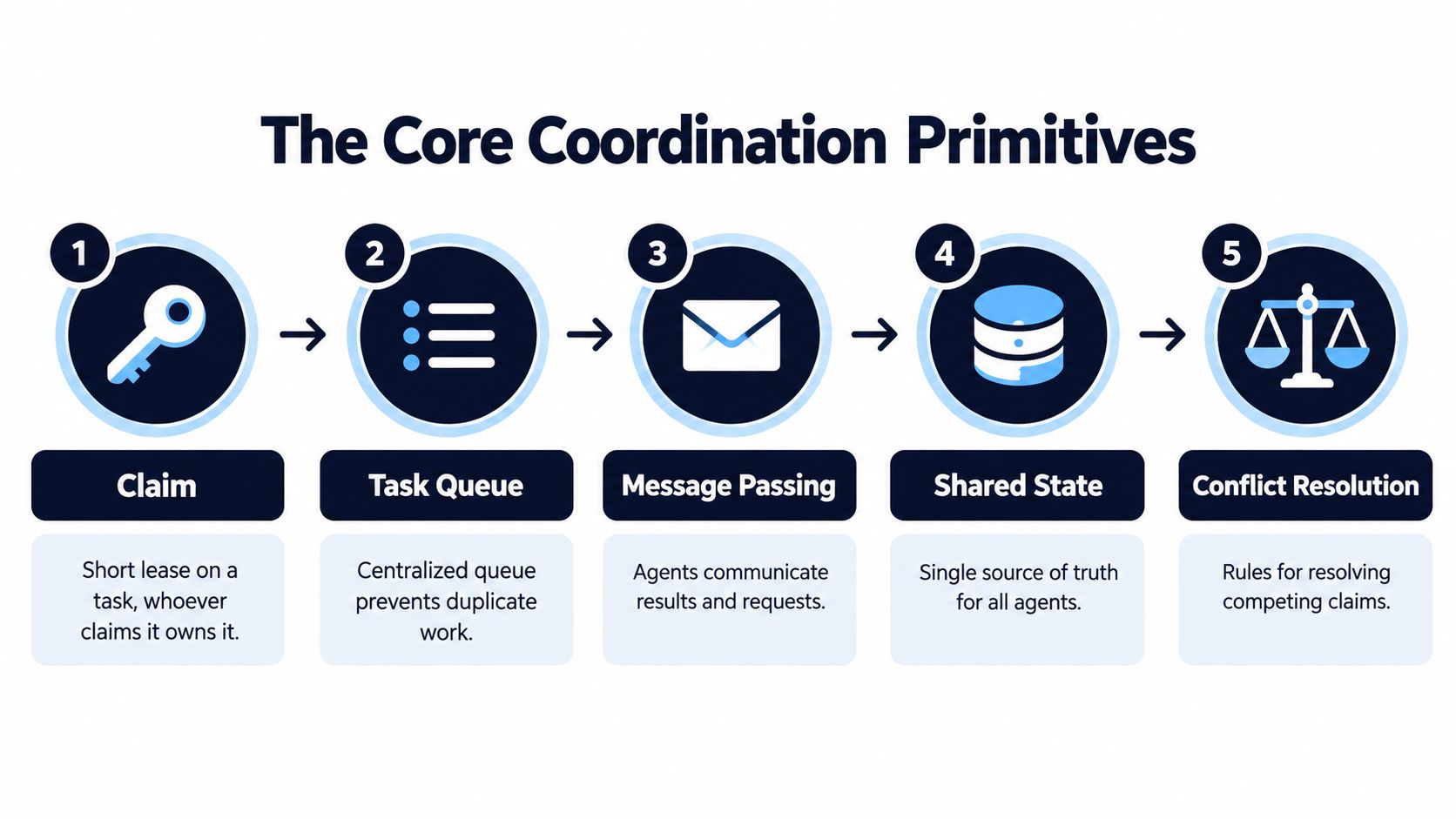
The fix starts with a few primitives that make the system legible. Think of them as the control plane for a team of humans and agents. They don't do the work for you, but they decide who may work, what they may touch, and what the next actor needs to know.
Claim, queue, briefing, rules, handoff
A claim is a short lease on a task. Whoever holds it is the only one allowed to mutate that task, and the lease should expire if the worker goes quiet so the system doesn't deadlock. That one rule alone removes a huge amount of accidental overlap.
A start-next queue is the ordered source of truth for what gets picked up next. It hands out unclaimed, unblocked work, so agents don't race each other to “grab” the same thing. The point is not speed for its own sake, it's predictable ownership.
A briefing is what every new session reads first. It should include the project brief, the rules, the current state, and the latest handoff. Without that, every new agent starts cold and spends time rediscovering the obvious.
Project rules are the persistent “always” and “never” instructions that sit above the agent's defaults. If a rule says a client scope change needs review, that rule should outlive the session that wrote it. A model's casual tendency is not a policy.
A handoff is the structured end-of-session record. It should say what was done, what's unfinished, and what's next, so the next person or agent starts from the last real state rather than from memory. That's how work stays continuous even when the actor changes.
How the pieces fit
Used together, the primitives form a layered protocol. The queue decides what's ready. The claim decides who owns it. The briefing gives the next session context. The rules constrain behavior. The handoff preserves continuity.
That's more useful than vague advice about “better prompts” because it changes the shape of the system. It stops agents from guessing who should act next, and it removes the need for every session to reconstruct the project from memory. The control plane becomes visible, which means it can be debugged.
Where MCP Fits in the Stack
The Model Context Protocol is best understood as the shared transport and capability layer, not as the whole coordination story. It standardizes how an agent client connects to a tool or data source and what it's allowed to call. That makes it possible for Claude Code, a desktop client, or a CI script to reach the same project state through a common interface.
The socket-and-plug analogy works here. MCP is the plug. Coordination is the dispatch board on the wall. One lets the client connect cleanly, the other decides what work gets handed out, who owns it, and what gets recorded at the end.
Why transport is not enough
If every session talks to the same project through MCP, you can authenticate, read shared state, claim tasks, and write handoffs through one path instead of scattering context across private notes. That's a big step forward, but it still doesn't answer the operational questions. Who gets the next task? What happens when two sessions want the same one? What does a reviewer need to see before approving a change?
That's why the primitives above still matter. MCP makes the board reachable. Claims, queues, briefings, and handoffs make the board usable.
The distinction matters in teams because people often treat integration as if it solves coordination by itself. It doesn't. A shared transport can connect every agent to the same room, but someone still has to run the room, enforce ownership, and preserve traceability when work moves from one session to another.
Shared access is not shared agreement. Without ownership and rules, you've just connected more actors to the same confusion.
Choosing a Coordination Topology
Once the primitives are in place, the next choice is how the agents are wired together. That isn't an aesthetic decision, it's a dependency decision. Different workflows need different shapes, and the wrong shape creates either bottlenecks or cascades.
| Topology | Best for | Main risk | Best when |
|---|---|---|---|
| Star | Clear routing and simple oversight | The coordinator becomes the bottleneck | One role can dispatch and validate work cleanly |
| Chain | Sequential pipelines | Early errors flow downstream | Each step depends tightly on the previous one |
| Graph | Cross-dependent work with shared state | Harder debugging and more coordination overhead | Several agents need to collaborate laterally |
A star shape works when one coordinator can route everything and keep the rules straight. It's easy to govern, and it gives you a natural validation point. The tradeoff is obvious, the center can become a choke point if too much decision-making lands there.
A chain is the right fit for pipelines. One agent hands output to the next, and the context moves in a straight line. That's efficient for ordered work, but a mistake near the front can contaminate the rest of the chain before anyone notices.
A graph is stronger when tasks overlap and share state. Agents can coordinate laterally, which is helpful when the work has cross-dependencies. It's harder to debug than a simple star, but it matches complex collaboration better.
MultiAgentBench reported that graph coordination performed best in the research scenario, and cognitive planning improved milestone achievement by 3% in the benchmark results. That doesn't mean every team should default to a graph, only that topology should follow dependency structure, not habit.
Governance, Attribution, and Least Privilege
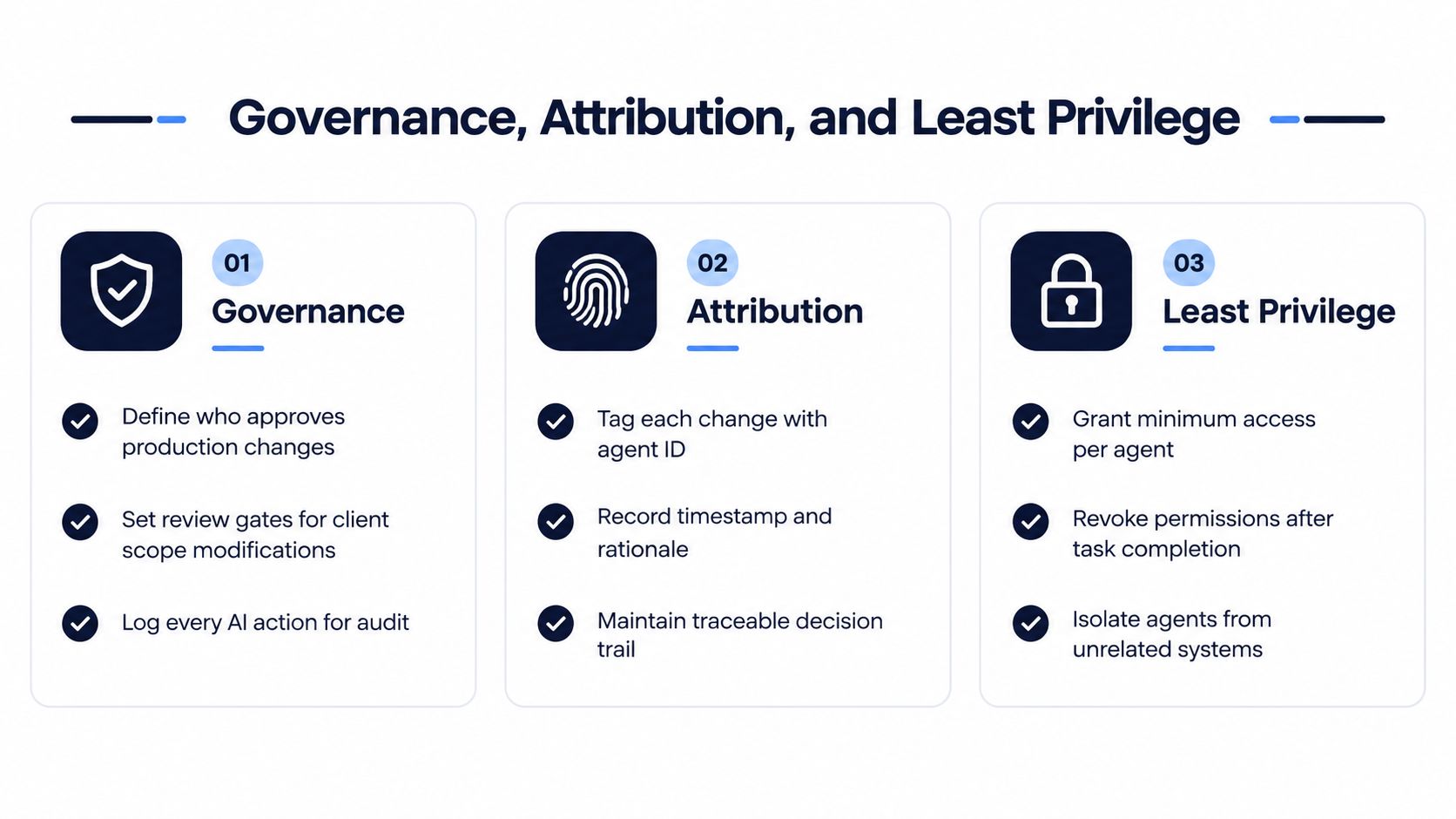
Coordination keeps agents from colliding. Governance keeps the team from being blindsided after the fact. The uncomfortable question is simple, when an AI changes production code, client scope, or a deliverable, can you reconstruct who authorized it, which agent acted, what context it used, and who approved the outcome?
The checklist that makes the answer yes
- Delegated identity: every agent acts for a named human, not as an anonymous process.
- Attribution on every change: each update carries the person and the agent that made it.
- Least privilege: the agent only gets the access needed for the task in front of it.
- Approval gates: high-impact actions pause for human review.
- Immutable records: the activity trail can't be rewritten after the fact.
The reason this matters is visible in enterprise adoption. 82% of organizations already use AI agents, but only 44% report policies to secure them, 72% consider agents a greater risk than machine identities, and 23% say an agent has been tricked into revealing access credentials, with chained vulnerabilities letting one compromised agent pass instructions or privileges to others according to SailPoint's AI agent adoption report. That's a governance problem as much as a security problem.
A solo-friendly local setup often skips these controls because one person can keep everything in their head. That falls apart the moment more than one human and more than one agent share a project. A team-ready board needs roles, permissions, review, and attribution, not just a place to drop tasks.
For a privacy-sensitive workflow, Projectify's privacy page is the right model to study because it shows how teams think about access, records, and traceability together.
Putting It Together and Answering the Hard Questions
The practical stack is straightforward. Every session reads a briefing first. Project rules sit above model defaults. Claims make ownership enforceable. A start-next queue hands out unblocked work. Every session writes a handoff. Every change is attributed to a named person and the agent that performed it.
The questions that usually come next are the right ones. When should agents run in parallel? Only when the work is decomposable, not because “more agents” sounds productive. How do you keep capable agents from doing conflicting work? Use claims, a ranked ready queue, and verified handoffs. How do you prove who authorized what? Use delegated identity, immutable activity, least privilege, and explicit approval for high-impact changes.
That's the same playbook serious teams need whether they're shipping code, reviewing content, or managing multiple client projects at once. The tool matters less than the discipline behind it.
Projectify gives small teams a shared board for people and AI agents, with claims, briefings, handoffs, and full attribution built in so sessions don't collide or start cold. If you're coordinating several agent sessions and want one place for ownership, context, and audit trails, visit Projectify and see how the workflow fits your team.
Give your AIs a desk.
One board for your team and Claude. Free for your first project.
Request access