Blog ai agent workflow automation AI orchestration multi-agent coordination
AI Agent Workflow Automation Patterns and Examples
Learn AI agent workflow automation with orchestration patterns, task claims, Start next, reliable handoffs, and practical integration examples.
You've opened several agent sessions to clear the backlog. One is fixing a bug, another is updating documentation, and another is drafting a specification. Everything looks productive until you discover that separate sessions picked the same task, changed a shared file, or made incompatible assumptions about a decision buried in yesterday's chat.
The difficult part of AI agent workflow automation isn't getting an agent to act. It's making sure the right agent acts on current information, within its permissions, and leaves behind work that someone else can verify and continue.
Why AI Agent Automation Creates Coordination Problems
Consider a small engineering team running coding and drafting agents alongside normal development. Each session reads the backlog and chooses something useful. Nobody explicitly assigns ownership because the tasks look independent.
Then a documentation agent updates an interface description while a coding agent changes that interface. Another session sees the original bug still marked open and starts its own fix. A developer now has to compare patches, reconstruct decisions, and decide which work to discard.
The visible failure looks like an overwrite. The underlying failure is uncoordinated access to shared work.
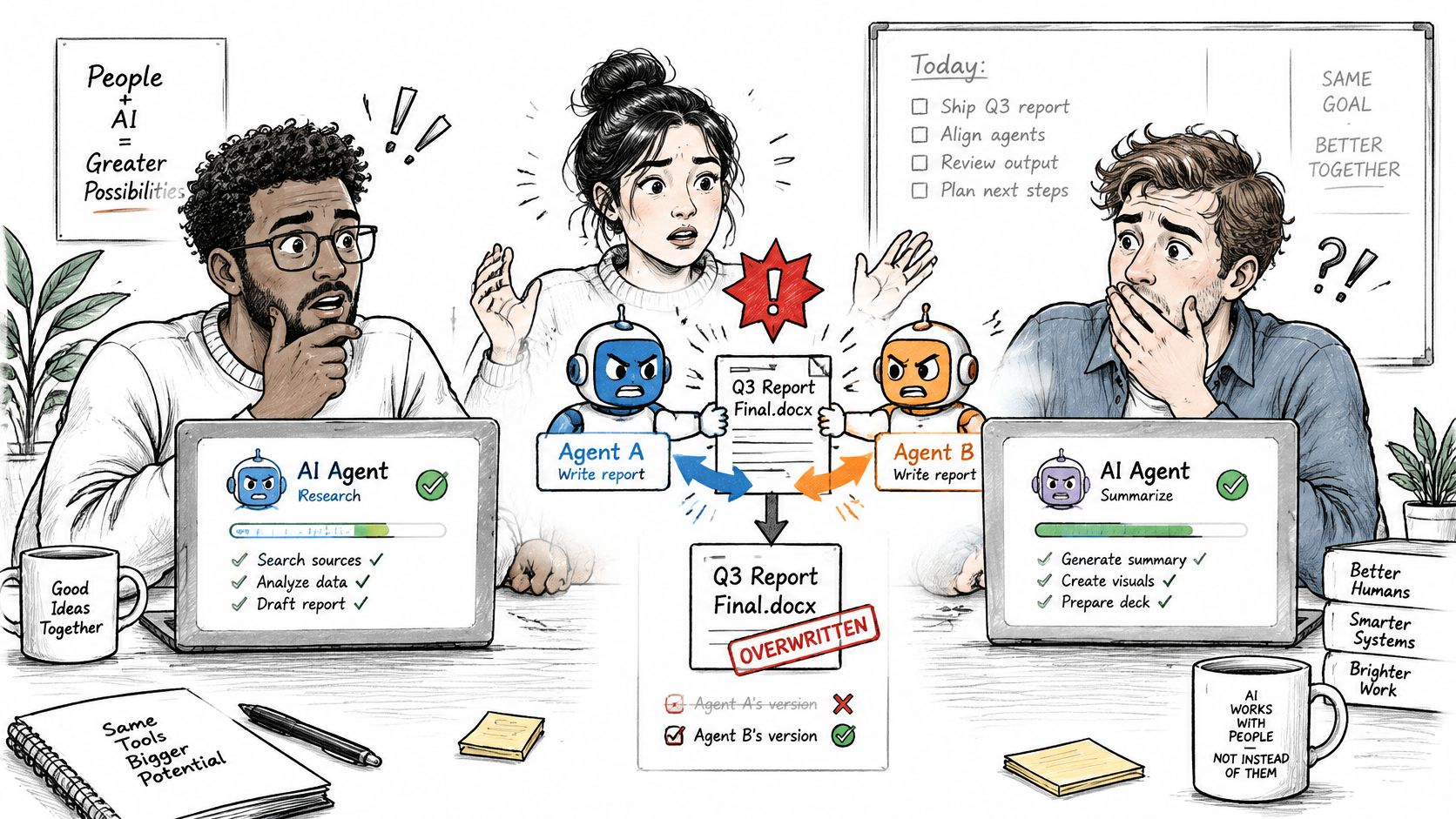
Apparent parallelism versus usable progress
These are representative failure scenarios, not evidence that parallel agents are ineffective. They expose the questions a workflow must answer before execution begins:
- Ownership: Who currently has permission to advance this task?
- State: What changed since the agent last read it?
- Decisions: Which assumptions have a person approved?
- Accountability: Who requested the action, and which session performed it?
Giving agents more detailed prompts doesn't enforce those boundaries. An instruction to avoid duplicate work isn't equivalent to an exclusive task claim.
Practical rule: If separate sessions can independently decide they own the same work, coordination is still manual, even when execution is automated.
The adoption context makes this distinction important. In McKinsey's 2025 State of AI survey, 62% of respondents reported at least experimenting with agents, but only 23% reported scaling an agentic system in a business function, and no individual function exceeded 10%.
For a small team, the practical requirement is therefore narrower than unrestricted autonomy: agents must claim work, expose blockers, preserve decisions, and demonstrate that the requested change happened.
Understanding Agentic Workflow Automation
AI agent workflow automation combines goal-directed planning with tools, relevant context, permissions, and a completion condition. The agent doesn't just describe what someone should do. It can choose and execute actions toward a bounded outcome.
A response-generating assistant might explain how to investigate a failing test. An agentic workflow could inspect the failure, retrieve relevant project guidance, prepare a change, run permitted checks, and submit evidence for review. That example describes a workflow design, not a guarantee that any particular agent can complete it reliably.
The essential components fit into a control loop.
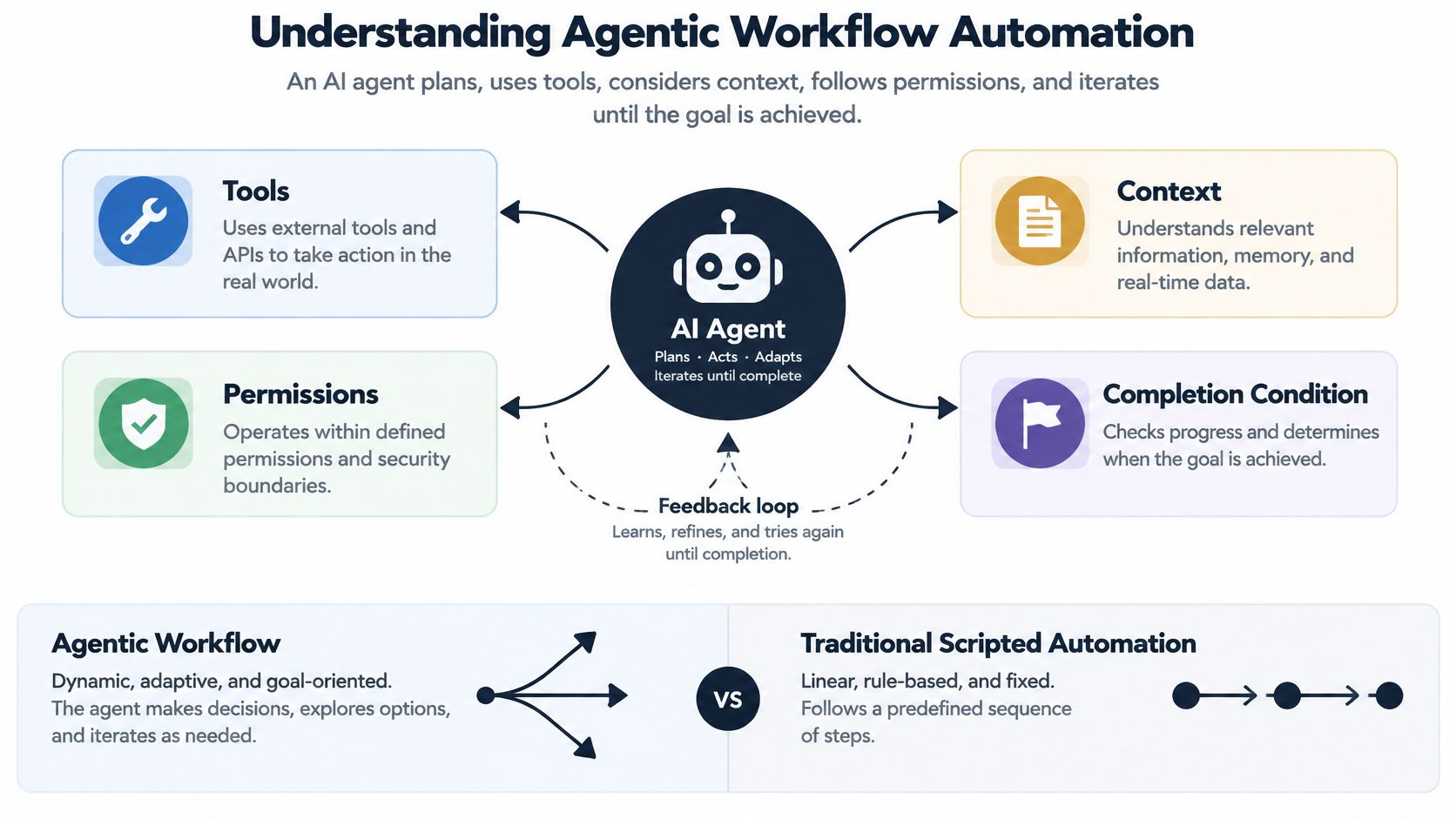
Separate reasoning from execution authority
McKinsey's analysis of the agentic AI opportunity distinguishes agents through their combination of autonomy, planning, memory, and integration across systems. It also argues for redesigning workflows and human roles rather than inserting agents into unchanged procedures.
That distinction matters operationally. A model can propose an appropriate action while the surrounding system remains responsible for deciding whether that action is allowed.
Use explicit control surfaces:
- Bounded task: Describe the intended change and what falls outside scope.
- Current state: Supply authoritative records, not just remembered conversation.
- Exclusive ownership: Establish who may advance the work.
- Permitted mutations: Restrict tools and actions to the task's authority.
- Verification: Define evidence that demonstrates completion.
- Handoff: Preserve enough information for the next responsible actor.
Autonomy should vary within the workflow
A documentation agent might prepare a draft without approval but require a person to authorize publication. A coding agent might investigate an issue freely while escalating a proposed change to a shared contract.
The approval boundary should follow consequence and reversibility, not whether the actor is called an agent. Preparing a recommendation and committing an irreversible business action deserve different controls.
Traditional scripted automation remains useful inside this design. Keep predictable operations deterministic, and reserve model reasoning for ambiguity, interpretation, and choosing among permitted paths. Dependability comes from combining those capabilities, not asking the model to rediscover every procedure during every run.
Free for one person. No card. Connected in a minute.
Choosing an Orchestration Pattern
Choose orchestration by inspecting dependencies and the cost of correction. Separate documentation drafts may tolerate parallel execution. A specification change that determines implementation behavior may need ordered review before anyone writes code.
The control-flow comparison below is a starting point, not a universal ranking of safety.
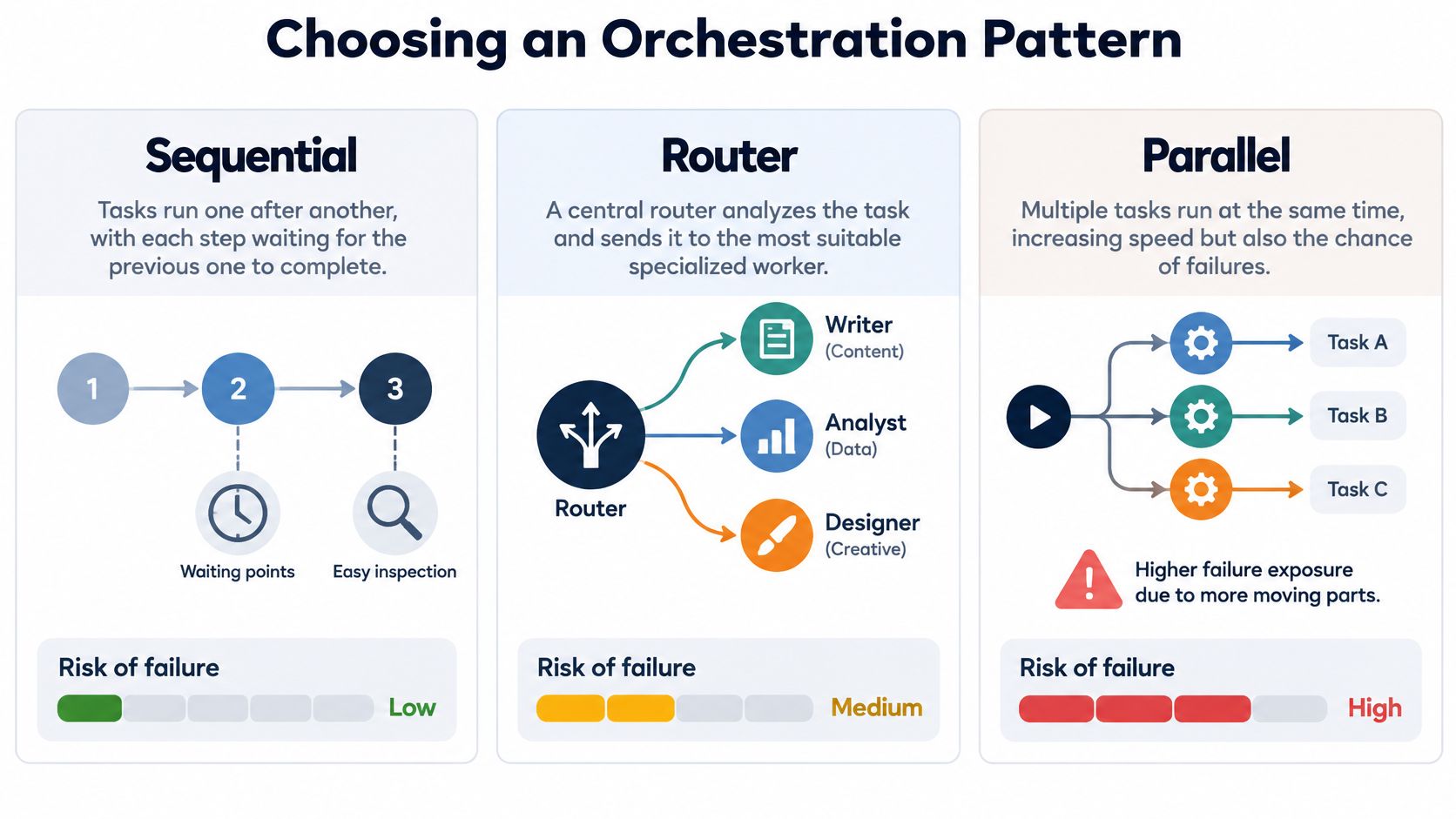
Sequential work and routed work
In a sequential workflow, each stage consumes an accepted result from the previous stage. For example, approve a specification, implement it, then review the implementation against the approved behavior.
This is straightforward to inspect because the handoff points are visible. The trade-off is waiting: downstream agents can't safely proceed while an upstream decision remains unresolved. Don't disguise speculative implementation as completed work just to keep every session busy.
A router classifies incoming work and sends it to a suitable specialist. A bug intake workflow might distinguish documentation problems from implementation defects, then send ambiguous reports to a person.
Routing concentrates responsibility in the dispatcher. Give it an explicit fallback for uncertain classification, and preserve the original request so a specialist can challenge the assignment without losing context.
Parallel execution and approval boundaries
Parallel agents fit work with separable outputs, such as drafting different documentation pages. Shared terminology, navigation, and interface definitions still need an owner. Separate task titles don't prove that the underlying resources are independent.
For practical examples of session boundaries, see this guide to running several Claude Code agents. The useful question is where sessions can proceed independently and where they must synchronize.
Human-in-the-loop orchestration places approval at a consequential transition. An agent can gather evidence and propose a specification decision, while a person accepts the choice before dependent work becomes eligible.
Use these selection criteria:
- Dependencies: Can workers finish without waiting for another worker's output?
- Context: Does each specialist receive enough information to act correctly?
- Correction cost: Can a mistaken action be reversed cleanly?
- Judgment: Does the transition require business authority rather than technical execution?
This video provides an additional orchestration reference.
A practical implementation can combine these patterns: route an incoming request, run independent investigations in parallel, then require approval before ordered execution. Orchestration doesn't remove complexity. It determines where the team must manage it.
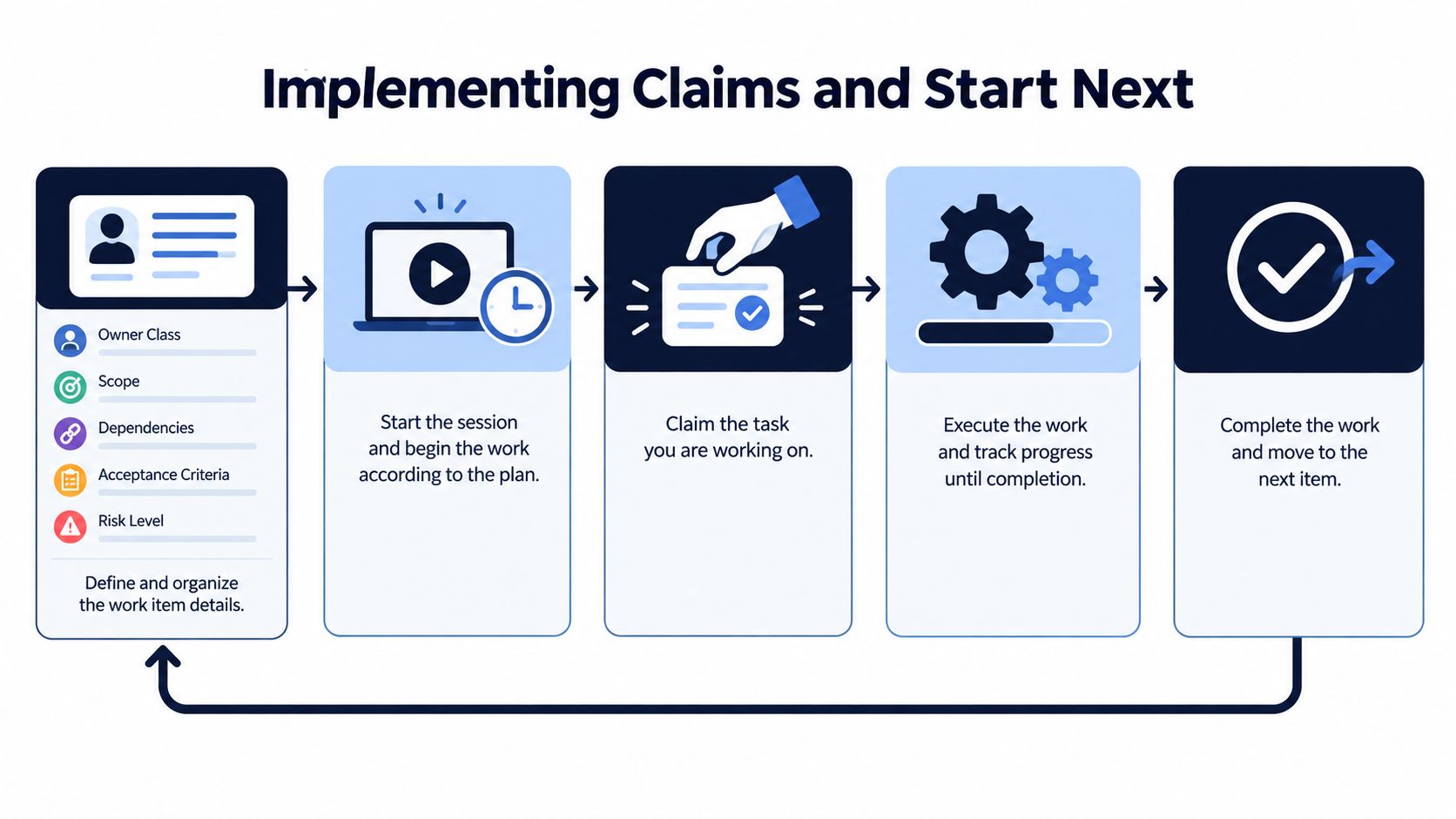
Implementing Claims and Start Next
Start with a work item precise enough that a different session could finish it without asking what “done” means. Record the owner class, scope, dependencies, acceptance criteria, and risk level.
For a bug fix, acceptance criteria should describe the expected behavior and relevant regression checks. “Investigate and fix” leaves too much room for an agent to stop after producing a plausible explanation.
Acquire ownership before changing work
A claim is a lease on a task, not a permanent assignment. The session must acquire it before advancing the task, and the acquisition must be atomic so competing sessions can't both succeed.
Let activity renew the lease and let inactivity eventually release it. The exact expiry policy should match the environment, but the safety property matters more: an expired holder must not regain write authority merely by resuming an old conversation.
Before a mutation, require the worker to confirm that its claim remains valid and reread the relevant state. For shared artifacts, task ownership alone isn't sufficient. Add resource-level controls, such as isolated branches, version checks, or explicit ownership of a shared document.
The implementation flow should make these boundaries visible.
Pull eligible work through Start next
Start next should select the highest-ranked task that is both free and unblocked, then acquire ownership as part of the same operation. Returning a candidate and claiming it later creates another race.
People and agents should pull from that shared queue rather than maintaining separate interpretations of priority. If nothing is eligible, return the reason: unresolved dependency, pending approval, or work already claimed.
Deliver a briefing before execution. Include project rules, relevant locations, current assignments, open work, and the latest handoff. Keep durable instructions separate from session commentary so a fresh agent can distinguish policy from an earlier worker's suggestion.
A useful briefing explains not just what to do, but which decisions the worker isn't authorized to reopen.
Execute, verify, and leave an attributable handoff
Before each action, validate required inputs and tool arguments. Use idempotent mutations where possible so retrying a request doesn't create duplicate changes, and make recovery conditional on the observed state.
Research on hazardous tool-use environments identifies specification drift, invocation error, execution failure, output drift, and cross-source conflict as distinct failure classes. Its practical implication is to design detection, bounded retries, alternative paths, and escalation rather than treating every failure as a reason to call the same tool again.
Finish with an activity record tied to the responsible person and executing session. The handoff should contain:
- Completed work: Actions taken and evidence checked.
- Unresolved issues: Blockers, uncertainty, and pending approvals.
- Touched resources: Tasks, artifacts, and shared files changed.
- Next safe action: What another worker can do without reconstructing the session.
Release ownership only after that record is durable.
Selecting a Coordination Model
A central orchestrator isn't automatically necessary just because several agents are active. Distinguish choosing work from enforcing ownership: a dispatcher can assign tasks badly, and peer workers can coordinate safely if the shared protocol is strong.
Research on coordination challenges in multi-agent systems identifies limitations in static structures as task complexity and agent counts grow. The engineering question is how much coordination machinery your actual workload needs.
Coordination Model Decision Criteria
| Coordination Model | Work Assignment | Collision Control | Best Fit |
|---|---|---|---|
| Centralized orchestrator | Dispatcher selects across queues | Shared claims plus dispatcher policy | Cross-project priorities and dependencies |
| Peer coordination | Workers pull eligible tasks | Atomic claims and shared state | Small teams with a common backlog |
| File-based board | Workers inspect shared records | Requires locking or version checks | Local workflows with limited concurrency |
| Manual dispatch | Person assigns each task | Human oversight plus explicit ownership | Irregular or approval-heavy work |
Choose by operational burden
A central orchestrator is useful when someone must reconcile priorities across projects, route specialized work, or surface stalled queues. Its cost is maintaining dispatcher policy, context freshness, and recovery when the dispatcher itself becomes unavailable.
Peer coordination keeps assignment simpler. Workers request eligible tasks and follow a shared protocol, but the team still needs a clear place for approvals and exceptions. This overview of multi-agent systems provides additional context for distinguishing collaboration structure from execution controls.
File-based boards can make state easy to inspect, but they don't automatically enforce leases or prevent concurrent edits. Manual dispatch can be appropriate when judgment dominates, provided assignments and handoffs don't disappear into private chats.
Use practical decision rules:
- Low-risk parallel drafting: Prefer independent outputs and a lightweight shared queue.
- Interdependent engineering: Make dependency status and shared-resource ownership explicit.
- Approval-heavy processes: Prioritize a visible human queue over autonomous routing.
When synchronizing an external board, keep disagreements visible on the task. A conflict between client-side status and internal execution state requires resolution, not a silent last-write-wins update.
Begin with the smallest protocol that enforces one owner, exposes blocked work, and preserves handoffs. Add a central coordinator when the team can identify a specific assignment problem it will solve.
Connecting Agents to Project Work
Treat the integration boundary as an authorization decision, not merely a successful connection. An agent needs access to the correct project, enough context to work, and no more authority than the responsible person should have.
A Claude Code session, a desktop conversation, and a CI job also have different identity and credential requirements. Don't force them through an interchangeable shared credential just because they operate on the same board.
Connect interactive sessions and unattended jobs differently
For Claude Code, use the provider's documented claude mcp add setup and complete browser approval where supported. The command name alone isn't a complete configuration: use the published transport and server details rather than guessing an endpoint.
The Claude Code MCP connection guide describes the relevant setup path. In the browser-approved connection described there, an API key isn't needed.
For Claude Desktop or a browser-based assistant that supports custom connectors, add the connector and approve access through its authorization flow. Check which person the connection represents before letting it change shared work.
For scripts and CI, use an API key where the integration supports it, with deliberate credential storage and revocation. A background job should have an identifiable owner, not an unexplained token that outlives the person who created it.
- Identity check: Confirm the person and agent recorded for a change.
- Permission check: Test that prohibited actions are rejected.
- Context check: Verify that the session receives the intended project's rules and records.
- Capability check: Distinguish read access from supported write operations.
Walk a project through the integration
Consider an implementation task and a separate documentation task. A cross-project orchestrator can identify which work is ready, while each worker still uses Start next and a task claim to establish ownership.
The coding session receives the approved behavior and testing guidance. The drafting session receives the documentation scope and relevant decisions. If the coding investigation reveals that the agreed behavior needs to change, the worker should propose a decision and block dependent work instead of rewriting the specification.
At the end, each session records its own actions and handoff. The responsible person can then inspect agent work without inferring identity from writing style or chat timestamps.
For client projects using Trello or Azure DevOps, a supported two-way synchronization arrangement can preserve the client's existing board. Keep synchronization conflicts attached to the affected task so the person reviewing it sees both the execution result and unresolved disagreement.
Don't infer broader tool capabilities from that connection. Reading a design file, retrieving repository context, and changing an external system are separate permissions and separate integration features.
Build a Reliable Automation Operating Loop
A workflow isn't dependable because an agent completed a convincing demonstration. It needs to tolerate repeated execution, slightly different inputs, stale assumptions, and recoverable tool failures without losing ownership or exceeding authority.
ReliabilityBench reports that a system with 96.9% pass@1 in an unperturbed setting fell to 88.1% under task perturbation at ε=0.2, an 8.8-percentage-point decline. That is evidence from a specific evaluation, not a forecast for your deployment, but it demonstrates why a clean demonstration isn't enough.
Inspect the execution, not just the answer
Use an operating checklist that covers both outcome and conduct:
- Scope: The worker stayed within the accepted task boundary.
- Authority: Ownership and permissions were valid when changes occurred.
- Freshness: The worker checked relevant current state before acting.
- Tool use: Arguments matched permitted schemas and preconditions.
- Verification: Domain-specific checks confirmed the desired result.
- Recovery: Retries were bounded and unsafe ambiguity triggered escalation.
- Continuity: Activity attribution and a usable handoff survived the session.
An API success response confirms that a request was accepted or processed under that API's semantics. It doesn't necessarily establish that the business requirement is satisfied. Read back the result, run the relevant assertions, and check that related state remains consistent.
Measure where humans still repair the workflow
Track collision rate, duplicate work, blocked-task duration, handoff completeness, unauthorized changes, and human interventions. For execution quality, separate single-run success from repeated-run consistency, and distinguish tool-call correctness from final task completion.
Record the full execution trace: retrieved context, selected tools, arguments, action ordering, intermediate checks, and final state. When a run fails, that record lets the team distinguish a planning mistake from stale data, invalid arguments, or a broken integration.
Key takeaway: Guardrailed autonomy means automating routine execution while reserving human judgment for approvals, exceptions, irreversible actions, and conflicting outputs.
Select a bounded workflow with a clear acceptance test. Establish claims and Start next, instrument the initial run, and inspect the trace with the person who normally performs the work.
Expand only when the team can explain failures, recover safely, and trust the handoff. Adding agents before those controls work gives the team more concurrent activity, not necessarily more completed work.
Projectify offers a shared task board for people and agents, with claims, Start next, session briefings, attributable activity, and structured handoffs. Visit Projectify to connect your existing assistants and try a bounded workflow before expanding parallel execution.