Blog AI project management AI agents multi-agent coordination
AI Project Management: What It Is and How to Adopt It
AI project management explained: how briefings, claims and handoffs keep AI agents coordinated, with risks, metrics and a pilot plan.
You open the project board and find two assistants editing the same specification. A developer has already fixed the bug an agent just picked up, and yesterday's architectural decision is buried in a chat nobody else can see. Everyone's working, but you're spending more time untangling the work than moving it forward.
That's the practical challenge of AI project management. Faster drafting and coding don't help much if people and agents can't tell what's current, what's authorized, and who owns the next change.
What AI Project Management Means Today
AI project management is planning, tracking, and coordinating work when AI assistants and people share tasks, owners, and deadlines. It includes familiar activities such as drafting status reports, but becomes a different operating problem once agents can pick up work and change shared records.
Say a developer asks an assistant to revise an API specification while a product manager asks another assistant to update its acceptance criteria. Both outputs might be reasonable. Without shared ownership and current decisions, they can still contradict each other.
The distinction isn't whether a team uses AI. It's how much authority the AI has, and how the team coordinates that authority.
Three levels of AI project management
| Level | What the AI Does | What People Still Own | Typical Example |
|---|---|---|---|
| AI-assisted tracking | Summarizes status and drafts tasks | Owns priorities, assignments and deadlines | Meeting summaries turned into draft tasks |
| Agent-operated board | Reads and updates tasks on request | Sets scope and reviews every output | One agent working through a backlog in order |
| Coordinated agent work | Claims tasks, follows rules and hands off between sessions | Approves scope, accepts decisions and watches metrics | Several agents on one project without overwriting each other |
These are useful operating levels, not a requirement to automate everything. A team that only needs reporting support may be well served by assisted tracking. A team running coding agents concurrently needs stronger coordination.
The scale of workplace adoption makes that distinction relevant: Microsoft and LinkedIn's 2024 Work Trend Index found that 75% of surveyed knowledge workers worldwide used generative AI at work, including 65% in Europe and 83% in Asia-Pacific. Several assistants may already contribute to a project without sharing its context.
Think of a kitchen. Each cook has a station, but the order rail helps them avoid preparing the same dish twice. AI project management provides that shared order rail for people and agents.
The board therefore needs more than a status column. It needs a reliable record of ownership, authorization, dependencies, and recent changes.
Find your team's current level before choosing more automation. What would let you safely move up a level: better task definitions, controlled write access, or coordination between sessions? Sometimes the right answer is to improve the current level rather than advance.
Briefings, Claims and Handoffs Explained
An agent can produce useful work and still leave the project harder to manage. Coordination requires a way to enter the project with current context, reserve work, and leave enough information for someone else to continue.
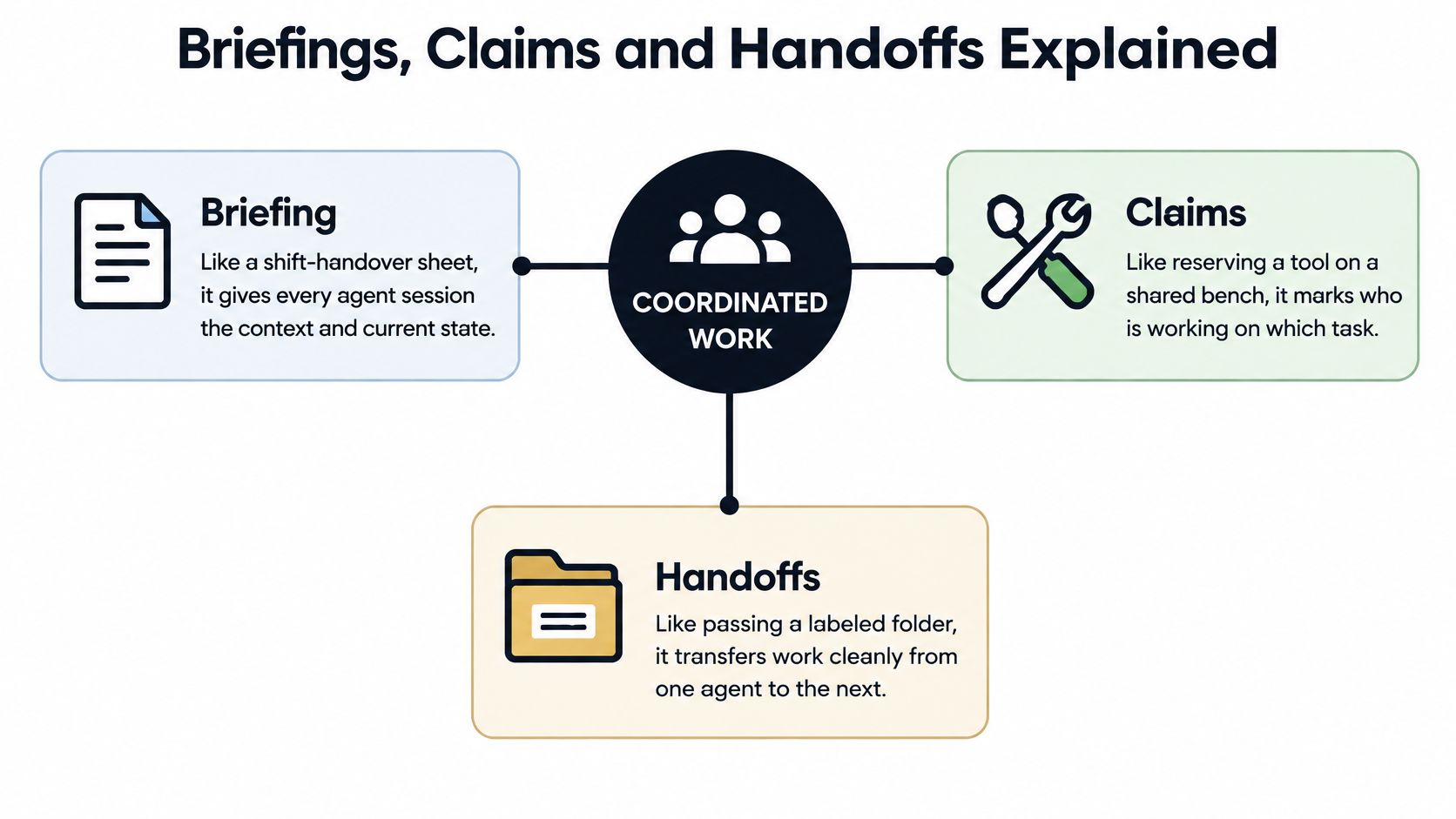
The relationship between those mechanisms should be visible, not hidden inside individual conversations.
Start with a briefing
A briefing works like a shift-handover sheet. It gives the incoming session the project purpose, standing rules, file locations, active owners, open tasks, and latest handoff.
Keep it operational. An agent investigating a checkout bug needs the relevant repository, reproduction steps, current restrictions, and any unfinished investigation. It doesn't need an unfiltered transcript of every project conversation.
Put project rules first. These are lasting always-or-never instructions, such as always running the relevant tests before requesting review or never changing a public interface without approval.
Include accepted decisions separately from suggestions. A useful decision record explains the context, alternatives considered, and consequences, so the next session doesn't reopen a settled question without a reason.
Claim before changing work
A claim resembles checking out a library book: another actor can see who holds it and must wait or request a handoff. The claim should identify the holder and last activity, with successful authorized actions renewing its lease.
A claim is a lease, not a lock. It must expire when its holder disappears, and an expired holder must reacquire permission before writing again.
Choose an inactivity window that matches the workflow. Don't treat a quiet agent as proof that its work is safely abandoned: check for uncommitted changes before reassigning the task.
Enforce claims in the write path where possible. A label saying someone owns a task won't prevent a second session from changing it if the underlying tools ignore ownership.
Leave a handoff someone can use
A handoff is an end-of-shift note: what was done, what remains unfinished, what should happen next, and which tasks or artifacts were touched. Include failed approaches and verification results when they affect the next action.
Connect the records. The briefing names the current claim holder; the task's claim points to the latest handoff; rules and accepted decisions appear inside the briefing. This makes AI agent workflow automation recoverable instead of dependent on a particular chat.
Test an active task with this checklist:
- Current briefing: Can an incoming session identify the goal and applicable constraints?
- Live claim: Can everyone see who may change the task?
- Usable handoff: Can another person or agent continue without repeating the investigation?
Free for one person. No card. Connected in a minute.
Which Work Benefits From Parallel Agents
Adding agents doesn't automatically shorten delivery. The deciding factor is dependency structure, whether each actor can make progress without waiting for another actor's result or modifying the same shared state.
This workflow illustration is a useful prompt for checking where work separates and where it must converge.
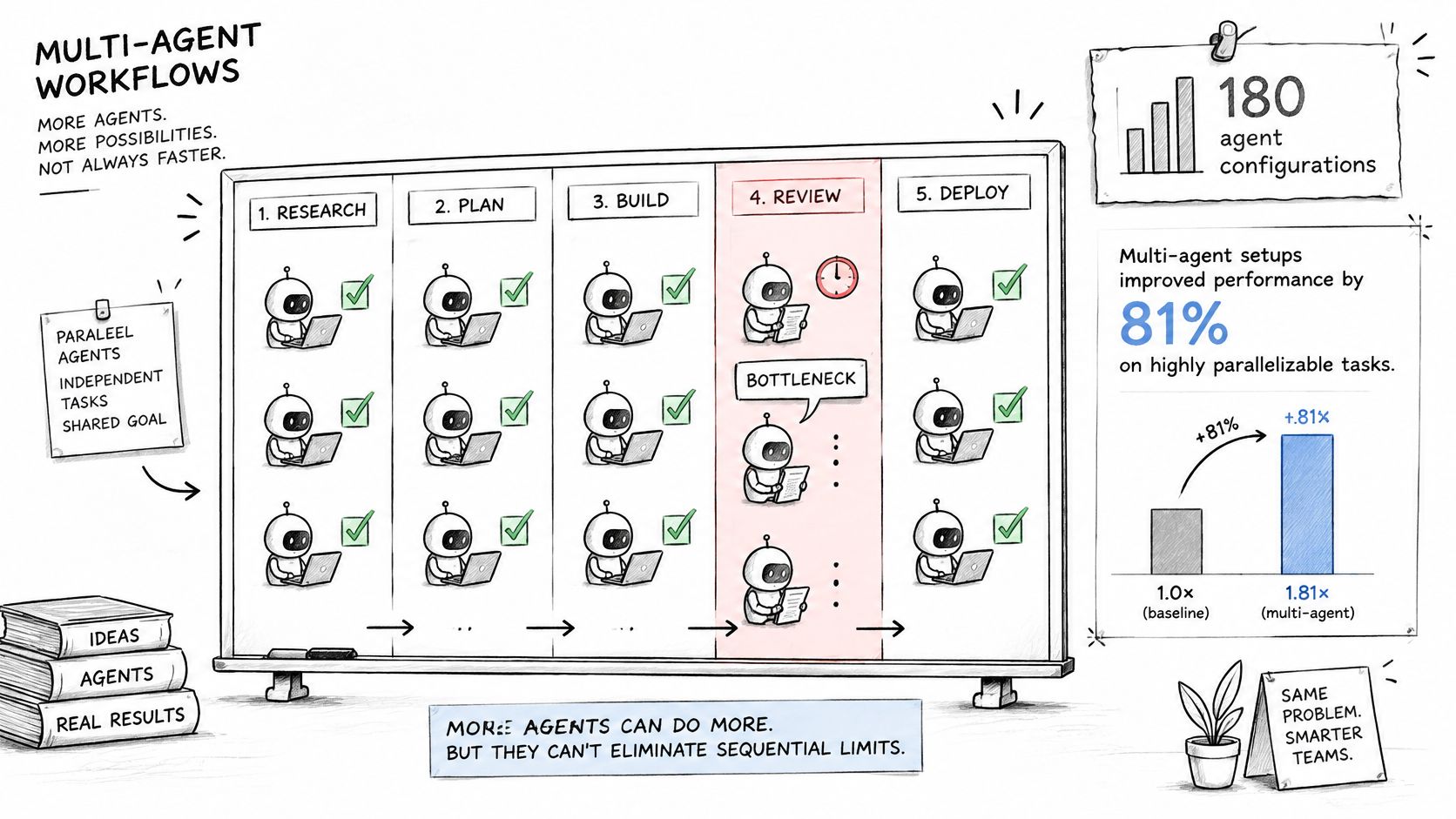
A controlled evaluation described by Google Research tested 180 agent configurations and found an 81% performance improvement on highly parallelizable tasks, but a 70% performance decline on sequential planning tasks. Those are benchmark results, not a productivity multiplier to apply to your backlog.
Independent investigations can run concurrently. Sequential planning requires actors to preserve ordering, exchange updates, and reconcile decisions, so additional agents can introduce more coordination work than useful execution.
Parallel and serial work types
| Work Type | Parallel or Serial | Reason | Dispatch Rule |
|---|---|---|---|
| Separate test investigations | Parallel | No shared state between them | Give each investigation its own agent and claim |
| Documentation passes on different modules | Parallel | Independent files and owners | Assign with separate claims |
| Isolated bug triage | Parallel | Each report stands alone | Queue reports and claim one at a time |
| Schema migrations | Serial | Later steps depend on earlier ones | One owner and a dependency gate before the next step |
| Architectural refactors | Serial | Shared interfaces change for everyone | One claim and a review before others start |
| Tasks touching the same files | Serial | Edits collide | Lease the files and queue the rest |
These classifications assume the stated boundaries hold. Documentation changes stop being independent if every agent also edits the same navigation file.
For example, separate agents could investigate payment failures and email-delivery failures. If both investigations require changing the shared retry mechanism, keep the investigations parallel but serialize the implementation.
Dispatch only work that is ready
Before dispatch, record prerequisites, shared resources, ownership, and completion conditions. A centralized queue should offer only unblocked work, not the highest-priority card.
Task claims alone don't reserve every shared resource. Distinct tasks may touch the same file, database, or deployment environment. Use artifact reservations, isolated worktrees, or explicit integration gates where appropriate.
This is the central design choice in multi-agent systems: choose an execution pattern that matches the work rather than forcing every task through the same arrangement.
For another view of agent workflows, use the video alongside your own dependency map.
Don't judge parallel execution by closed-card counts alone. Track makespan, the elapsed time to finish the whole batch, alongside blocked time, coordination overhead, and rework.
Try a small backlog exercise: list a handful of open tasks, mark those that share files or depend on another result, and identify the independent group. Dispatch that group first, not the entire backlog.
Risks AI Adds to Project Management
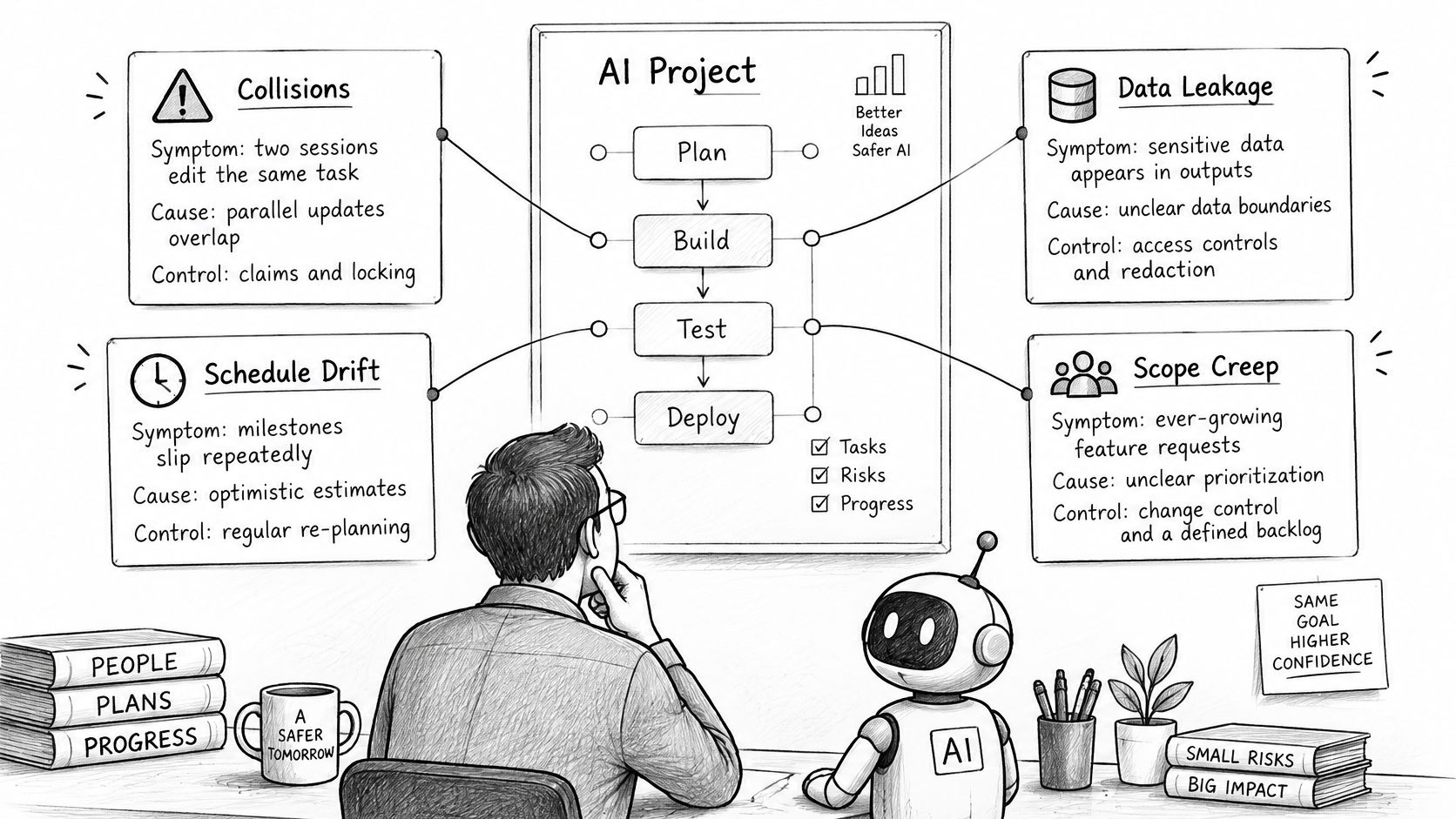
A collision can look like progress until review. Two sessions close their assigned cards, each with plausible diffs, but they disagree about the same interface; the repair lands on a developer who now owns both implementations and neither decision.
The failure is coordination and state management. Locally reasonable changes still need an authorized project state, with one owner, one current context, and one record of what was accepted.
Match each symptom to a control
- Collisions: Sessions change the same task or artifact because ownership is not enforced. Require claims, show the current holder and last-active time, and refuse writes from anyone without the claim.
- Stale context: An incoming session repeats an investigation or contradicts an accepted decision. Refresh the briefing at session start and preserve handoffs and decision records, so time to resume stays low.
- Unclear authorship: Reviewers cannot distinguish a person's change from an agent's action. Record the responsible person and, for agent actions, the agent identity.
- Unreviewed work: Agents begin tasks without agreed scope, size, or acceptance criteria. Require approval before execution, not only before closing the card.
- Access creep: An agent receives broader permissions than the person it represents. Bound its access to that named person's permissions and restrict sensitive operations.
A decision log template helps reviewers distinguish an agent's proposed direction from a human-approved commitment. Keep the acceptance state explicit; a confidently written recommendation is not authorization.
Don't budget an assumed productivity gain
The productivity evidence below shows why forecasts need caution: a randomized trial involving 96 full-time Google engineers estimated that AI reduced time on a complex enterprise task by approximately 21%, with a large confidence interval, while the contrasting independent study involved 16 experienced open-source developers working on 246 real issues and found a 19% increase in completion time, as summarized alongside the ICSE software-engineering productivity evidence.
These settings are not interchangeable. Repository familiarity, task complexity, tool integration, verification burden, and the reviewer's ability to assess generated changes can move the result in either direction.
Plan capacity from measured throughput for comparable tasks, including correction and review time. Treat a promising demonstration as a hypothesis to test on your own board, and keep defect escapes and rollbacks visible beside speed. A quicker implementation that needs extensive repair leaves less capacity for the next task.
Install attribution and claims first. They provide the trail for investigating who acted, whether the action was authorized, and which overlapping work needs repair.
Metrics That Show Whether It Works
| Metric | What It Reveals | How to Measure It | Healthy Direction |
|---|---|---|---|
| Collision rate | Tasks touched by two actors at once | Count overlapping claims per week | Falling |
| Duplicated effort | Work done twice | Count tasks closed as duplicates or reverted | Falling |
| Time to resume | Cost of picking up unfinished work | Time from handoff to first new change | Falling |
| Attributable changes | Share of changes tied to a person and an agent | Agent-made changes with both fields filled, divided by all agent-made changes | Rising toward complete coverage |
| Review iterations | Burden of checking agent output | Review rounds per task | Stable or falling |
| Cycle time by work type | Speed of parallel versus serial work | Median start to done, split by work type | Falling for parallel work |
Make the measures trustworthy
Treat these as operational definitions, not perfect proxies. If claims are enforced exclusively, attempted conflicting claims may reveal contention even when overlapping claims never occur.
For duplicated effort, tag why a task was reverted. A requirements change isn't the same failure as an agent rebuilding work that already existed.
Measure resume time consistently, and separate time waiting for an available worker from time spent reconstructing context. Otherwise, a scheduling delay can look like a poor handoff.
Human-only changes need a person identity, not an invented agent identity. For agent-made changes, both fields should be present so reviewers can trace the action to its authorized owner.
Measurement rule: Count the cost of reaching an accepted outcome, not just the speed of producing a draft.
Include adoption and audit costs
In Capterra's July 2025 survey of 2,545 respondents across 11 countries, 41% identified AI adoption issues as their top software challenge, while 71% considered security critical when purchasing project-management software. Skills, onboarding, workflow fit, and security deserve attention alongside delivery speed.
Your first return may come from reducing coordination loss and audit uncertainty, rather than increasing the volume of automated work. Less repeated investigation and clearer approvals can be valuable even when implementation cycle time barely changes.
Record a baseline before agent execution begins. Where existing records don't capture a measure, mark it unavailable and start collecting it; don't reconstruct a precise baseline from memory.
Split results by work type and execution pattern. Faster independent investigations shouldn't conceal slower refactors, rising review burden, or unauthorized changes.
Keep conventional delivery and quality checks beside this dashboard: accepted outcomes, escaped defects, and the effort spent correcting output. Falling review iterations are healthy only if reviewers haven't stopped checking.
Start with measures the team can collect within a week. If a metric requires a separate analytics project before anyone can use it, defer it until the workflow is stable.
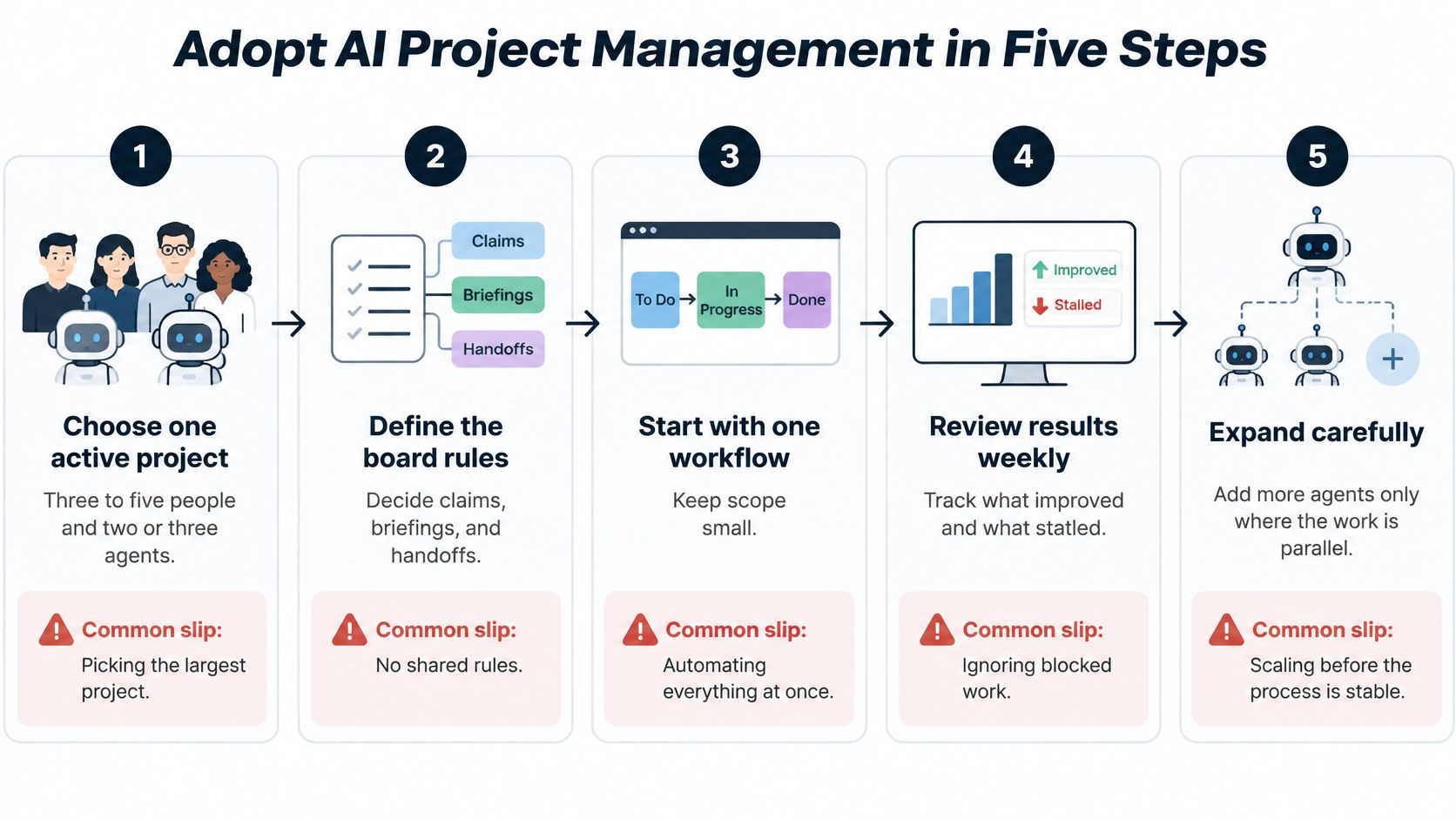
Adopt AI Project Management in Five Steps
Treat adoption as a bounded operating experiment. The aim is to learn whether your team can delegate work while preserving ownership, quality, and recovery, not to demonstrate how many agents it can launch.
Use this process visual as a reminder to keep scope small and expansion conditional.
Prepare a bounded pilot
Choose one active project.
For a manageable pilot, you might choose a project with three to five people and two or three agents. Those are example pilot boundaries, not a research-backed staffing ratio.
Select work with visible outcomes and a person who can approve scope promptly. A maintenance project with reproducible bugs or module-specific documentation is easier to assess than a broad platform rewrite.
The common slip is choosing the largest project because it promises the biggest saving. That also introduces competing deadlines, legacy dependencies, and enough variation to hide why the pilot succeeded or failed.
Write the brief and standing rules.
Define the desired outcome, excluded work, relevant repositories, acceptance criteria, and escalation owner. Make the briefing part of session startup, rather than an optional document.
As a practical starting exercise, write at least five always-or-never rules. Examples include always attaching verification evidence, always identifying shared-interface changes, never accessing production secrets, never expanding scope without approval, and never treating a proposed decision as accepted.
Ask an agent to explain the task boundaries before allowing execution. If its interpretation differs from the owner's, repair the brief first.
The slip is writing excellent instructions that no agent receives. Test the startup path itself, including which rules appear before execution tools become available.
Classify the open backlog.
Inspect dependencies and shared artifacts before assigning workers. Mark implementation work as serial when it changes interfaces that other tasks consume.
Split mixed tasks where that creates a clean boundary. Independent investigations can produce findings for a single implementation owner, without giving every investigator permission to modify shared code.
The mistake is treating separate cards as proof of independence. Read the likely change surface, not just the task titles.
Run the workflow and make the expansion decision
Enable claims, handoffs, and attribution.
Start every session from the briefing, and require a claim before changes begin. Test interrupted work deliberately: stop a session, inspect its handoff, and have another actor attempt to continue.
Check that the activity record identifies the responsible person and acting agent. Also test rejected actions, expired ownership, and work awaiting human review.
A person approves scope before execution and accepts decisions. Agents can propose alternatives and explain consequences, but they shouldn't mark their own proposals as final commitments.
The common slip is relying on chat history alone. Private conversations may help an individual worker, but they aren't a dependable shared project record.
Run a time-boxed pilot and apply a written gate.
For example, use a two-week pilot, with baseline collection completed before execution begins. Review the six coordination measures alongside quality, approval compliance, and time spent supervising agents.
Set the expansion gate before starting: collisions must fall, attribution for agent-made changes must approach complete coverage, and quality and authorization checks must remain acceptable. If collisions were already absent, require them to remain absent rather than demanding an impossible reduction.
If the gate fails, narrow the scope to independent parallel work and rerun the pilot. Diagnose whether the problem was task selection, missing context, weak enforcement, or reviewer capacity.
Don't scale on enthusiasm. Add agents only when the current workflow produces accepted work without creating more recovery effort than the team can sustain.
For this pilot, Projectify is a board built for AI from the ground up: agents connect over MCP, claim work, keep the Brief current, and hand off between sessions. We offer cloud hosting or self-hosting on your own server with Postgres, so deployment can fit your operating requirements.
Start a bounded pilot this month with Projectify, where people and AI agents work on the same board with claims, shared briefings, handoffs, and attributed changes. Choose an active project and use its results to decide whether to expand; email hello@projectify.si with questions about setting up the workflow.