AI Code Review Workflows That Actually Work
You open a pull request and find conflicting advice from parallel agents. The security reviewer wants validation moved into the handler. Another agent has already moved it into a shared service. A human asks which commit either agent reviewed, and nobody can tell. Before deciding whether the code is safe, you're reconstructing who did what.
Why AI Code Review Breaks When Agents Multiply
That conflict isn't necessarily a reasoning failure. Both recommendations might make sense against different snapshots of the repository. The operational failure is letting reviewers inspect different states, propose overlapping edits, and report conclusions without identifying their evidence.
Consider a hypothetical authorization change. An agent reviewing the route sees no permission check and flags an access-control defect. Another agent finds a check in middleware and dismisses the concern. Neither establishes whether the changed route uses that middleware.
The human reviewer now has competing conclusions instead of a verified execution path. Asking a stronger model to arbitrate might help, but it won't establish which revision each agent inspected or whether another session changed the middleware afterward.
Speed creates a coordination obligation
AI code review should be treated as a protocol, not a comment generator. When agents work independently, the team needs explicit rules for ownership, evidence, and completion. Otherwise, each additional reviewer introduces another output somebody must reconcile.
The trust gap makes that reconciliation especially important. 96% of surveyed developers don't fully trust AI-generated code to be functionally correct, while only 48% always check AI-assisted code before committing, according to the Sonar developer survey. Skepticism alone isn't a verification process.
Practical rule: A finding isn't ready for review until someone can identify the inspected revision, reproduce the concern, and name the person responsible for its disposition.
Useful coordination starts with a few distinctions:
- Review scope: Identify the behavior under inspection, not just the files an agent may read.
- Change authority: Separate permission to investigate from permission to modify shared code.
- Completion state: Distinguish an agent finishing its run from a human accepting its conclusions.
A better prompt can improve a finding. It can't resolve an ownership conflict that the workflow never recorded. Preserve attribution and context first, then optimize the model's instructions.
The Four-Stage AI Review Pipeline
Run automated review against an immutable commit, with an owner and exit criterion for each stage. The ordering matters: establish what's being reviewed, collect executable evidence, ask the model to reason about remaining risks, and package the result for a human.
The pipeline should make incomplete work visible rather than letting an empty comment stream imply success.
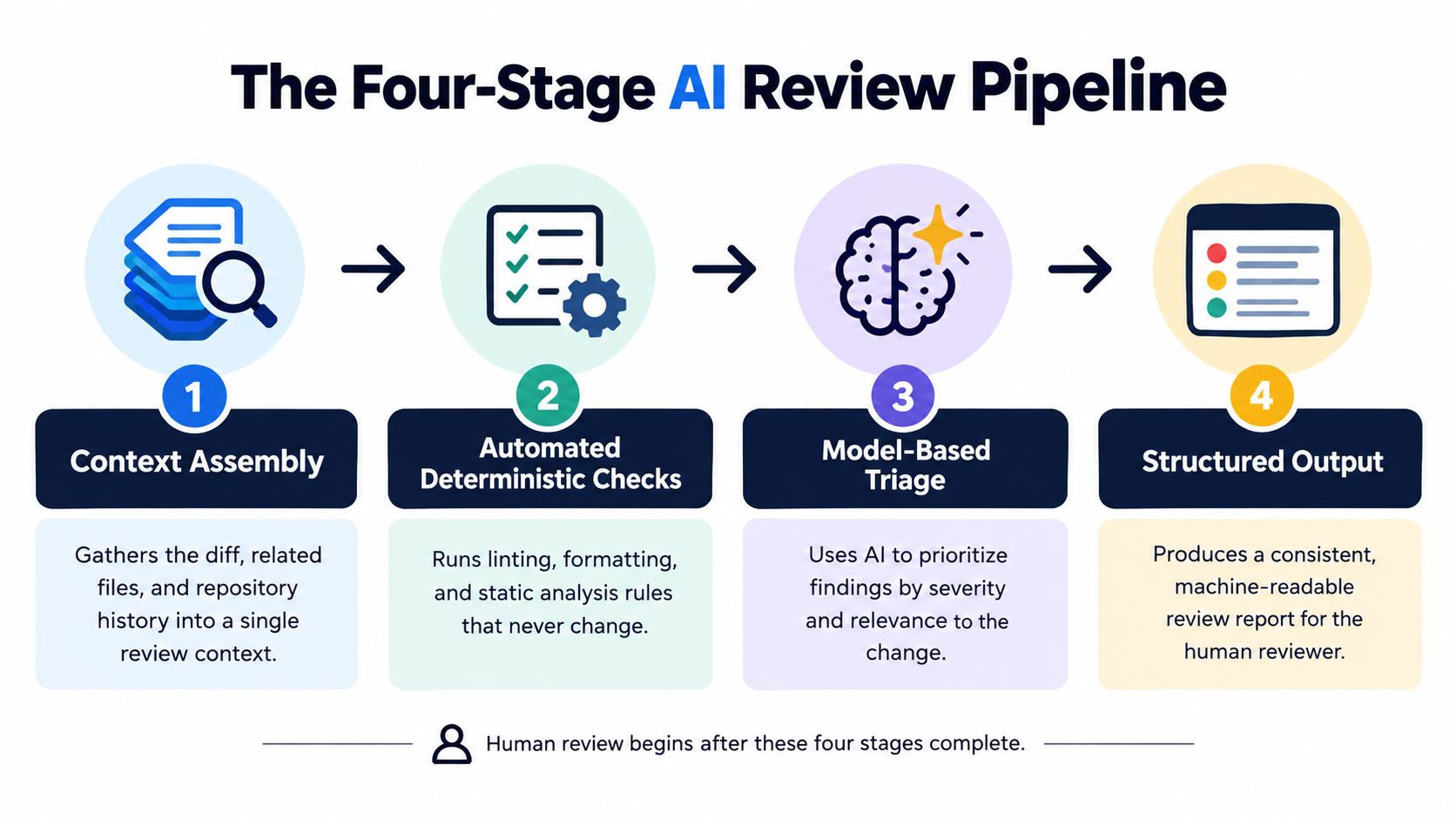
Four-Stage AI Code Review Pipeline
| Stage | Owner | Exit Criterion |
|---|---|---|
| Context assembly | Review coordinator | Commit, scope, relevant code, and project rules are identified |
| Automated deterministic checks | CI runner | Required checks finish with results and execution errors recorded |
| Model-based triage | Scoped review agents | Findings include evidence; uncertainties and coverage gaps are explicit |
| Structured handoff | Review coordinator | Deduplicated report reaches the assigned human reviewer |
Context assembly should resolve the base and head revisions before collecting surrounding code. If the branch changes during review, preserve the existing report against its original commit rather than attaching it to the new head.
Deterministic checks establish facts the model shouldn't guess. Run unit tests, integration tests, static analysis, dependency scanning, and secret detection as appropriate. A failed test belongs in the evidence bundle; a check that couldn't execute belongs in a separate incomplete-check field.
Triage before handoff
Ask the model to prioritize behavioral defects, explain consequences, and distinguish demonstrated failures from hypotheses. Don't spend reasoning capacity rediscovering formatting violations already covered by tooling.
For a hypothetical refund change, CI might pass while the model notices that retrying a request could repeat the refund. The agent should inspect idempotency handling and propose a reproducer, not immediately rewrite payment logic.
The coordinator then consolidates overlapping findings and records dissent where agents disagree. A structured report should distinguish verified defect, needs investigation, and nonblocking suggestion.
Human approval follows this automated preparation. Humans can intervene earlier when context is missing, but the normal review queue should receive an evidence bundle rather than scattered agent transcripts.
Human Reviewer vs AI Assistant vs Autonomous Agent
Humans own acceptance of risk. An editor assistant helps a developer investigate locally. A background agent performs bounded work without requiring continuous interaction. Those are different responsibilities, even when the underlying model is similar.
The distinction is easier to maintain when permissions follow the role rather than the tool's capabilities.
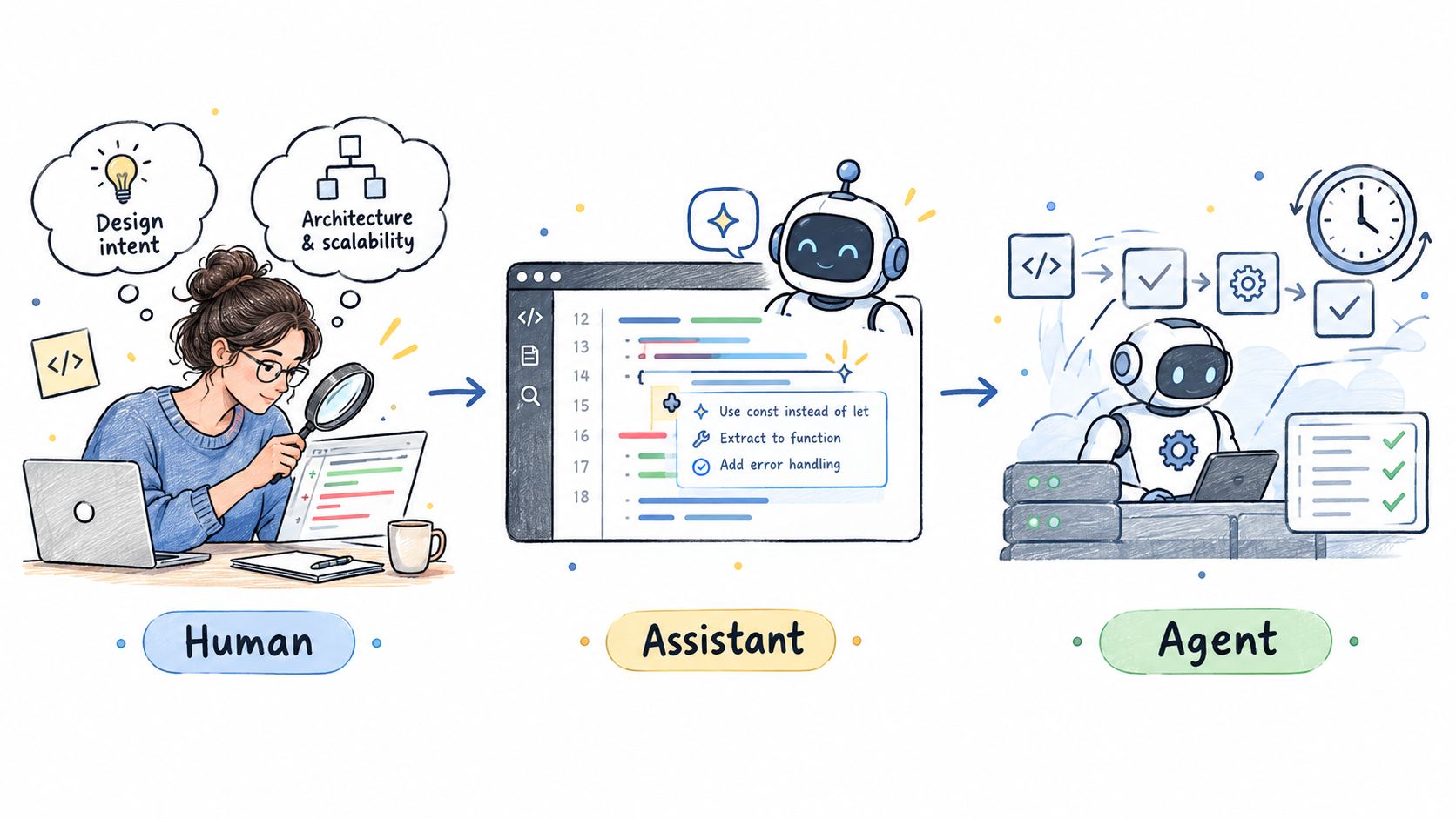
Assign responsibility by consequence
| Role | Appropriate responsibility | Boundary |
|---|---|---|
| Human reviewer | Judge business invariants, compatibility, and acceptable risk | Must not substitute agent confidence for verification |
| AI assistant | Explain code, explore a finding, draft a focused test | Doesn't independently approve the change |
| Autonomous agent | Inspect a scoped area, execute permitted checks, prepare evidence | Doesn't broaden scope or merge without authorization |
The evidence supports augmentation more clearly than autonomous approval. In GitHub's controlled code-quality study, 202 valid submissions generated 1,293 human reviews, and Copilot users had a 56% greater likelihood of passing all 10 unit tests. The constrained task and human assessment don't establish that an automated reviewer can safely approve production changes.
Separately, GitHub's Copilot Chat research reported 15% faster reviews and 85% of developers feeling more confident in code quality. Faster review and greater confidence aren't equivalent to verified defect detection.
An AI coding assistant fits naturally into an interactive investigation. Autonomous agents need more explicit boundaries because a developer isn't watching every action.
Before an agent starts, give it a claimed review task and a briefing containing project rules. At session end, require a handoff to a named successor, even if the successor is the same person tomorrow.
Keep the agent that proposes a fix separate from the human who accepts its consequences. Letting an agent revise code and declare its own concern resolved removes the checkpoint precisely where independent judgment matters.
Context Pack and Structured Finding Format
A diff shows what changed. It doesn't necessarily explain which callers depend on the behavior, which failures are acceptable, or why an apparently unusual implementation exists.
Build a context pack around the question the reviewer needs to answer. For an authorization change, that means following the request through routing, middleware, policy evaluation, and data access rather than retrieving every file containing the word permission.
A usable context pack
- Revision and intent: Base commit, head commit, change summary, and intended behavior.
- Relevant code: Diff, surrounding functions, callers, interfaces, and affected tests.
- Repository conventions: Error handling, authorization boundaries, compatibility rules, and approved patterns.
- Execution instructions: Test configuration, runnable commands, required fixtures, and environment limitations.
- Ownership and history: Responsible maintainers, relevant design decisions, prior incidents, and concurrent work.
Index source, tests, configuration, and decision records for retrieval. Keep generated bundles out of ordinary model context, but don't omit migrations or dependency changes because tooling produced them.
Retrieve progressively. Start with the changed execution path, then expand when the agent encounters an unresolved dependency. Record missing context explicitly instead of letting the model fill gaps with assumptions.
Require findings that can be challenged
Multi-round review remains difficult: across 2,269 real review tasks in five languages, the strongest evaluated model achieved an F1 score only slightly above 0.55, as described in the review research indexed by Chalmers. That's a reason to demand inspectable evidence, not longer explanations.
Require each finding to contain:
- Identity: Finding identifier, reviewed commit, agent identity, and responsible human.
- Classification: Defect type, severity, confidence, and affected location.
- Evidence: Execution path, triggering input, violated invariant, and relevant code references.
- Verification: Minimal reproducer or proposed test, execution result, and remaining uncertainty.
- Disposition: Accepted, rejected, deferred, or awaiting investigation, with rationale.
For a retry concern, the evidence might describe a request repeated after an external payment succeeds but before local state persists. That's a testable claim. A comment merely suggesting better retry handling isn't.
A reviewer should be able to reject a finding by disproving its execution path, not by debating how persuasive the explanation sounds.
Store findings as durable artifacts. Chat can announce them, but it shouldn't be the only place their evidence or resolution exists.
Measuring Review Quality Beyond Synthetic Benchmarks
A strong synthetic score doesn't establish that an AI reviewer understands your repository. Synthetic mutations can test recognizable mistakes without testing the architectural assumptions that make production defects difficult.
A reported comparison of AI review benchmarks illustrates the risk: the best model reached 0.847 F1 on 100 synthetic mutation samples, but only 0.066 F1 on 50 real bug-fix pull requests. These are reported benchmark results, not an estimate of what your team will achieve.
Build an internal evaluation that can disappoint you
Collect historical production bugs, reverted changes, security incidents, and accepted review findings. Reconstruct the repository state available before each fix so the reviewer can't retrieve the answer.
Freeze the evaluation set and keep it separate from prompt-development examples. Have experienced reviewers label valid findings, severity, localization, exploitability, and whether existing tests already covered the defect.
Evaluate distinct questions separately:
- Precision: How much of the reported output describes valid defects?
- Recall: Which known defects did the reviewer miss?
- Acceptance: Which findings did maintainers act on, and why?
- Operational burden: How much investigation did invalid or duplicate findings require?
- Delivery outcomes: Track escaped defects and review latency without assuming the agent caused every change.
Break results down by language, change size, subsystem criticality, and defect class. An aggregate score can conceal weak authorization review behind strong detection of straightforward local errors.
Change the workflow when the evidence changes
Suppose a team selects a reviewer based on synthetic results, then discovers that its internal evaluation contains mostly cross-file failures the agent misses. The useful response isn't to publish the synthetic score more prominently.
Keep the agent on narrower tasks where its findings hold up, improve retrieval for the missed paths, and require specialist review for the weak categories. Re-evaluate after changing prompts, models, or retrieval logic.
Faster comments can increase workload when developers must investigate speculative claims. Measure the time spent verifying and rejecting findings alongside review latency. A quiet reviewer that catches relevant defects may be more useful than a prolific reviewer whose comments rarely survive scrutiny.
CI Gates and Human Checkpoints
Don't map model confidence directly to merge permission. Confidence is part of a finding, not proof that the stated failure exists. Define pipeline behavior through repository policy and executable evidence.
Separate a job's execution status from its review verdict. An agent that times out hasn't found the code safe; it hasn't completed the assigned review.
Use explicit categories so developers know what blocks delivery and what requires judgment.
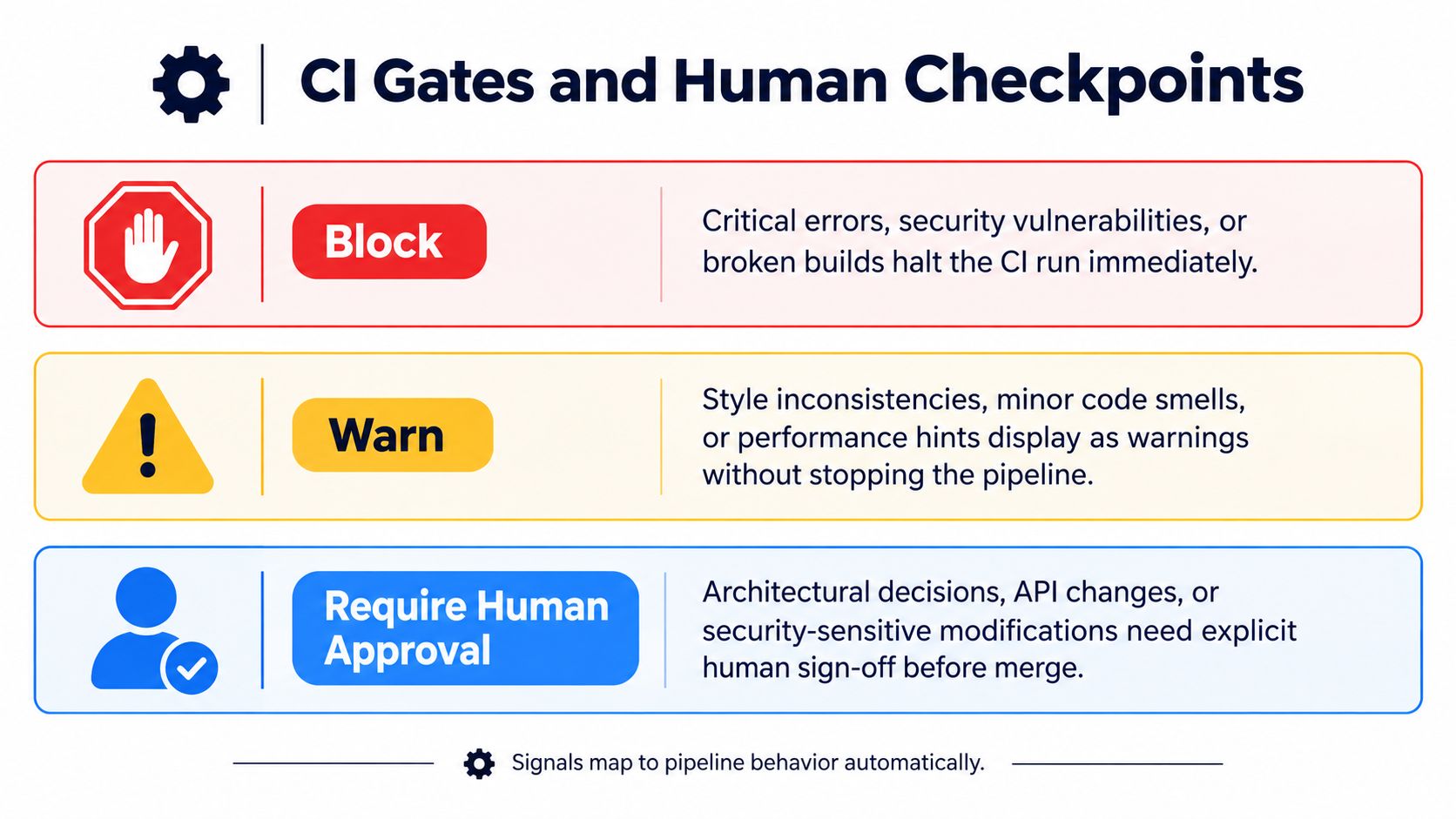
Translate evidence into pipeline behavior
- Block: Required tests or builds fail, secret detection triggers a defined policy, or a required security check reports a policy-defined failure.
- Warn: The model offers a maintainability suggestion, performance hypothesis, or low-impact concern without demonstrated production risk.
- Require human approval: A finding alleges severe behavioral impact, or the change touches a policy-defined sensitive area such as authorization, public contracts, or destructive migrations.
Severity should describe consequences. A reproducible authorization bypass deserves different treatment from a speculative optimization, regardless of how confidently either agent writes.
CI should block on deterministic failures and explicitly defined policy conditions, never on raw AI confidence.
For a high-severity AI finding, require a named reviewer to accept, reject, or assign further investigation before merge. The checkpoint can block on missing disposition, without pretending the model has conclusively established the defect.
Preserve the decision boundary
Keep commit identity attached to checks and approvals when connecting a GitHub review workflow. If subsequent edits invalidate the evidence, require the relevant checks and approval again rather than inheriting a stale verdict.
Record the final decision, rationale, evidence, and approving person. Rejections deserve explanations too: a documented false positive can improve future evaluation and prevent another agent reopening the same argument.
Provide an emergency override with a named owner and an explicit reason. An override should bypass a gate visibly, not erase the failed check or make an incomplete automated review appear successful.
Running the Protocol Across Parallel Agents
Parallel review works best when agents investigate independently but publish through shared coordination. Give security, correctness, and compatibility reviewers distinct scopes while keeping them anchored to the same commit and decision record.
A shared work board makes those assignments and unresolved questions visible outside individual sessions.
Treat review work as owned work
A claim should grant temporary ownership of a task, not unrestricted authority over the repository. Independent reviewers can inspect overlapping code, but agents shouldn't apply competing fixes to the same work item.
Keep review and remediation separate. When a reviewer identifies a defect, create an assigned repair task rather than letting every specialist start editing. If the repair changes assumptions another reviewer used, mark the affected review stale.
Brief each new session with the current rules, active assignments, accepted decisions, and latest handoff. This is the practical difference between running several chats and operating coordinated multi-agent systems.
The coordination model is worth inspecting alongside the review configuration.
A coordinator can deduplicate reports, but it shouldn't quietly resolve substantive disagreements. If reviewers disagree about whether middleware protects a route, preserve both claims and assign verification of the actual request path.
An operating checklist
- Anchor: Confirm every report and check belongs to the intended commit.
- Assign: Claim investigation and remediation separately.
- Brief: Load current project rules and accepted decisions.
- Verify: Require reproducible evidence for consequential findings.
- Attribute: Preserve both the acting agent and the person responsible.
- Hand off: Assign unfinished investigations before ending a session.
- Close: Record the human decision and apply the defined CI policy.
The least glamorous practices, attribution and context preservation, make the rest usable. Without them, even a correct finding can become untrustworthy after another session changes the code.
The question isn't whether an AI can spot a bug. It's whether the team can carry that finding from discovery to verified resolution without losing ownership along the way.
Projectify gives people and their AI agents a shared board with task claims, session briefings, handoffs, and person-plus-agent attribution. Visit Projectify to organize a review workflow where every investigation has an owner and unfinished work survives the next agent session.
Give your AIs a desk.
One board for your team and Claude. Free for up to 3 people.
Start freeHow it works: claims · Start next · the handoff · pricing