Audit Trail Software: How to Compare Tools in 2026
Compare audit trail software for compliance, attribution and AI agent accountability. Get a feature checklist, tool categories and a decision guide for 2026.
The popular advice on audit trail software is to capture more events and keep them longer. That's incomplete. A detailed activity feed can show that an agent changed a record without establishing whether it had authority, whether another agent held the task, or whether anyone approved the result.
Accountability requires more than chronology. Buyers should compare tools by what a reviewer can independently verify: the integrity of the record, the chain of responsibility, and the evidence supporting the outcome. Those are different tests, and passing one doesn't guarantee the others.
Audit Trail Requirements and Their Sources
Use this checklist before comparing dashboards or integrations. Its rows distinguish regulatory requirements from security recommendations and practical evidence formats. They aren't all universal legal obligations.
| Requirement | What the software must record | Typical source |
|---|---|---|
| Timestamp | Date and time of each create, modify, and delete action, computer-generated and independent of the operator | 21 CFR Part 11 §11.10(e), for covered closed systems |
| Actor identity | The person responsible and, for AI-driven actions, the authenticated agent acting for that person | OWASP agent payment guidance |
| Original and changed values | Earlier information remains visible; a change doesn't obscure prior records | 21 CFR Part 11 §11.10(e) |
| Tamper evidence | Append-only storage or an integrity mechanism that exposes alteration or removal | OWASP logging guidance |
| Separation | Transaction trails kept apart from general security and debug logs | OWASP logging guidance |
| Retention | Trail retained at least as long as related records and available for review and copying | 21 CFR Part 11 §11.10(e) |
| Export | Machine-readable evidence, such as JSON or CSV, readable independently of the application | OWASP agent payment guidance, with format verified during procurement |
The FDA's 21 CFR Part 11 became effective on August 20, 1997, establishing conditions under which electronic records and signatures can be accepted as equivalents to paper records and handwritten signatures. Its closed-system audit-trail provision requires secure, computer-generated, time-stamped entries, preservation of previously recorded information, and retention alongside the related records.
Don't reduce that obligation to a timestamp column. A reviewer needs to connect an action to the affected record and distinguish the record's earlier state from its replacement. A feed saying that someone updated a document may identify activity while omitting the information needed to examine the change.
Separate legal scope from buying criteria
Part 11 isn't a blanket requirement for every team buying audit trail software. Determine which records and underlying recordkeeping obligations apply before treating its controls as mandatory. Conversely, an activity feed alone doesn't establish compliance where those obligations do apply.
The same distinction matters for agent controls. Person-plus-agent identity and structured exports are useful evaluation criteria, but they shouldn't be described as wording taken directly from the FDA's audit-trail provision. Include them because your workflow requires accountable delegation and usable evidence.
For teams evaluating AI governance tools, assign each checklist row an owner and an acceptance test. Compliance should define the obligation, engineering should explain the implementation, and the eventual reviewer should confirm that the evidence is understandable.
Procurement rule: A tool missing a checklist row will fail an audit request that requires that capability. Resolve the gap before purchase, not during evidence collection.
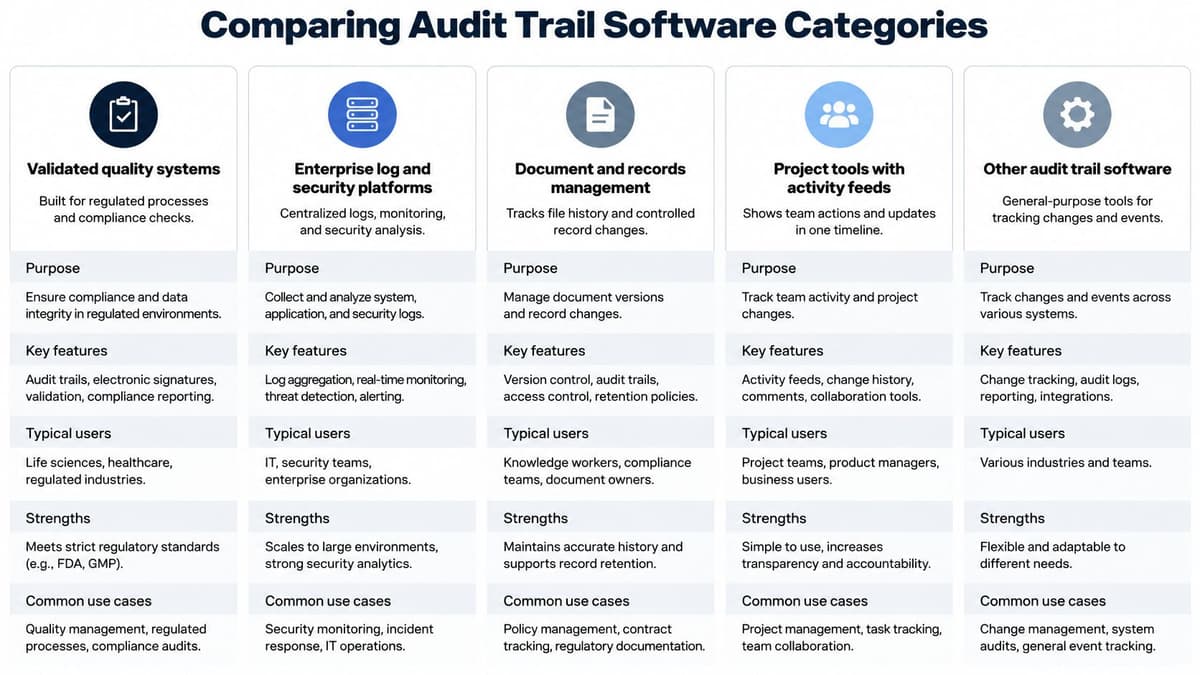
Comparing Audit Trail Software Categories
| Category | Strongest at | Typical gap to investigate | Tamper-evident storage | Per-agent attribution |
|---|---|---|---|---|
| Validated quality systems | Regulated workflows and validation evidence | Change-control effort and total cost | Require implementation evidence | Verify explicitly |
| Enterprise log and security platforms | Centralized retention, monitoring, and investigation | Reconstructing business records from technical events | Verify storage configuration | Requires identity-rich inputs |
| Records management tools | Controlled files and version history | Task-level changes outside documents | Verify protection of history | Verify explicitly |
| Project tools with activity feeds | Task updates in team context | Administrative editing or deletion of history | Don't infer from an activity feed | Verify explicitly |
| Agent-coordination boards, including Projectify | Person-and-agent attribution, claims, and handoffs | Regulatory validation and integrity evidence | Not established by attribution alone | Available in our board |
Treat these as evaluation categories, not certifications. A category name can suggest where to begin, but it doesn't prove how a particular deployment stores evidence or handles privileged access.
Compare the unit of accountability
A validated quality system is a sensible starting point when the object under review is a controlled laboratory or manufacturing record. Ask for validation documentation and a demonstration of the configured workflow, rather than accepting a general compliance label.
An enterprise log platform is worth evaluating when investigators must correlate activity across infrastructure and applications. For a disputed approval, however, require a demonstration that technical events can be assembled into the actual business transaction.
Records management fits questions about a file's approved version. A project activity feed fits questions about task ownership or status, but neither should be assumed to cover the other's evidence needs.
An agent-coordination board addresses delegated work. Our board attributes changes to people and agents and coordinates task ownership, but those capabilities don't themselves establish regulated-system validation or immutable storage.
Choose by the reviewer's question
Say an agency manages client work on a shared board. Its immediate tests should concern per-change attribution, client-scoped evidence, and access boundaries. Buying a validated quality system wouldn't automatically solve those workflow questions.
Choose the category by the question the auditor will ask, not by the length of the vendor's feature list. Where a requirement remains unproven, record it as a procurement gap rather than converting a category-level expectation into a product fact.
Try this on your own backlog.
A month of Premium free. No card. Connected in a minute.
Matching Software to Your Accountability Situation
| Situation | Priority features | Ask the vendor |
|---|---|---|
| Validated life sciences lab | Applicable Part 11 controls, retention, copying for review | Which validation evidence and export formats do you provide? |
| Regulated device or clinical study | Time-stamped trail, original-information preservation, role-based access | How are records retained and produced on request? |
| Client agency on shared boards | Per-change attribution, client-scoped export, visible sync conflicts | Who can see each client's trail? |
| Engineering team with parallel AI agents | Agent identity, claims, handoffs, decision records | Are agent actions attributed to a named person? |
| Small team without a regulator | Timestamp, actor, change history, readable export | Can we inspect the export without your software? |
Read priority features as acceptance conditions for the initial deployment, not capabilities to consider after onboarding. The vendor question should lead to a demonstration with sample records, permissions, and exported evidence.
A lab should request validation evidence for its intended use. An engineering team should test delegated identity and overlapping work. Neither should assume that a tool proven useful in the other setting meets its own accountability requirements.
Apply the strictest obligation to the relevant record
For mixed environments, identify the strictest applicable obligation first, then add operational controls such as agent attribution. Don't apply a compliance label indiscriminately to every task, chat message, and artifact. Map each controlled record to its required storage, access, review, and retention process.
Say an engineering team uses agents to prepare a software change connected to a regulated device. The task board might coordinate implementation, while a controlled system holds the approved evidence. The buyer should test whether stable identifiers connect the task, changed artifact, approval, and controlled record without leaving an undocumented transfer.
That arrangement is a proposed architecture, not an automatic compliance solution. Someone must own the boundary between systems and verify that exports preserve the relationships.
Test the boundaries that matter
For an agency, create separate client projects and inspect access from each relevant role. Attempt an export and check whether it exposes unrelated client material. If boards synchronize, introduce conflicting updates and confirm that reviewers can identify the unresolved discrepancy.
Our two-way synchronization surfaces conflicts where users already look, and each agent acts at its person's permission level. Those are relevant controls for shared work, but they don't establish that every requested client-specific export format is available.
For a small team, keep the test proportionate. Choose a completed task and confirm that a colleague who didn't participate can inspect its history and supporting files without relying on the original author's explanation.
Testing Tamper Resistance and Log Separation
The OWASP Logging Cheat Sheet recommends protecting logs from unauthorized modification and deletion, detecting alteration or removal, recording access, and copying logs to read-only media as soon as practical. It also distinguishes transaction and audit trails from security logging and recommends enforcing retention boundaries.
Turn those recommendations into a trial-account test. Use synthetic records, and obtain authorization before attempting anything beyond ordinary application permissions.
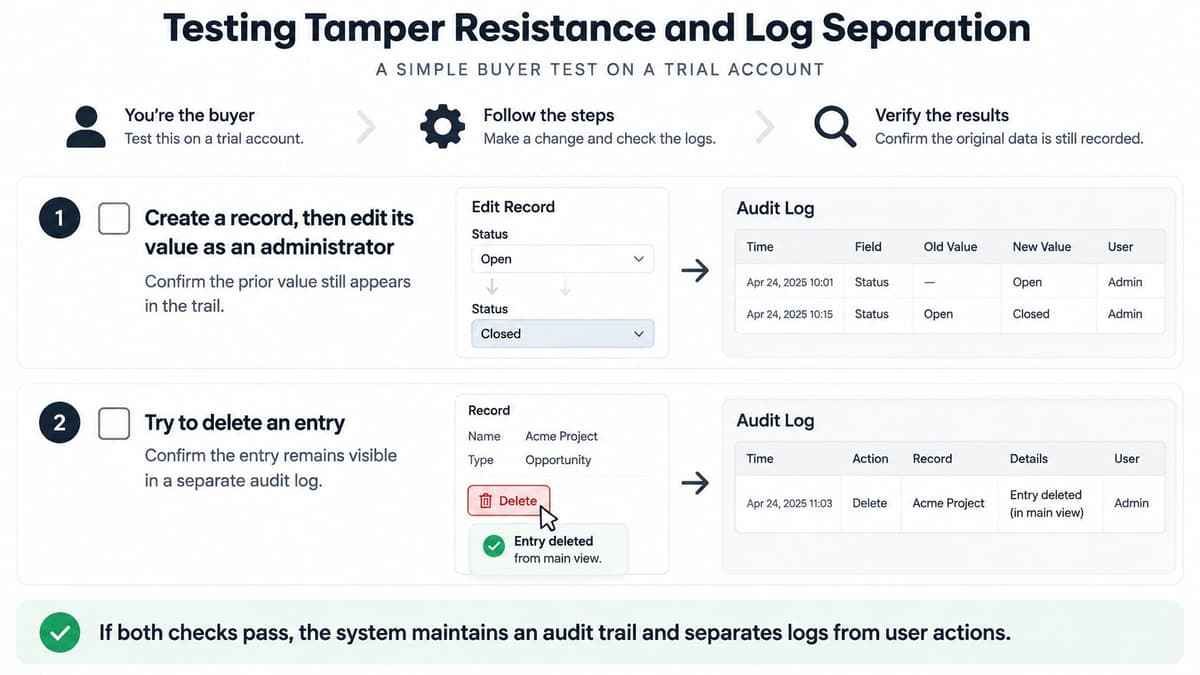
Create and edit a record as an administrator. Change a meaningful field, then inspect the earlier value, replacement value, actor, and time. A current-state snapshot can't establish what the administrator replaced.
Attempt an authorized deletion. Check whether the application blocks it or preserves independently protected evidence of the removal. Logging a deletion into the same deletable store doesn't resolve the integrity problem.
Identify who controls the storage. Request documentation showing whether entries are append-only and whether project administrators can alter the underlying history. Application permissions and storage-level privileges need separate examination.
Verify the integrity mechanism. If the vendor claims hash chaining, request an exported sample and a verification procedure that detects an altered or missing entry. A cryptographic label isn't evidence that verification works.
Inspect separation and log access. Confirm that transaction evidence has appropriate access controls and that access to the logs is itself recorded. A separate screen isn't necessarily a separately protected trail.
Exercise retention settings. Test expiry, authorized holds where relevant, and the permissions needed to change policy. Reviewers need assurance against both premature destruction and unnecessary retention.
Distinguish recovery from integrity
Our Project Drive is a versioned copy of everything the project makes, with backups. It gives reviewers another place to inspect earlier project output, but versioning and backups alone don't prove that an audit trail is immutable or independently protected.
A database containing who changed what can be useful operationally. If the same administrator can rewrite that history without detection, it isn't strong compliance-grade evidence.
Reject a tool for an integrity-sensitive use case if a privileged user can change or remove relevant history without independently detectable evidence.
Attributing Each Change to a Person and an Agent
Start with the ordinary investigation fields: when, where, who, what, outcome, account identity, trace ID, and span ID. Then add delegated identity. The person responsible for an agent and the authenticated agent performing the request should remain distinguishable.
For agent-specific controls, OWASP's AI-agent payment guidance recommends associating the authenticated agent with requests and results, signing requests and responses with nonces and timestamps, hashing sensitive arguments rather than logging raw private data, and chaining entries using the preceding entry's SHA-256 hash. These are useful evaluation benchmarks beyond payments, not universal legal mandates for engineering tools.
Follow a delegated change from approval to release
Say a person approves the scope of a shipped feature. An agent claims the implementation task, invokes a code-editing tool, updates the artifact, and hands the work to a reviewer. The trail should let an investigator follow that chain without treating every action under the person's account as a human action.
The task claim answers a distinct question: Who held this work when the change occurred? Approval establishes permission to pursue the work; the claim establishes temporary ownership; the tool result identifies what happened. Keep those records connected rather than collapsing them into a single updated-task event.
Research on trustworthy multi-agent auditability identifies integrity, coverage, temporal coherence, verifiability, accessibility, privacy compatibility, governance alignment, and resilience as relevant dimensions. The practical consequence is that reviewers need coordination context, not merely a larger event stream.
More log volume doesn't establish responsibility when the record omits authority, task ownership, or competing claims.
Check concurrency without confusing it with approval
Our approach to agentic project management combines claims, a starting briefing, and attribution on every change. An agent acts for one person and sees exactly what that person can see, at that person's permission level.
Claims are leases with one holder at a time. A claim frees itself 30 minutes after the holder goes quiet. That helps coordinate parallel work, but a claim isn't a substitute for human approval or a preserved record of permission changes.
In any demonstration, inspect the person ID, agent ID, permission context, task identifier, claim history, tool invocation, outcome, and correlation identifiers. Then simulate a handoff and competing task request to see whether the responsibility chain stays intelligible.
Proving an Outcome, Not Just Recording an Event
A complete log can still leave a reviewer unable to verify a result. An entry showing that an agent edited a file establishes an action, not that the change satisfied its task or that the cited evidence supports it.
The World Economic Forum's AI agent governance report describes audit logs as important to governance, debugging, oversight, and evaluation, and recommends recording agent actions and planning throughout the lifecycle. For buyers, the further test is whether the retained material supports an independent review without requiring a replay of the whole session.
Preserve decision evidence, not an indiscriminate transcript
Activity provenance establishes what happened. Decision and evidence provenance connects a consequential choice to its context and support. Request source links, relevant alternatives, human approval, tool or model versions, changed artifacts, and a concise handoff.
That doesn't require collecting every private message or exposing internal model deliberation. Preserve the explicit rationale and evidence needed to assess the decision, with appropriate access controls. More sensitive text isn't automatically better evidence.
A practical decision log template should keep the following distinctions clear:
- Context and decision: What problem required a choice, and what was selected?
- Alternatives and consequences: What other approaches were considered, and what trade-offs were accepted?
- Evidence and approval: Which sources or tests support the choice, and who accepted it?
- Artifact references: Which version of the work implements that decision?
Our decision records contain context, the decision, alternatives considered, and consequences. An agent can propose one, and a person accepts it.
Make the next review possible
Our session handoffs contain what was done, what remains unfinished, what comes next, and which tasks were touched. The next person or agent starts from that record rather than reconstructing context from scattered chat.
Say an agent fixes a bug by changing retry behavior. A reviewer should be able to inspect the task, decision record, test evidence, changed artifact, and handoff to determine whether the fix addresses the reported failure. A transcript may help investigate an exception, but it shouldn't be the only usable account.
Verification standard: An immutable record is insufficient if a reviewer can't locate and assess the evidence supporting the result.
Time-box a sample review. Pick a completed change and trace its task, agent, responsible person, evidence, approval, and next action. Record missing relationships as product or workflow gaps before buying.
Confirm Your Requirements Before You Buy
List applicable obligations. Identify the regulator, client contract, and internal policies governing each record, because the strictest applicable requirement sets the floor.
Select your required acceptance tests. Prioritize the checklist capabilities that would disqualify a tool, without treating the remaining applicable obligations as optional.
Run the authorized tamper test. Exercise administrator actions and inspect independent evidence, because a vendor's assertion isn't proof of the configured control.
Open a sample export independently. Inspect structured records in a spreadsheet or reviewer's tool, because a downloadable package is useful only if its contents remain readable and connected.
Inspect retention and deletion rights. Establish who can change policy or remove entries, because those permissions determine whether premature destruction is possible.
Our owner or admin can export everything under People › Workspace as a zip containing every project, task, document, decision, and file. The download link arrives by email and works for 7 days. Inspect the package separately for the audit fields and relationships your review requires.
Choose the tool that passes export and tamper tests for your strictest applicable requirement, and reject any tool that cannot export the trail you need.
Projectify offers person-and-agent attribution, task claims, decision records, and session handoffs for teams coordinating AI-assisted work. Visit Projectify to evaluate those workflows against a completed change, then inspect the workspace export before deciding whether it meets your accountability requirements.