Blog agentic project management AI agent coordination AI project management
Agentic Project Management: How AI Agents Run Work
Agentic project management explained: how teams coordinate AI agents, assign work, keep attribution and audit trails, and start a first workflow.
You've got agents writing code, drafting specs and fixing bugs, but you're still the person handing out tickets and explaining what happened in the last session. Then an agent changes a shared file without warning, another works from an outdated decision, and you spend the afternoon untangling work that was supposed to save time.
The missing piece isn't necessarily a better model. It's a work system that tells people and agents what's available, who owns it, which rules apply and when to stop for approval.
What Agentic Project Management Means
Agentic project management is a way of running projects in which AI agents participate directly in the work system. They read the project brief, select eligible tasks, act within a named person's permissions and report results. Humans set objectives, resolve trade-offs and approve consequential changes.
The definition has a practical test: shared context, explicit ownership and an auditable record of actions. Without those, you've connected an agent to tools, but you haven't established a dependable way to manage its work.
Say a product team runs several agents that write code, draft specifications and fix bugs. On Tuesday morning, separate sessions pick the same onboarding ticket and overwrite each other's changes. Both agents may have followed their instructions correctly. The team failed to make ownership exclusive.
The difference is easier to see as a kitchen than a chatbot conversation.
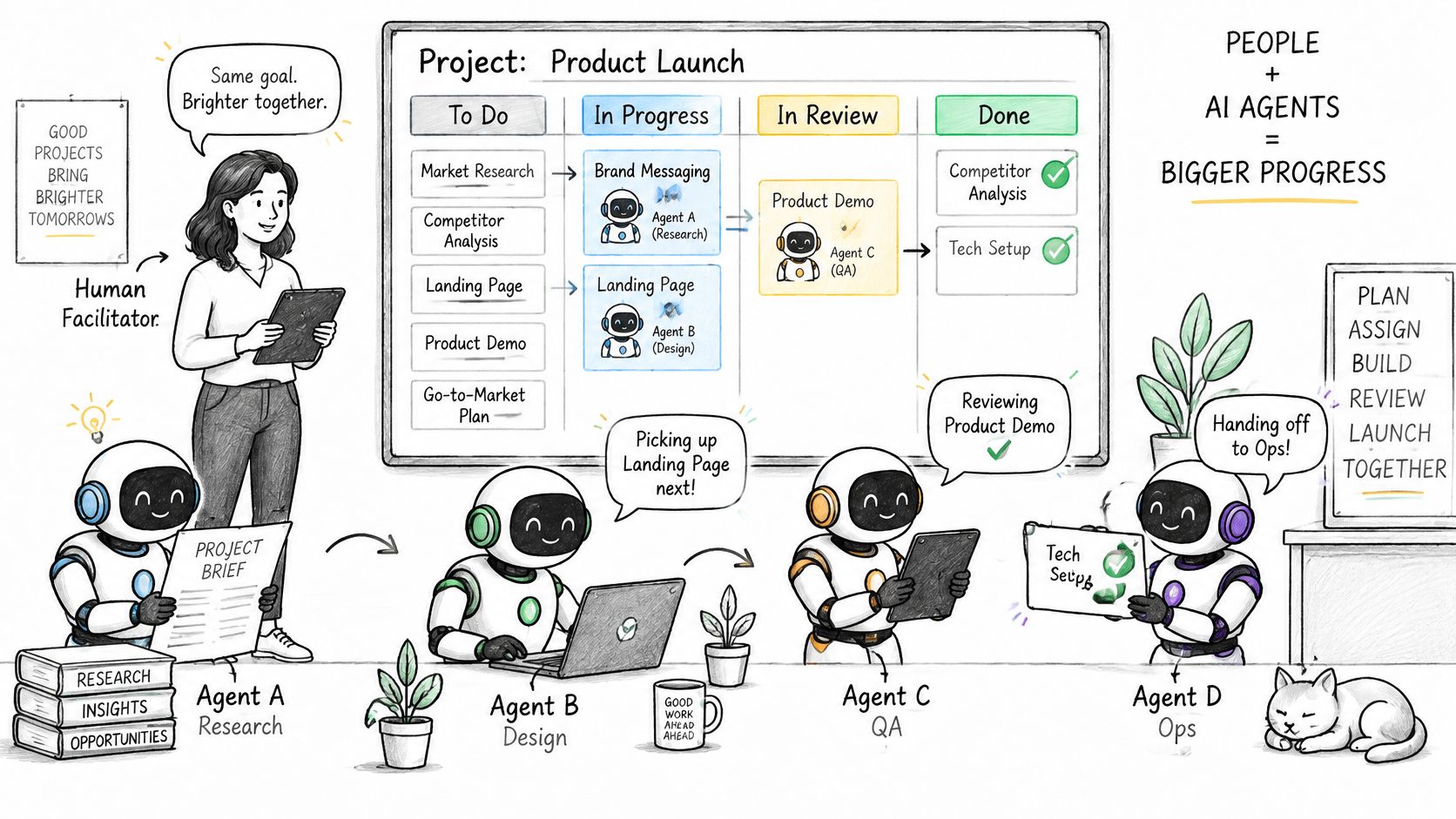
From answering questions to performing work
A traditional board resembles a whiteboard of sticky notes that people move manually. Agentic project management resembles a busy kitchen with a shared order rail: each cook checks the ticket, claims a station and leaves usable notes for the next shift.
The important transition is from AI that summarizes status to AI that interprets a backlog and performs work across tools. That creates a coordination obligation, not permission to remove supervision.
Adoption is real but still developing. In 2025, 23% of organizations reported scaling an agentic AI system in at least one business function, while 39% had begun experimenting, according to McKinsey's Global Survey.
Treat an agent as a participant with bounded authority, not as an invisible extension of someone's chat window.
How It Differs From Automation and Chatbots
Four approaches to running work with AI
| Approach | Who picks the next task | Remembers project context | Credits each change |
|---|---|---|---|
| Rule-based automation | Fixed triggers set in advance | No | Logs the rule that ran |
| Chat AI assistant | The person, in each chat | Only within one chat | Usually not |
| AI features inside a task tool | The person, with AI suggestions | Partly | Mixed with human edits |
| Agentic project management | Shared queue ranked by rules and dependencies | Yes, through briefs and handoffs | Person and agent, for every change |
These are operating patterns, not absolute limits on every product. A chatbot can have saved memory, and an automation can write detailed logs. The distinction is whether the whole workflow preserves context, coordinates ownership and attributes execution.
Rule-based automation is appropriate when the route is predictable. A merged pull request can trigger a task update without any system reasoning about what should happen next. Don't replace a reliable trigger with an agent just to make the workflow sound more advanced.
A chat assistant helps someone think through a problem or draft an artifact. Ask it to outline a migration plan, and it can produce useful work. But unless the conversation writes durable project state, the next session won't have a dependable account of what was accepted or rejected.
Suggestions aren't coordinated execution
AI features inside a task tool reduce local effort, such as drafting a ticket description or summarizing comments. They don't, by themselves, establish how multiple sessions should divide work. A suggested due date still needs an owner who understands the consequences.
Agentic project management adds a shared queue, a brief every session reads and a handoff every session writes. The distinction resembles a thermostat, a smart assistant and a house manager: the thermostat follows a setting, the assistant answers requests, and the manager reads the house log, assigns jobs and records completed repairs.
Before adopting a tool, run these tests:
- Parallel-work test: Could separate agents work simultaneously without taking the same assignment?
- Attribution test: Could you identify which agent changed a particular line, whose authority it used and whether the required approval existed?
A polished chat interface doesn't answer either question.
Free for one person. No card. Connected in a minute.
The Working Loop From Brief to Handoff
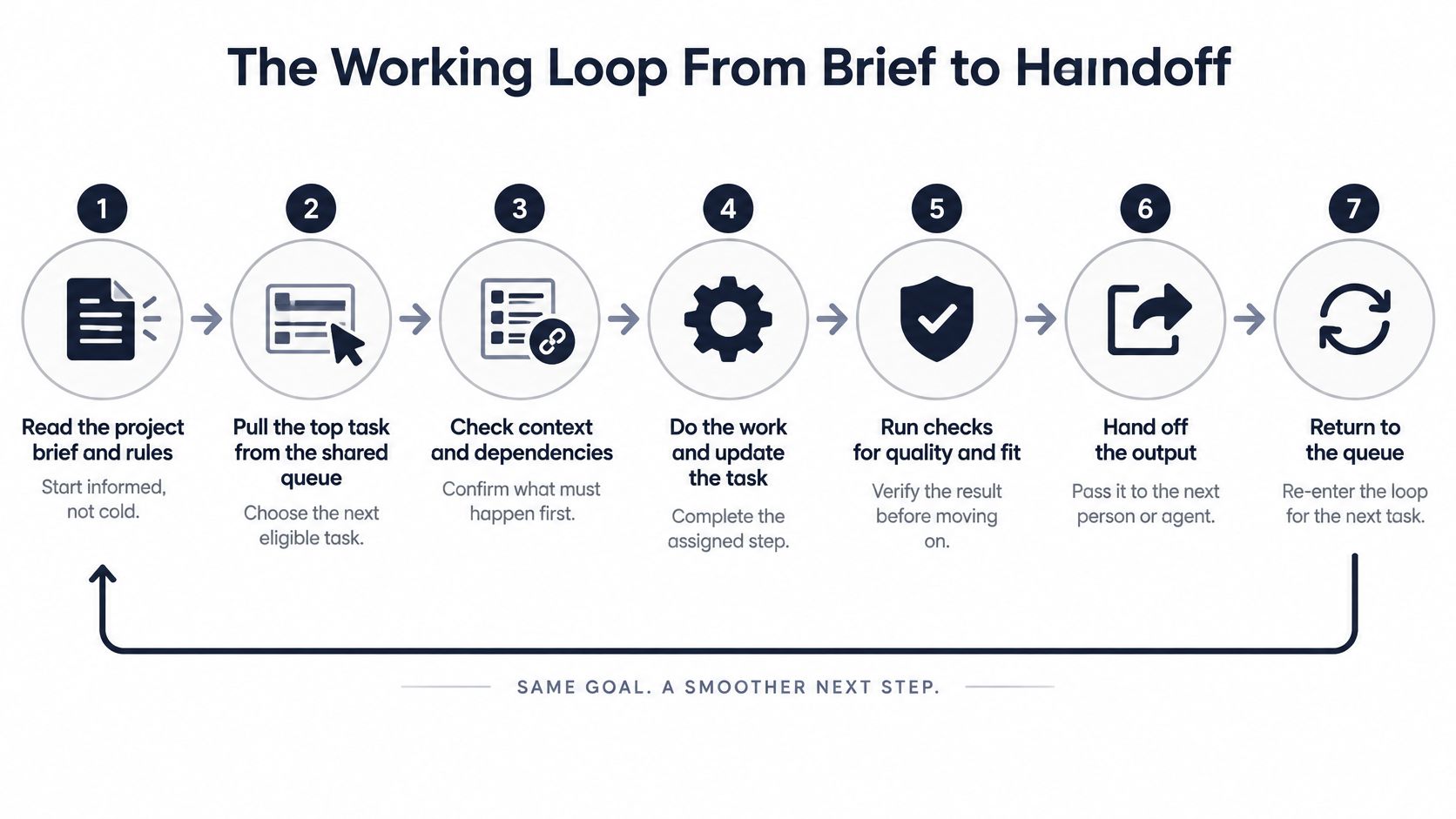
A useful agent loop has an explicit beginning, an execution boundary and a durable ending. Don't rely on the agent to reconstruct those boundaries from a long conversation.
The workflow should make each transition visible.
Make the session accountable
Read the project brief and rules. Load the current goal, constraints, relevant decisions and latest handoff before choosing work. Skipping this step lets an agent produce a technically sound result against an obsolete requirement.
Pull the top eligible task. The shared queue should expose work that's available and whose prerequisites are satisfied. Choosing an appealing ticket from the full backlog can start implementation before a required design or contract decision exists.
Claim the task before acting. Make the ownership change an indivisible operation, rather than checking availability and claiming later. Otherwise, separate sessions can both see an unclaimed ticket and begin.
Work and post meaningful updates. Announce the start, warn before touching shared resources, and report blockers or completion in the project room. Silence forces teammates to guess; constant narration makes important warnings difficult to find.
Record decisions while the reasoning is available. Capture the choice, relevant alternatives and consequences, and run the task's quality checks before declaring success. A finished artifact without its rationale leaves the next person unable to distinguish an intentional trade-off from a mistake.
Close with a usable handoff. State what changed, what remains unfinished, what should happen next and which tasks or artifacts were touched. A note that merely says work is in progress makes the next session repeat the investigation.
Stop at the human approval gate. Route scope changes, releases and other protected actions to the authorized person, with evidence attached. Creating an approval request isn't approval, and finishing the technical work doesn't authorize publication.
Preserve the baton
Think of the handoff as a relay baton. A fast implementation doesn't help if the next runner has to search the track for the information needed to continue.
A practical handoff should distinguish verified results from assumptions. Link the diff and test output, identify any untested behavior, and name the decision needed to unblock the next action.
When designing AI agent workflow automation, make these transitions part of the workflow rather than optional writing habits. A healthy loop starts with an informed session and ends with enough evidence for someone else to continue without reopening the entire conversation.
Keeping Parallel Agents From Colliding
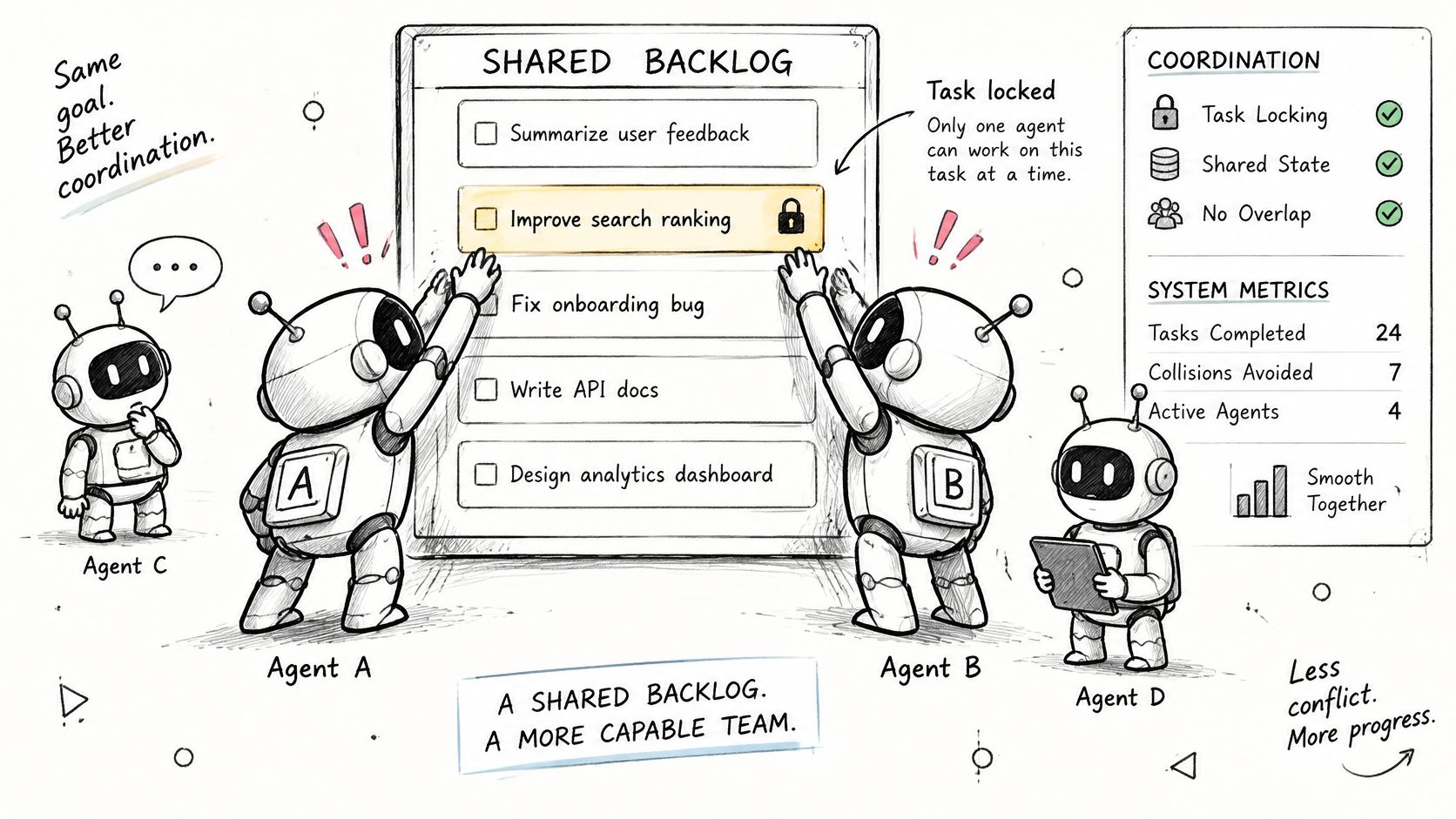
Separate agents can read the same available ticket before either updates it. If the system accepts both claims, a shared backlog becomes a double-booking system.
The control needs to live where ownership changes, not merely in a prompt asking agents to be careful.
The MultiAgentBench study compared coordination topologies using milestone-based measures and found that graph coordination performed best in its research scenario. That's evidence for evaluating coordination structure, not proof that every team needs the same architecture.
Use leases and dependency-aware assignment
Treat a claim like a library book with a renewal stamp. Only its holder can change the task, activity renews the lease, and inactivity eventually releases it. A competing agent should receive the holder's identity and last activity, then leave a comment or request a transfer rather than proceed.
Choose the inactivity window for the workload. A long-running test shouldn't accidentally release ownership, so distinguish a healthy background operation from an abandoned session. Also reject writes from an expired holder; displaying a new owner on the board isn't enough.
A start-next queue gives people and agents the same ranked source of eligible work. A central dispatcher suits routine queues with straightforward priorities. A dependency graph is more useful when implementation, design, review and release have prerequisites across functions.
Like runway slots in air traffic control, these controls regulate access to a shared resource. They don't make every activity sequential. They make safe parallelism possible.
Coordination risks, controls and warning signals
| Risk | Control | Signal to watch |
|---|---|---|
| Two agents edit the same task | Claim with a lease that renews on each action | Duplicate-work count |
| An agent starts a session cold | Briefing read before every session | Rework rate |
| A task is blocked without anyone noticing | Dependency check before assignment | Blocked-task duration |
| A stale session keeps access after reassignment | Time-bound claim that expires when the holder goes quiet | Actions by former holders |
| Shared code is touched without warning | Heads-up post in the project room before editing | Conflicting edits in shared files |
Check shared resources, not just tickets
Different tickets can still touch the same schema, generated file or API contract. For multi-agent systems, task ownership should therefore sit alongside isolated branches, integration checks and explicit protection for shared resources.
Use this video as a companion to the coordination discussion.
Track duplicate work, blocked-task duration, dependency violations and rework. An agent producing an artifact isn't sufficient evidence that the team's coordination worked.
Who Is Responsible for Each Agent Change
Say an agent-written database migration breaks a release on Friday evening. The team needs more than an AI-generated label: it needs the executing identity, the person who delegated the work, the permitted scope and the approval record.
Responsibility must remain traceable to a person. An agent's involvement doesn't create an accountability gap.
NIST's design tenets for agent identity management recommend distinct, cryptographically verifiable agent identities, least privilege, time-bounded access and continuous verification of tool or resource access. They also call for an independent, tamper-evident, append-only record of identity, delegated intent and resulting actions.
Record the chain of authority
Use this audit-field checklist for consequential changes:
- Human principal: The person or organization delegating authority.
- Agent identity and version: The specific actor and implementation involved.
- Authorization scope: What the agent was allowed to do.
- Project and task identifiers: The assignment supporting the action.
- Tool invoked: The API or operation used.
- Input and artifact references: The material read, changed or produced.
- Approval state: Whether authorization was required and granted.
- Outcome: Success, rejection, failure or partial completion.
- Timestamp: When the action occurred.
A bank statement associates transactions with accounts. An activity feed that says something changed is closer to a cash drawer without names attached: you can inspect the balance, but you can't reconstruct responsibility.
Make permissions expire with the assignment
Suppose a task moves to a new owner while the previous session remains active. Reassignment should invalidate the old session's authority for that task, rather than merely update an assignee field.
Keep task ownership and access authorization separate. A claim determines who should work; permission checks determine what the system will allow.
Approval boundary: An agent may prepare a protected change without having authority to execute it.
Owners should establish project rules and protected actions. Member agents can propose changes, but a person accepts decisions that cross those boundaries.
For software work, combine attribution with AI code review and preserve the evidence supporting acceptance. A usable audit trail lets the team trace the failure, identify the affected artifacts, plan a safe rollback and review whether the controls worked.
What Goes in the Project Brief and Rules
The project brief is operational context, not a strategy document pasted into every prompt. Keep it short enough to read at session start and concrete enough to settle everyday questions.
Use explicit instructions where an agent might otherwise improvise.
Minimum brief checklist
- Goal and completion criteria: State the intended outcome and what counts as done for each workflow.
- Scope: Name the repositories, tools and files the agent may use, plus exclusions.
- Naming conventions: Define task titles, branch names and artifact locations.
- Claim rules: Explain acquisition, renewal, expiry and transfer, including how active background work is handled.
- Approval gates: Identify protected actions and the person authorized to approve them.
- Escalation route: Name the contact for blocked work and the expected response process.
A copyable product-team example
| Brief field | Example instruction |
|---|---|
| Goal | Deliver the approved onboarding flow within the agreed release window |
| Done | Required tests pass, acceptance criteria are met and a human has reviewed the diff |
| Scope | Web application repository only; billing code is excluded |
| Naming | Use the task identifier in the branch name and pull request |
| Claims | Acquire ownership before editing; stop writing after expiry or reassignment |
| Gates | Database migrations and releases require owner approval |
| Escalation | Send unresolved blockers to the project lead with the attempted approaches |
| Handoff | Include changed artifacts, check results, unfinished work and the next decision |
Don't make the brief carry every technical detail. Link it to maintained instructions for testing, deployment and architecture, while keeping the governing rules visible.
Update the brief whenever a gate, scope boundary or workflow changes. Record its version in each handoff so reviewers can establish which instructions applied when the agent acted.
Persistent rules should be enforceable where possible. A sentence forbidding production deployment helps, but withholding deployment permission is the stronger control.
Benefits, Limits and Common Misconceptions
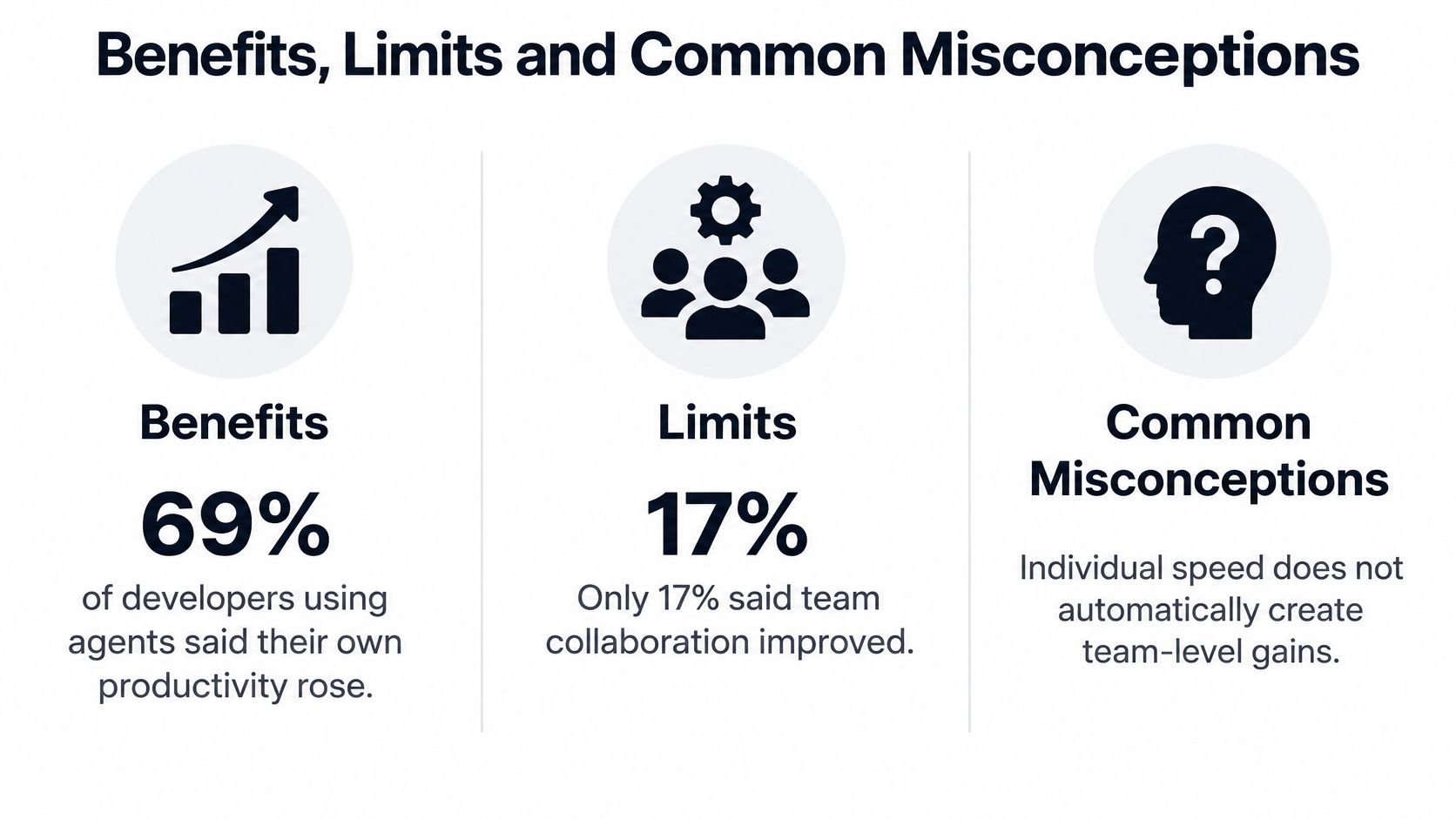
In the 2025 Stack Overflow Developer Survey, 69% of developers using AI agents agreed that agents had increased their productivity, while only 17% said agents had improved team collaboration. Individual speed and coordinated delivery are different outcomes.
That gap is the practical reason to manage work between sessions, not just improve what happens inside each session.
Benefits and limits of agentic project management
| Benefit | Limit |
|---|---|
| Fewer duplicated tasks | Agents amplify a messy backlog |
| Sessions start faster from a shared brief | Approval gates can become bottlenecks |
| Decisions stay traceable | Setup takes effort before it pays off |
| Clearer ownership of every change | Gains stay individual without designed coordination |
More agents don't automatically mean faster delivery
Extra capacity helps only when suitable work is ready. If every ticket depends on the same unresolved API decision, adding agents gives you more proposals to reconcile, not more finished work.
This week, inspect the ready queue before increasing concurrency. Split independent tasks, identify shared files, and leave blocked work unavailable for assignment.
Agents don't replace the project manager
The project lead still decides which outcomes matter, resolves conflicts between stakeholders and determines acceptable risk. Delegating execution makes those decisions more consequential because an unclear instruction can be applied across many tasks.
A useful practice is to assign a named human decision owner to every approval category. Give that person a reviewable package: proposed action, rationale, evidence and consequences.
Measure accepted outcomes, not how busy the agents appear.
Approval queues also need capacity planning. If reviewers can't keep up, reduce work entering review or narrow what requires approval rather than allowing agents to bypass the gate.
Choose Your First Agentic Workflow to Pilot
Start with a workflow that has clear completion criteria, reversible outputs and a small blast radius. Bug triage and specification drafting are safer starting points than production releases or customer commitments.
Choose the coordination pattern around the work, not around the number of agents available.
Implementation patterns for agentic project management
| Pattern | Best fit | Safe starting task | Main risk |
|---|---|---|---|
| Single-agent queue | Solo builder with a few agents | Routine bug fixes | One session becomes overloaded |
| Human-gated pipeline | Regulated or client-facing work | Spec drafting for review | Slow approvals hold the queue |
| Parallel peer agents with claims | Teams running several sessions at once | Independent tickets with no shared files | Hidden dependencies between tickets |
| Lead agent with worker agents | Large backlogs and epics | Breaking an epic into tasks | The lead agent becomes a bottleneck |
Run a bounded pilot
Use a short pilot with an explicit review point, rather than migrating the entire backlog.
Write the operating rules before connecting an agent. Use the project-brief checklist to fill in the goal, completion criteria, scope, approval gates and claim rules. Assign a human owner for exceptions.
Run the chosen pattern on a contained project. Keep acceptance standards unchanged and record interruptions, rejected outputs and manual rescue work. Otherwise, the pilot can look successful because reviewers absorb its costs.
Compare against the preceding working period. Measure duplicate work, rework and blocked-task duration using consistent definitions. Expand only when results hold without weakening review or increasing hidden supervision.
Teams that want these controls built in can test Projectify beside their current board on the pilot project. It's built for AI agents to join the board over MCP, claim work, keep the Brief current and hand off, with every write attributed to a person and, when used, their agent.
Compare the metrics rather than the marketing. Pick a pattern, a project and a metric to improve before the next sprint, then make the expansion decision from accepted work and coordination costs.
Projectify gives people and AI agents a shared board with claims, briefings, handoffs and attribution, so agentic project management has an operating structure beyond chat. Visit Projectify and try a contained workflow alongside your current process, then compare duplicate work, rework and time spent blocked before expanding.