Requirements Traceability Matrix: How It Works in Practice
Learn what a requirements traceability matrix is, how to build one step by step, and how to keep it accurate as requirements change.
You're two days from a release review, and someone asks which tests prove the password-reset rule still holds after last week's rewrite. The spec is in one doc, the tickets are in another, and the passing run lives in a chat thread nobody can find. A requirements traceability matrix is the record that keeps those pieces on one page, so a change shows you what else has to move.
What a Requirements Traceability Matrix Is
A requirements traceability matrix is a grid. Each row is one requirement. The columns show where that requirement came from and where you prove it. The idea behind the grid is bidirectional traceability: every requirement links upward to a parent requirement, business need, contract, or regulation, and downward to design, implementation, and verification evidence.
Think of a shipping manifest. Each parcel is tied to an order at one end and a delivery confirmation at the other. If either link is missing, you can't tell whether the parcel was never packed or was delivered to the wrong address. Requirements behave the same way between a stakeholder need and a test result.
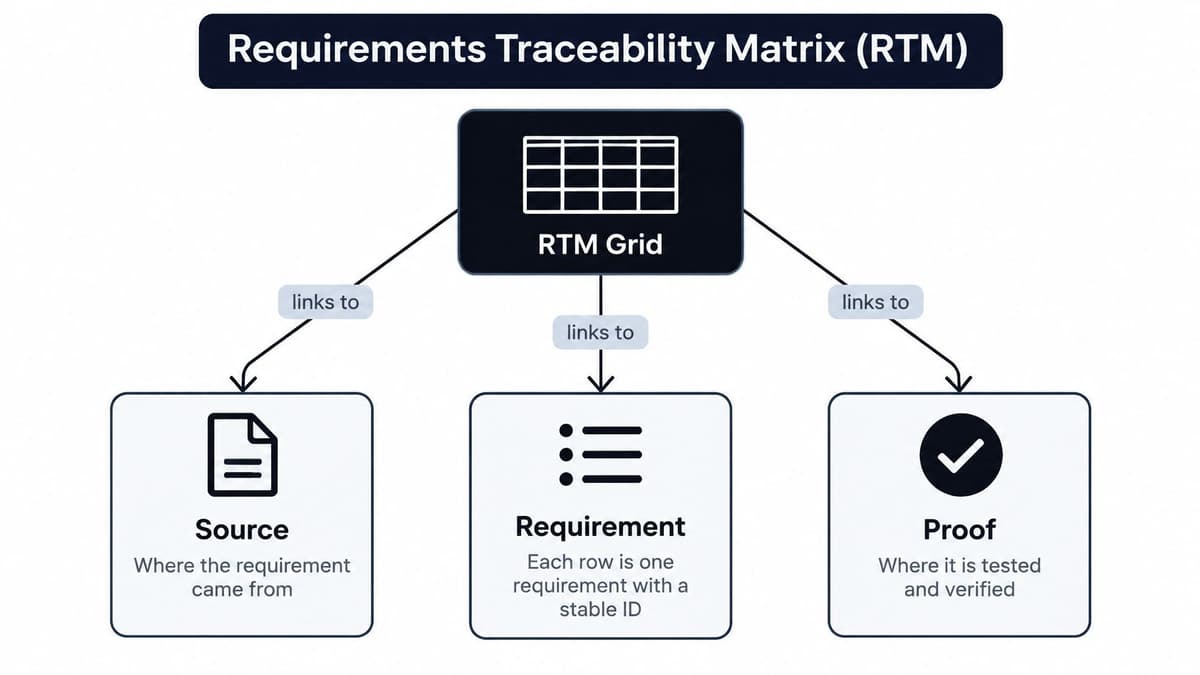
Without that grid, requirements get lost, copied twice, or built because someone thought they sounded useful. At review, nobody can prove which of those happened. NASA's requirements management guidance treats traceability as a normal part of requirements management, usually kept in a requirements matrix or a modeling tool. Each requirement is traced to a parent or source, or marked self-derived, and verification and validation results are mapped back into the same database.
A mature matrix can span at least five layers: system requirements, software requirements, design components, implementation, and test cases, plus hazards and validation evidence where they matter. NASA describes that matrix as the primary evidence of bidirectional traceability, and the links should be verifiable and readable by a person, not only by a tool.
A requirement with no source, no design link, or no test is a gap. The matrix puts that gap on the page instead of in someone's memory.
The Columns and Links Every Matrix Needs
Lay the matrix in layers. Each row is one requirement. Each group of columns is one layer of the chain.
| Layer | What it records | Worked example |
|---|---|---|
| Source | Parent requirement, stakeholder need, contract, or regulation | Customer need CN-6: users reset passwords without support |
| Requirement | Unique ID, statement, priority, and owner | SRS-014, email reset within five minutes, high priority, identity owner |
| Design | Component or interface that realises the requirement | auth-reset-service |
| Implementation | Code, configuration, or change that delivers it | Commit a3f9 |
| Test case | Test that verifies the behaviour | TC-088 |
| Status | Verification result, build, and date | Passed on build 412, 12 March |
Read SRS-014 across the row. The source is customer need CN-6, users reset passwords without calling support. The requirement itself has a stable ID, a measurable statement, a priority, and a named owner. Design points at auth-reset-service. Implementation points at commit a3f9, not at "the auth folder." The test is TC-088, and status says it passed on build 412, with a date so an older green run can't stand in for this release.
The rule that makes a row complete
Every requirement connects to at least one design or implementation artifact and at least one verification artifact. A row that names the service but has a blank test cell is not done. A row that names a test but has no design or code link is not done either. Blank cells are risk signals, not tidy-up work for the week before audit.
An IEEE empirical study of 24 medium-to-large open-source projects found that traceability completeness for three requirements-implementation activities significantly affected software quality, measured by defect rate. More complete traceability reduced the expected defect rate. Weight the gaps. A missing link on a payments or access-control requirement counts more than a missing link on a label change.
Check the links backward
Forward links show that a requirement was built and checked. Backward links show that a test, a component, or a commit has a justified origin. If TC-088 doesn't point back to SRS-014, you don't know whether the test still matches the rule or was copied from an older suite.
Try this on one sheet before you scale it. Five columns are enough for the trial: source, requirement ID and statement, design or code ID, test ID, and status. Fill SRS-014, or one real requirement from your backlog. If you can't name a single ID in any column, the structure is fine and the underlying records aren't stable yet.
Try this on your own backlog.
A month of Premium free. No card. Connected in a minute.
Choosing How to Verify Each Requirement
Pick the proof before you write the check. NASA's software requirements guidance says each requirement should have an identified verification method: test, demonstration, analysis, or inspection. It also asks whether a measurable accomplishment criterion exists. The same standard expects project managers to perform, record, and maintain bi-directional traceability across requirements, design, code, and testing, and to judge whether those relationships are correct, complete, consistent, accurate, readable, traceable, and testable.
| Method | Use when | Evidence recorded | Example |
|---|---|---|---|
| Test | The behaviour can be run and measured | Test case with expected and actual results | Login locks after five failed attempts |
| Demonstration | The operation can be shown without detailed measurement | Recorded walkthrough signed by a reviewer | Dashboard exports a PDF for an auditor |
| Analysis | The result follows from calculation or modelling | Calculation sheet or model output | Model shows the 95th percentile login under two seconds |
| Inspection | The property is visible in design or code | Review checklist with reviewer sign-off | Passwords are never written to logs in plain text |
Match the method to the requirement
A lockout rule is a test: run five failures and record the actual result next to the expected one. An export that an auditor must see is a demonstration: a signed walkthrough, not a unit assertion. A latency budget is analysis when you derive it from a model, or a test when you measure it on a build. "Passwords never appear in logs" is inspection: a reviewer signs a checklist against the logging code.
Name the method on the row before anyone writes the procedure. If you wait until a test already exists, you reconstruct the evidence to fit the script.
Make the statement measurable
"Fast login" can't be verified. "Login completes in under two seconds at the 95th percentile on the reference build" can. If you can't write the evidence into the status cell, the requirement isn't verifiable yet. Rewrite it, then choose the method.
NASA also expects verification results in a requirements-compliance or verification matrix. That turns the grid into retained evidence, not a planning sheet you throw away after kickoff. Coverage is then a count you can defend: requirements with linked, passing evidence for this build, divided by in-scope requirements, with every uncovered ID listed. A percentage without those IDs hides the holes. Tie the status rules to your definition of done examples so "passed" means the same thing to engineering and to the release reviewer.
Practical rule: If the evidence can't sit in the row, the requirement still needs rewording.
How to Build Your Matrix Step by Step
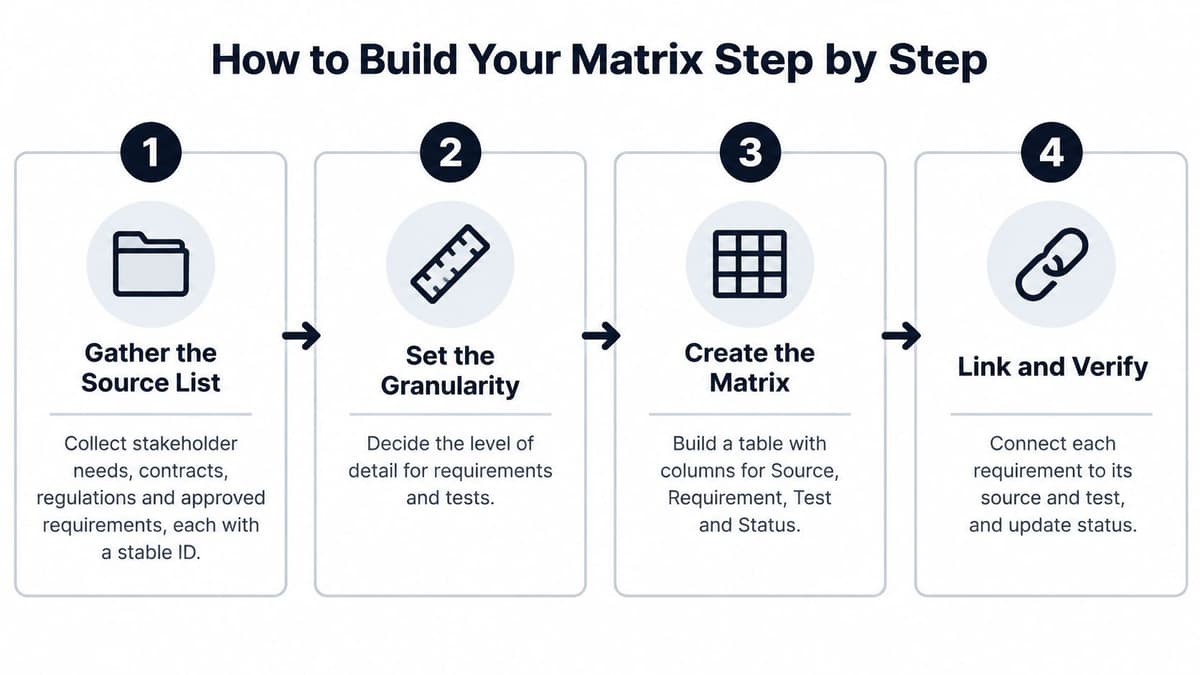
Build the matrix in the same order you'll defend it. IDs first, links second, results last.
From source list to a signed review
Gather the source list. Collect stakeholder needs, contract clauses, regulations, and approved requirements, each with a stable ID. A link is only as good as the ID behind it. Renaming SRS-014 to "reset v2" breaks every downstream pointer.
Set the granularity. One row per testable requirement, not per paragraph of the specification. The usual slip is a row so broad that one happy-path test appears to cover a whole feature. Split "users can reset and recover access" into the email path, the expiry rule, and the lockout rule.
Create the columns you will maintain. Source, requirement, design, implementation, test, status, and owner cover most software work. Add a hazard or regulation column only where that layer changes a release decision. Extra columns that nobody updates become false comfort.
Link upward first. Give each requirement a parent, or mark it self-derived and write the reason in the source cell. "Self-derived, performance budget for the login service, accepted by the tech lead on 3 March" is a source. A blank source cell is not.
Link downward with one ID per relationship. Add the design element, the implementation artifact, and the test case. The slip here is linking tests to an epic. The epic looks covered while three of its requirements have no check at all. Put those links in the same place you track delivery, next to the project implementation plan, so a scope change and a trace change are reviewed together.
Record results with a build and a date, and name an owner for every failure. "Passed" without a build is a rumour. "Failed" without an owner waits until someone notices it in the review meeting.
Run a completeness check. Filter each column for blanks and list those IDs as open items. Don't average them into a single green percentage before the list exists.
Set the review point before you need it. End of each sprint, or the day before release branch cut, the matrix is updated and someone signs the snapshot. A healthy review shows few blanks, every failure owned, and every requirement traced to a source you can open.
A short walkthrough of the same flow helps if your team is building the first sheet together.
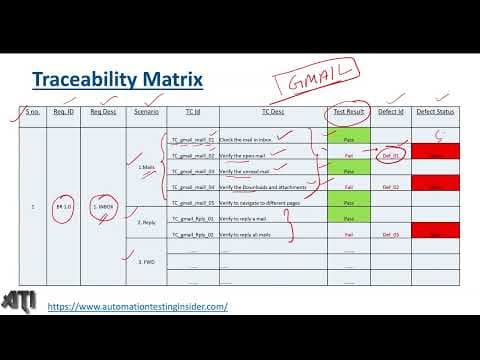
Plays from YouTube. Pressing play loads it from Google.
Stop when the sheet answers two questions for one feature: where did this requirement come from, and which evidence on this build shows it holds? Add layers after that, not before.
Keeping the Matrix Current as Work Changes
The matrix goes stale in ordinary work, not in a crisis. Someone rewords a requirement, a refactor renames a module, a test ID changes, and the sheet is edited by hand a week later. NASA's bidirectional traceability guidance calls out limited scalability for large or dynamic requirements, and the need for manual updates when software or requirements change. A bigger spreadsheet doesn't fix that. A smaller model that notices broken links does.
| Gap | Likely cause | Fix |
|---|---|---|
| Requirement with no test | Test never written, or the requirement was reworded after the test | Assign an owner and block release until a test is linked |
| Test with no requirement | Convenience check, or a case copied from an old suite | Link it to a requirement or retire the test |
| Code with no requirement | Scope creep or an undocumented change | Trace it to a source or flag it for review |
| Stale link after a change | Requirement edited, linked tasks and tests left as they were | Re-review every linked item when the requirement version changes |
| Failed verification with no owner | Result recorded, nobody triaged it | Route it to a named owner with a due date |
What to fix first
Don't burn the week closing every blank equally. Gaps on high-change, safety, security, and externally regulated requirements carry the release risk. A stale link on the lockout rule outranks a stale link on tooltip copy.
Track weighted traceability completeness: high-risk requirements count for more than low-impact ones. Report four counts beside that weight, not inside it: forward gaps, backward gaps, failed verification links, and stale links after a requirement change. One rolled-up percent hides which of those four you're sitting on.
Minimum evidence after every change
Trustworthy traceability after a change is a short list, not a full relationship map.
- Source: a parent, a contract clause, a regulation, a hazard, or a written self-derived reason.
- Downstream artifact: at least one design element or implementation ID.
- Verification artifact: at least one test, demonstration, analysis, or inspection record for the current version.
- Owner and version date: a person accountable for the row, and the date the links were last confirmed.
When the requirement text changes, mark every linked row for review before the next release. Don't wait for the test to fail in production to discover the old case still checks the old wording.
Treat the matrix as a change-impact record. If a link can break without a person seeing it, the record isn't current.
That review belongs in the same habit as your audit trail software: who changed the requirement, why, and which checks were reopened because of it.
Why Full Coverage Still Misses the Right Product
A full column of passing tests can still describe the wrong product. Say SRS-014 passes on build 412: the reset email arrives within five minutes, TC-088 is green, and the row looks complete. Users are still locked out, because accounts freeze after repeated failures and there is no self-service account recovery. The email rule was implemented correctly. The need, getting back in without support, was never the row you verified.
That split is the second question the matrix has to carry. Verification asks whether you built the requirement as written. Validation asks whether that behaviour satisfies the source: a user need, a contract clause, a regulation, or a hazard. NASA's software requirements standard expects requirements to be clear, complete, consistent, feasible, maintainable, and testable, not merely present in a matrix, and it traces stakeholder needs through design, implementation, tests, hazards, and validation.
When generated work looks finished
AI-assisted changes make this gap easier to miss. Generated code, a generated test, and a generated design note can fill the implementation and test cells without anyone accepting that the source was right. The row looks linked. Nobody has signed that the outcome matches the need.
Keep a backward path on every row, from the requirement to its source, and a separate validation note that the delivered behaviour meets that source. Three questions belong in that note:
- Who accepted this source, and on what date?
- Which outcome was checked against the need, not only against the requirement text?
- Which decision changed the requirement, including the alternative you rejected?
If the password-reset story had those answers, the lockout behaviour would have shown up as a missing source, not as a surprise after a green build. High link coverage and a wrong product can sit in the same sheet. The validation column is how you tell them apart.
Start Your Own Matrix Before the Next Release
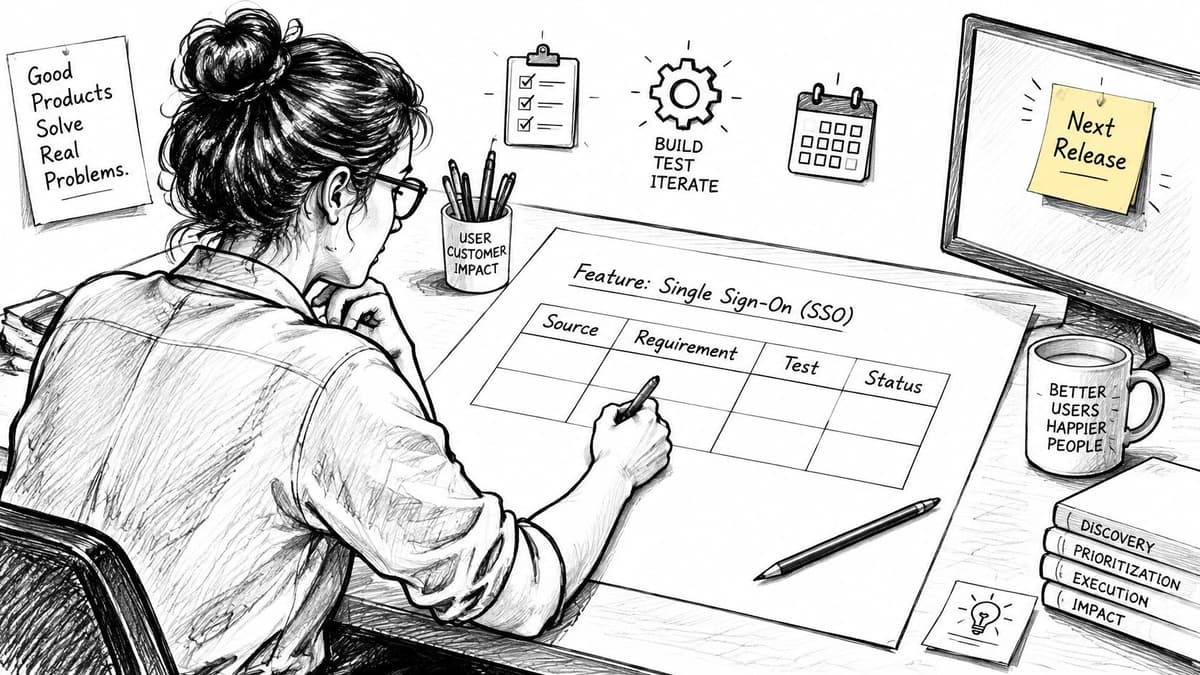
Don't boil the whole backlog. Pick one active feature, or the release you're about to cut. List its requirements with stable IDs and build a four-column sheet: source, requirement, test, and status. Do it before the next review, not after someone asks for the evidence.
Run three filters and write down the IDs they return.
- Blank source cells. Each one is a requirement you can't justify.
- Requirements with no test. Each one is a behaviour you plan to ship without proof.
- Tests with no requirement. Each one is either a hidden need or a check you should retire.
A spreadsheet is enough for a small team if every edit carries a date and an owner. Once several people, and their assistants, change requirements, tasks, and tests in parallel, the sheet drifts unless the links live where the work already happens.
Projectify is one place teams keep that record on the board itself. It's built for people and agents together, with claims so they don't collide, a briefing so they don't start cold, and attribution on every change. On our own board that has meant 277 tasks planned, claimed, and shipped, 51 decisions recorded with the alternatives considered, and 100% of changes attributed to a person. A dated spreadsheet does the same job when the scope stays small. Expand past the first feature only after those three filters come back clean.
Projectify keeps requirements, tasks, decisions, and handoffs on one board, with every change attributed to the person or agent who made it, so a traceability review isn't a scavenger hunt through chat. If your next release needs that chain from source to proof, see how Projectify records the work as it happens.